


Rednote, or Xiaohongshu in Chinese, is a lifestyle app similar to Instagram that is continuing to grow in popularity. Over the past two years, we’ve published an annual article addressing the platform’s demographic changes and what they may mean for businesses interested in conducting branding activities on the platform.
This article is a continuation of this tradition for 2026.
Key Takeaways
- Rednote’s monthly active users surpassed 350 million.
- While some analysts believe male users fell this year, more recent reports argue Rednote’s hosting of the FIFA World Cup caused a spike.
- The 18-to-24-year-old demographic continues to grow.
Rednote’s Monthly Active Users in 2026
Last year, it was a little difficult to find the exact number of monthly active users (MAU) on Rednote, as different sources provided conflicting data. We stated that the number was somewhere between 300 and 350 million, predicting that the latter would certainly be surpassed within the next year.
Truth be told, this is what happened.
What Does This Mean for Your Marketing?
With Rednote’s MAU continuing to rise at a steady clip, we can safely say that the app is here to stay as a dominant player in the digital marketing space. This is despite people in China, like many Western nations, showing signs of Internet fatigue.
While WeChat remains a permanent feature of life in China today and foreign brands may be more familiar with Douyin due to its similarity to TikTok, Rednote’s growing popularity shouldn’t be overlooked. Unfortunately, the exposure the app got in early 2025 after TikTok was banned in the United States and many netizens moved to Rednote as an alternative appears to have worn off since then. This doesn’t mean the app is any less important for any brand with its sights set on China.
Rednote’s Gender Demographics in 2026
However, the data provided in the last section came out before the summer. This is important because Rednote was one of the sponsors allowing Chinese users free access to the FIFA World Cup in June and July.
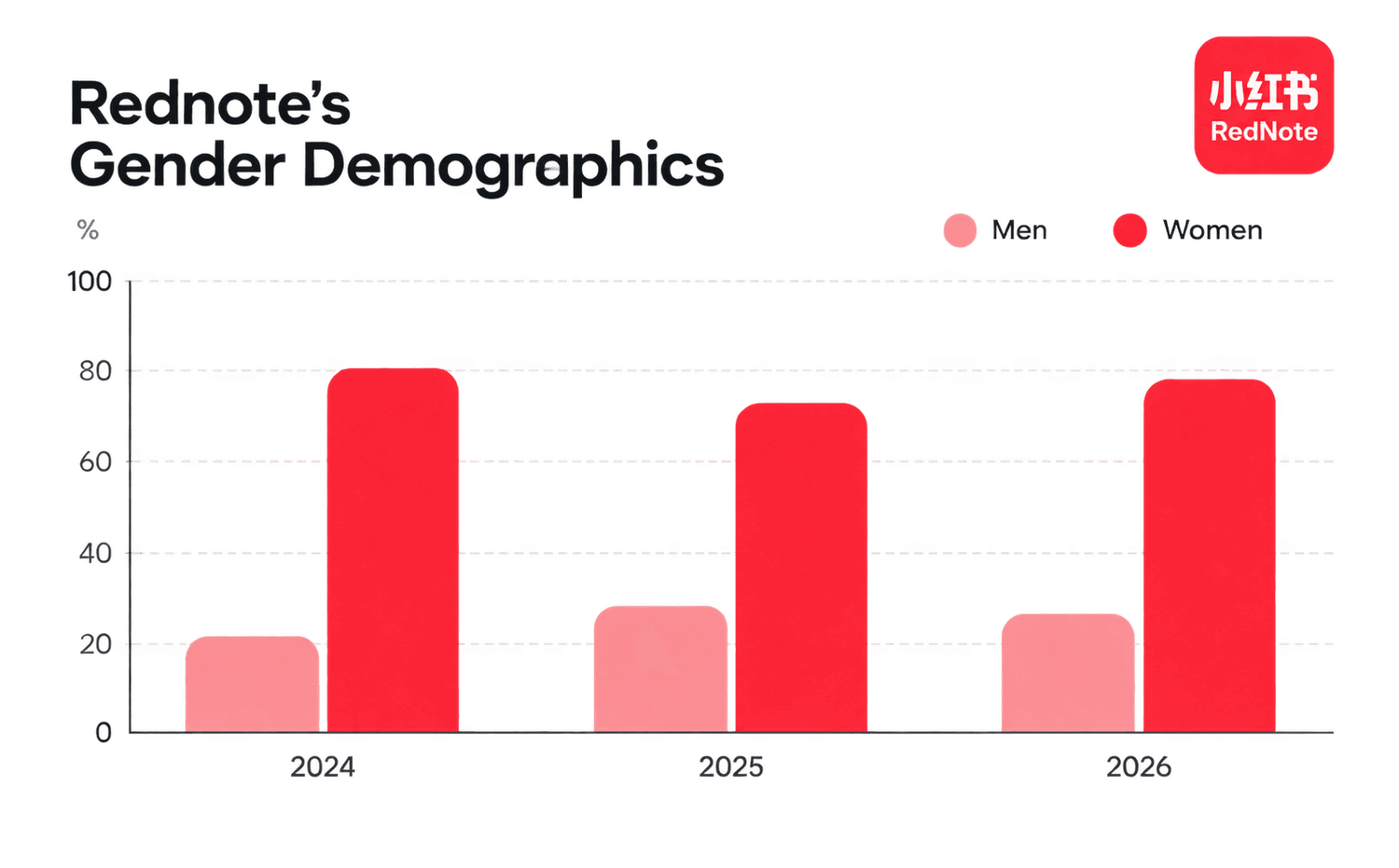
A Baidu article published shortly after found that male users jumped from 23% to 28% over these two months while female users dropped by 7%. While this followed the trend we pointed out last year—more males are using Rednote—this dataset conflicts with Qiangua’s 2026 report (the primary source for our data). Based on the data from multiple reports, we put male usership at 28% last year.
To make matters more complicated, Qiangua’s data for this year (again before the summer) showed a decline in male users from last year, falling from 28% to 25.9%.
We can assume that because of the World Cup’s popularity in China this year, more male users have joined the app in the past few months. Unfortunately, we will need to wait for Qiangua’s report next year to compare their results to the Baidu article.
What Does This Mean for Your Marketing?
Because of its female user base, Rednote, over the years, has been primarily a “lifestyle” app where women share tips on fashion, beauty, tourism, and female empowerment.
However, Rednote’s collaboration with the FIFA World Cup should not be seen as an anomaly. Instead, it should be seen within the greater trend of the app trying to attract more male users. Last year, for instance, we wrote about how the company had other events related to camping, tech, male skincare, figurines, and alcohol.

For brands or services popular with a male audience, this may be the perfect time to jump on Rednote, as these special events may offer incentives to those who encourage male users to join the app.

A Camping Event Sponsored by Rednote & Partners
Rednote’s Age Demographics in 2026
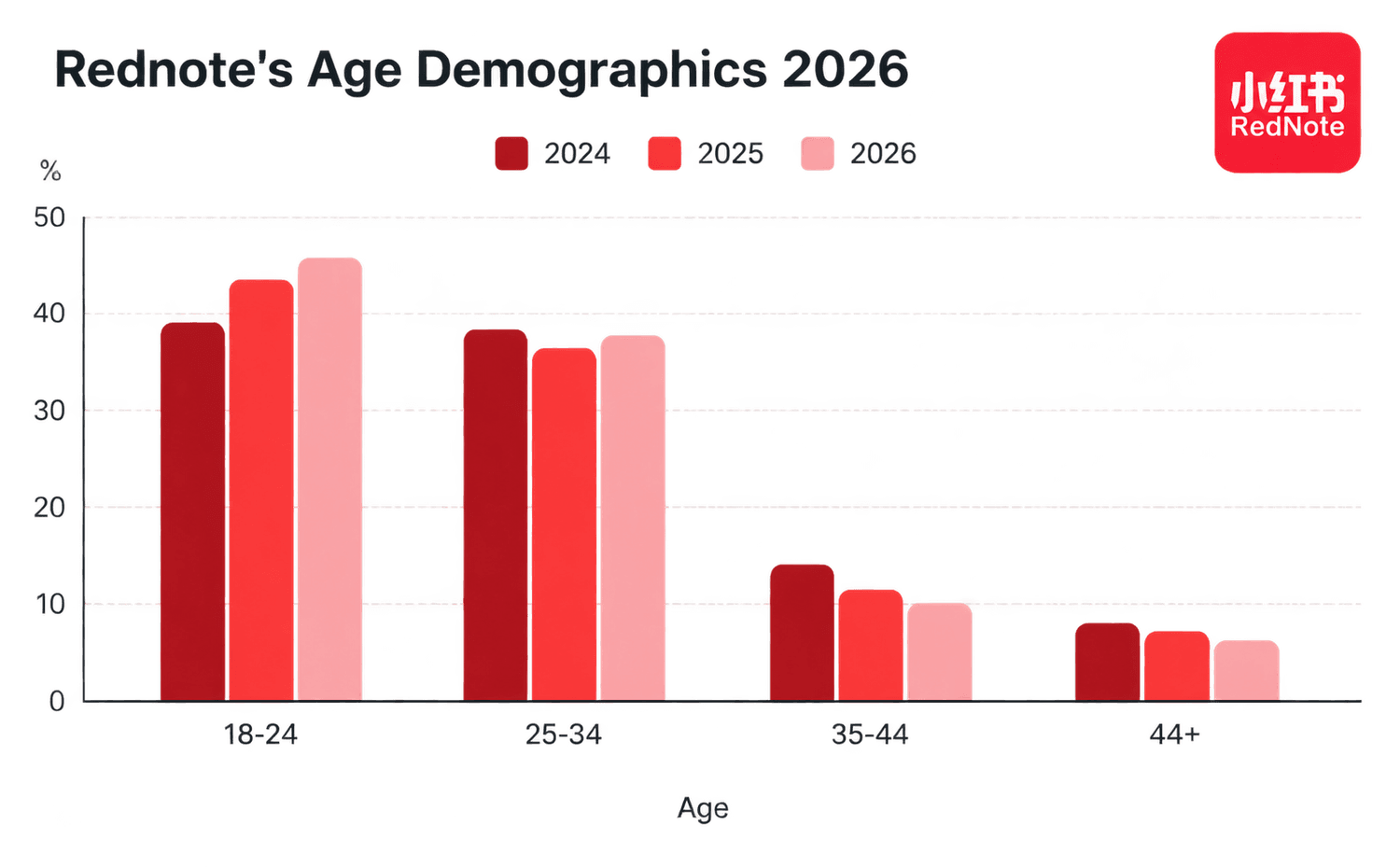
While we saw the trend of more men using Rednote reverse in the first half of 2026, this was not the same for age demographics. In 2025, we noticed that the app was becoming more popular among younger users.
In 2026, users between
- 25–34-year-olds also saw a small bump from 36.9% to 38% (showing positive growth compared to 2025).
- 18–24 jumped once more from 43.8% to 45.7%,
- 35–44 fell from 11.5% to 9.9%,
- 44+ dropped from 7.8% to 6.5%, and
What Does This Mean for Your Marketing?
In the future, we’ll need to check in to see whether this trend continues. For now, however, it seems that Rednote is retaining its image as the app for college students and those who have recently entered the workforce.
Brands looking to use Rednote should try to tailor their advertising primarily to this younger group. For example, use younger actors in your content, or at least celebrities who appeal to this demographic.
One trend researchers have picked up on this year is that Rednote is becoming more of an app consumers turn to for answering questions. Therefore, if university students make up a large proportion of the user base, brands should consider how their products answer questions people this age may have.
How does your stationery make it easier to be organized in class? Are you selling a food or snack that is cheap but nutritious enough for a student short on money? Do you have a piece of furniture that could brighten up a desk on a day with too much homework?
Rednote’s Location Demographics in 2026
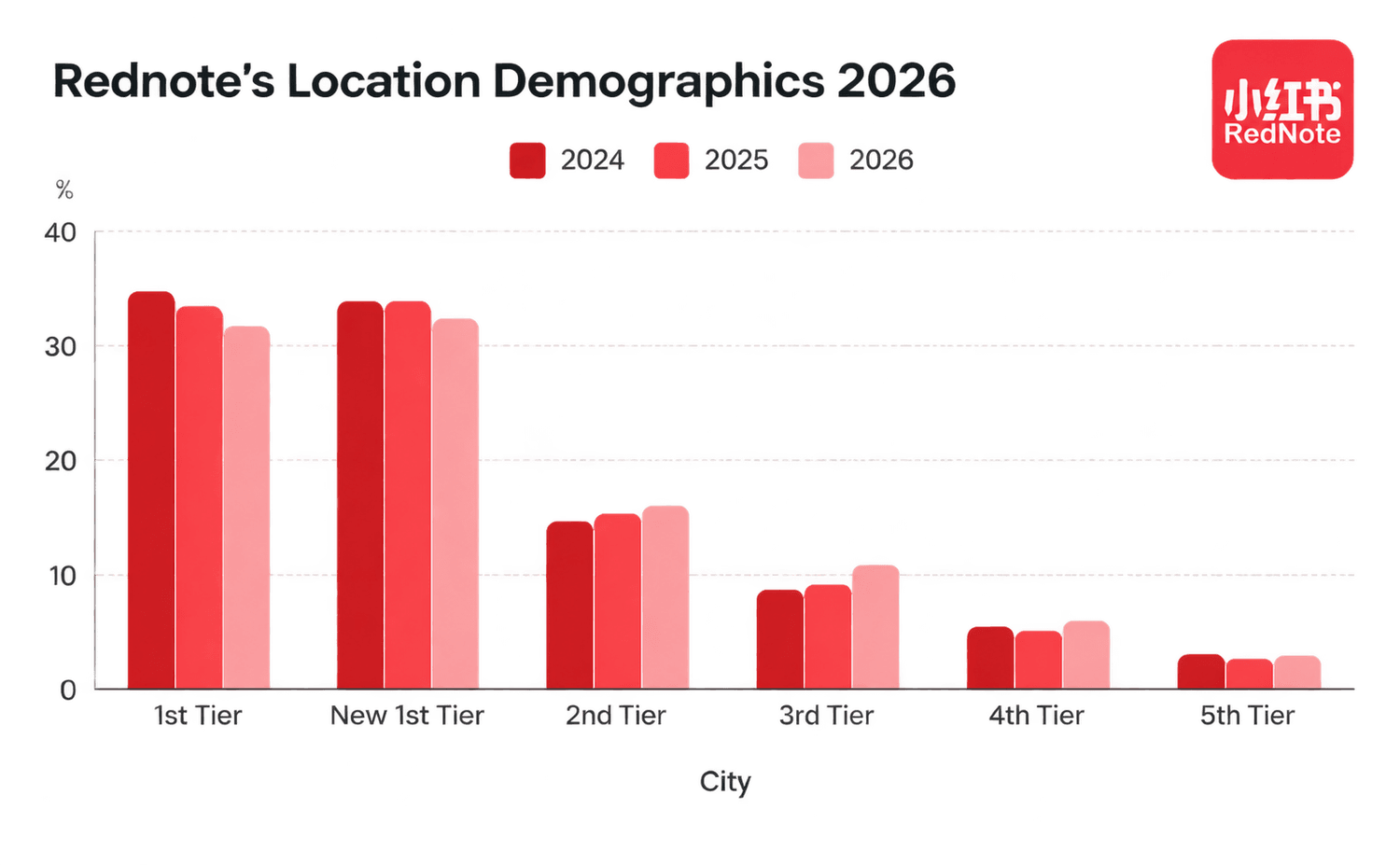
Turning to the data on where Rednote’s users are based, we can see that nothing has changed much since 2024.
However, while Rednote users are still heavily located in 1st-tier cities (Shanghai, Beijing, Shenzhen, and Guangzhou), their presence on the app has slightly fallen from 32.8% to 31.3%.
New 1st-tier cities dropped from 33.5% to 32.3%, while 2nd-tier and 3rd-tier cities increased to 16.9% and 10.8%, respectively.
What Does This Mean for Your Marketing?
The above data shows that Rednote’s users tend to be from the more affluent parts of China. For foreign brands, this is good, as it means you can assume that most people using the app are more likely to be internationally minded. This translates to a higher possibility of them being familiar with your company.
As we mentioned last year, richer cities do not always mean more disposable income, and recent data confirmed this once again. Five counties in Zhejiang had more consumer spending than Shanghai and Beijing. Of course, this province is one of China’s richest, but these counties (Leqing, Yuhuan, Yiwu, Wenling, and Haiyan) are not 1st-tier cities.
The South China Morning Post believes these smaller counties will eventually surpass the spending in 1st-tier cities in the future as people seek out cheaper rents and improved transport systems allow citizens to more easily commute into the cities. If this trend moves in tandem with Rednote’s increasing popularity in these areas, companies will need to start learning about these lesser-known cities.
Ultimately, the most important lesson might be that the desire for certain brands is no longer location-dependent.
Contact Nanjing Marketing Group
Thanks for giving our Rednote demographics and marketing guide a look over. We hope to make more in the future to keep tabs on trends in China.
If you’re interested in exploring ways to improve your own branding on Rednote, please contact us!