

“Chinese people generally just want to buy cheap stuff. They don’t care about quality or customer service.” ~ Presumption by a foreign business person
Well, nothing could be further from the truth because customer support in China is among the most advanced and responsive services worldwide. Platforms like WeChat and Alibaba offer personalized, highly efficient, and almost instantaneous 24/7 support from real people and chatbots—increasingly with the support of AI.
In this article, our experts share their 18 years of China marketing and customer support, both as a business (on behalf of our brand and our clients) and as customers. I think some of our clients can often forget that we also use all of China’s many digital offerings to shop, buy, communicate, and entertain ourselves.
We will examine what Chinese customers expect from online support and which tools to use and share our real-life tips, new case studies, and more insights never before published online.
Let’s begin.
Introduction
Before we dig deep into the topic, let’s get the basics down. While the terms customer service and customer support are used synonymously, they refer to slightly different things. Customer service is the general term used to describe all interactions to help clients, whereas customer support typically involves solving problems and technical assistance.
Whatever you call it, helping customers has been around since merchants first started selling their products and services thousands of years ago. Needless to say, customer support has since evolved from call centers, email, and online support to social media, chatbots, and AI-driven assistance.
Customer Service: China vs. West
While customers are highly valued globally, the approach to customer service may differ depending on the country.
In Western countries, customer service is still predominantly manual and, therefore, limited to business hours. However, in China, instant support is mostly handled by chatbots (often AI-supported) and is provided on key platforms like
- WeChat (owned by Tencent),
- Taobao (owned by Alibaba), and
- JD.com (partly owned by Tencent).
Moreover, in China, customer service is deeply integrated into all popular apps, and customers can get assistance without changing platforms. Conversely, in Western countries, customer service is typically offered separately via email, website, and phone rather than integrated into specific platforms.
In terms of customer orientation, brands in China typically offer refunds and hassle-free dispute resolution—sometimes even without the need to return a product, whereas in the West, return policies tend to be more complex, and refunds usually take longer (if they are approved at all).
While the communication style in China is normally indirect and focused on saving face, customer service is more direct and transactional. Don’t get us wrong, the communication is still friendly and polite, just more focused on the task at hand. In contrast, Western customer support tends to focus more on a personal approach and relationship-building while still solving the issue efficiently.
Finally, China implements AI and chatbots before elevating the issue to a real person to solve. AI technology is more regulated in Western countries and still used with some sort of caution, so customer service still relies more on real people, which is one reason why the service is often limited to business hours.
What Do Chinese Customers Expect?
Overall, Chinese online shoppers prioritize fast (we are talking seconds) methods of communication, and they want the unnecessary hassle of sending an email or taking an extra step. They want an answer to their question or a solution to their problem, and they want it now.
This means Chinese netizens expect assistance on the go, wherever they are, without changing platforms. Therefore, in-app support is crucial if you don’t want to lose your clients or prospects. For example, cosmetic brand L’Oréal uses WeChat for real-time support in China and email support to follow up on more complex inquiries.
It’s probably obvious, but online users in China seek support in their native language (Simplified Mandarin). This is non-negotiable, and brands offering only English support don’t last long in China, so be sure to provide localized content, support materials, and FAQs for your Chinese audience.
Finally, Chinese shoppers want brands that offer friendly and customer-oriented support that resolves disputes in their interest and does so fast; therefore, be sure to have customer support mechanisms that understand Chinese culture, preferences, and needs.
Where to Provide Customer Support
Support your customers where they are and serve them based on their preferences:
- WeChat Official Account (Service Account): This is essential as every Chinese citizen uses WeChat, regardless of age, occupation, or location.
- WeChat Mini Program: This is more suitable for larger brands.
- Chinese Website: Use chatbots and AI support first and human assistance second. Don’t miss this trend, as the chatbot market is expected to grow by almost 10 billion US dollars in the coming years.
Email and phone support is only relevant for really large brands or very specific niches. Read this in-depth article on providing customer support in China via WeChat.
Video Content
Internet users are overwhelmed with information already, so try not to overload them with unnecessarily long pieces of text. A bold image or interesting hook (in the first seconds!) is more likely to grab the user’s attention than a long FAQ.
Short videos that explain your product or service (demo, tutorial), showcase a testimonial or influencer and answer frequently asked questions can be an alternative and engaging way to address common customer support issues.
For example, a software company could create a series of short “how to” videos on software installation, basics, and advanced use, resulting in fewer support tickets. When brands struggle to create video content, repurposing existing text FAQs and transforming them into short explainer videos can be a first step.
Our Tips
Tools like WeCom and Zendesk are useful CRMS for WeChat to provide customer service for Chinese consumers.
Adding video Q&As, tutorials, and additional video content can simplify complex issues, increase engagement, and reduce costs.
If you run PPC advertising on Baidu, the platform offers its customer support tool, Aifanfan (爱番番), free of charge. Our team frequently uses and recommends Aifanfan (WeChat and website integration, chatbot, API, and more), and you can run direct interaction ads with a CTA to customer support.
For customer service and customer relationship management (CRM), we also recommend Shangwutong (商务通) by Zoosnet (this is not an advertisement or affiliate link!). This paid service is widely used in China to facilitate communication and allows WeChat and website integration, chatbot, API, and more. In comparison, Shangwutong focuses more on live chat support and customer service management, while Aifanfan specializes in AI-supported marketing automation and boosting sales.
It’s important to monitor the most popular Chinese platforms where your target audience hangs out, like Douyin or Rednote, to identify your customer’s pain points and address them (a process known as “social listening”).
Consider implementing a Tier support system where AI chatbots and FAQs handle basic questions. With this in place, WeChat customer service handles the more complex issues, and phone support is reserved for premium and B2B clients.
Finally, we recommend hiring a specialist for Chinese customer support (ideally a native Chinese speaker) and training your support team to respond to the expectations of Chinese customers.
Our Checklist
To sum it up, here’s our practical checklist for providing customer support in China
- Choose a customer support tool like WeChat Official Account, Zendesk, or Aifanfan
- Localize content and offer customer support in Simplified Chinese
- Integrate AI or chatbots to handle basic inquiries
- Use video content to address common issues
Next, let’s check out how this looks in practice.
Case Study: St. Mary’s
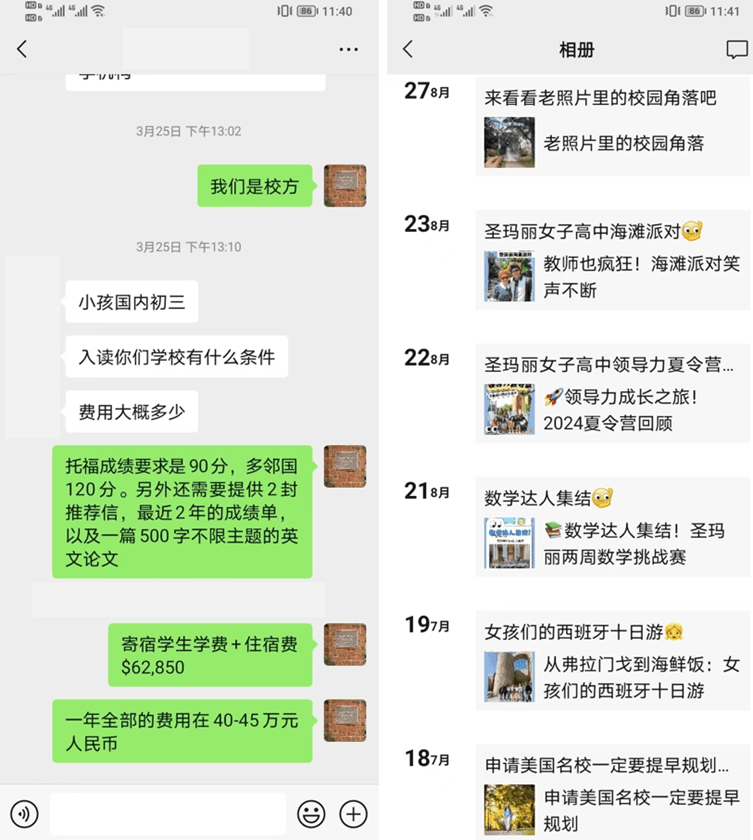
International high school, Saint Mary’s, was struggling to enroll Chinese students when they first came to us, and we immediately noticed that they had no Chinese-language customer support. Developing and establishing a customer support tool was one pillar to improve their overall conversion rate.
Now, St. Mary’s uses WeChat Mini-Programs to handle inquiries from students and their parents in China, and the admission process, fees, and other inquiries can be clarified instantly, which increases enrollments.
Let’s take a look at another real-life example.
Case Study: Lizenzero
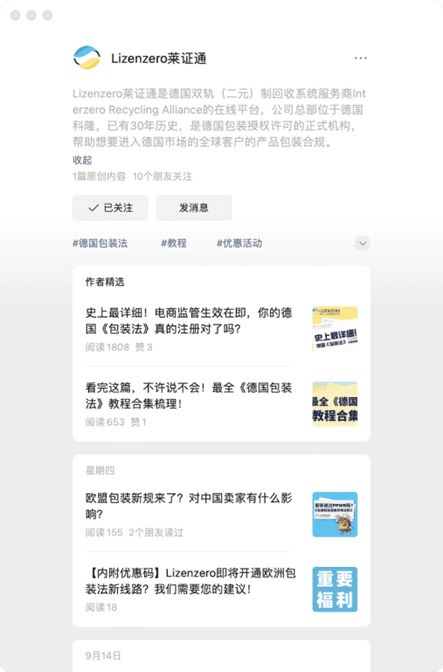
Lizenzero is an online platform that provides licensing, helping global manufacturers and retailers comply with the complex German Packaging Act.
To expand the presence of Lizenzero in the Chinese market, we helped them with an integrated marketing strategy that included running ads and setting up customer service for the Chinese market.
We launched a WeChat Official Account, published bi-monthly articles, and integrated Zendesk for seamless customer support. After one year, license requests grew significantly, and Lizenzero became the first packaging authorization service to offer free Chinese-language customer support.
Let’s wrap it up.
The Takeaway
A localized approach to customer support in China is key to avoiding any backlash from unsatisfied customers. For example, a brand like Nike focuses on highlighting cultural values in China and provides exceptionally polite and respectful customer service.
Moreover, fast response times, customer orientation, and a presence on the biggest social apps are a must from the perspective of Chinese customers.
We recommend
- using WeChat live chat and chatbots (with the help of AI),
- investing in video tutorials and explainer content, and
- working with a native Chinese customer service representative or consultant (based on the size of your business).
Increase customer satisfaction, and you will (hopefully) see an increase in your sales. Ready to get started with Chinese customer support? Contact us today.