

Expanding your business into China presents an enormous opportunity. However, to succeed, being in the right place at the right time is crucial.
With more than one billion people connected across various Chinese social media platforms, they are a key channel to reach consumers and win them for your brand.
Sophie, China social media and marketing expert with more than four years of experience. She shares Nanjing Marketing Group’s experience and real-life insights into how Western brands can leverage these tools to generate leads, raise awareness, and drive ROI.
Let’s jump right in.
Chinese Social Media – Overview
Discussing marketing opportunities for foreign brands in China requires a cultural (and technical) understanding of the digital landscape in the largest e-commerce economy in the world.
While platforms like Facebook, Google, YouTube, and LinkedIn dominate Western countries, separate distinctive apps have emerged in China in the last two decades.
Why? There are three main reasons:
- Most Western social and search platforms are blocked in China.
- Chinese online user behavior, culture, and preferences which differ from the West.
- A high level of innovation and competition in China has led to the creation of multi-service apps with many integrated features from shopping to payment; there are no direct equivalents to these super-apps like WeChat in the Western world.
In this article, we will take an in-depth look at six key Chinese social media platforms and their potential for Western businesses to
- Raise brand awareness and trust
- Engage customers
- And ultimately drive sales
We will examine the main features and opportunities for foreign companies of
- WeChat – the ultimate all-in-one solution for marketing in China
- Rednote – social commerce leader
- Zhihu – go-to Q&A platform in China
- Bilibili – leading video and creative platform
- Douyin – China’s favorite short video app
- Weibo – most popular microblogging space
Let’s take it away.
When it comes to marketing Western brands in China, the first word you will hear is always “WeChat”.
China’s all-in-one super app WeChat, or “Weixin” (微信), has been around since 2012. It was developed by Tencent and has evolved into far more than just a messaging platform. Today, WeChat is China’s largest and most widely used app with more than 1.3 billion active users.
In terms of Western equivalents, WeChat is basically a mix of Meta’s services (Facebook, Instagram, WhatsApp) together with email newsletters, brand websites, and PayPal.
This video tour by Nanjing Marketing Group’s founder Tait shows you what WeChat looks like in real life.
WeChat Key Functionalities
Far beyond social networking, WeChat offers:
- Messenger
- Short videos
- Live streaming
- Newsfeed
- Shopping
- WeChat Pay
So, what do people use WeChat for the most?
WeChat Key Features
The most commonly used areas of WeChat include:
- Personal Accounts
- Official Accounts
- Moments
- Mini-Programs
Next, let’s take a look at the types of brands that can benefit from a WeChat presence.
Who should (NOT) be on WeChat
Due to the above reasons, WeChat is THE place for all businesses to be, both Chinese and foreign. It is basically a MUST to have a brand presence on this app because it is used by almost every Chinese person.
This is also the logical potential downside: your business can easily get lost in the sheer endless information of the WeChat universe. Brands really need to stand out, use content and targeting in a smart and effective way to reach their audience. Therefore, it is not uncommon – even for Chinese brands – to work with specialized agencies to maximize the success of their WeChat marketing efforts.
In summary, WeChat is ideal for small to large B2B and B2C companies offering products and services. Depending on the budget, there are a variety of options to get your brand out there. Detailed step-by-step guide for WeChat marketing for B2B brands.
Problems that WeChat Marketing Can Solve
Brands lacking a presence and brand awareness in China may want to connect with partners and potential customers in the Far East.
However, LinkedIn, Facebook, and the likes are unavailable (comparison Facebook vs. WeChat). Furthermore, Chinese websites and business directories are inaccessible or only available in Mandarin language.
This is where WeChat adds value with its vast user base and large variety of functionalities. As such, WeChat is a powerful tool to build relationships and establish brand awareness in the Chinese market, ultimately driving sales and customer loyalty.
WeChat Opportunities
Western brands can benefit from a WeChat presence as follows:
- Connecting with partners/businesses through through their personal or Official Accounts
- Reaching a large and high-value audience organically
- Engaging customers through a variety of touchpoints
- Managing leads
- Handling customer support with or without a CRM
- Advertising and marketing
How WeChat Works for Brands
Coming from a Western perspective, this is how online content works in China on WeChat:
- Website content => Set up a WeChat Official Account (Service Account recommended)
- Website navigation => WeChat Custom Menus
- Landing pages => HTML5 Mini Sites
- Email newsletter and blog articles => Publish WeChat Articles
- Online Ads like Facebook => WeChat Ads
- Telegram Groups => WeChat Groups
Now, let’s take a closer look at how to promote a brand on WeChat.
WeChat Advertising
In terms of paid strategies, there are five options on WeChat, which we have described in great detail here. WeChat Ads allow precise according to the users’ location, behavior, preferences, and more.
- WeChat Moment Ads: appear in users’ Moments feed, blend with personal content, “organic” feel
- WeChat Official Account Ads: appear articles or posts by Official Accounts, effective targeting
- WeChat Video Account Ads: appear in feeds of users following video accounts, highly visual
- WeChat Mini-Program Ads: additional services and functionalities within WeChat ecosystem
- WeChat Search Ads: sponsored listings in WeChat’s search results
And what about paid and organic strategies for foreign businesses?
WeChat Marketing
Our colleague Ivy has recently put together a designated WeChat marketing guide with all the details.
The key strategies to promote brands on WeChat are:
- Content marketing
- Influencer collaboration
- Loyalty programs
Let’s take a closer look.
WeChat Official Accounts
Official Accounts are basically a must for larger and medium-sized brands, both foreign and domestic. They offer structured and scalable marketing options to reach a larger audience through:
- Organic content: articles (similar to blog posts) and posts
- Menu customization: links to promotions, customer support, etc.
- WeChat Channels: live streaming and short-form videos
- Mini Programs: additional services like loyalty programs (often used in China for cafes, restaurants, etc.)
- WeChat Pay: for easy payment
- WeChat Groups: audience engagement
- Influencer collaborations: build trust
- QR Codes: drive traffic to Official Account
- Search: Optimize your content
For smaller brands, a Personal Account may suffice.
WeChat Personal Accounts
On the other hand, Personal Accounts are ideal to informally share updates to peers through:
- WeChat Moments
- WeChat Groups
- Direct Messaging
This was a lot of information on WeChat. What are the main steps to set up an international brand for success on WeChat?
Summary: Key Strategies for WeChat
- Register a WeChat Official Account (Subscription)
- Share articles, posts, etc. (Organic content strategy)
- Engage with your audience (Convert from leads to sales)
- Paid ads round off your WeChat marketing strategy
And what does all this look like in real life?
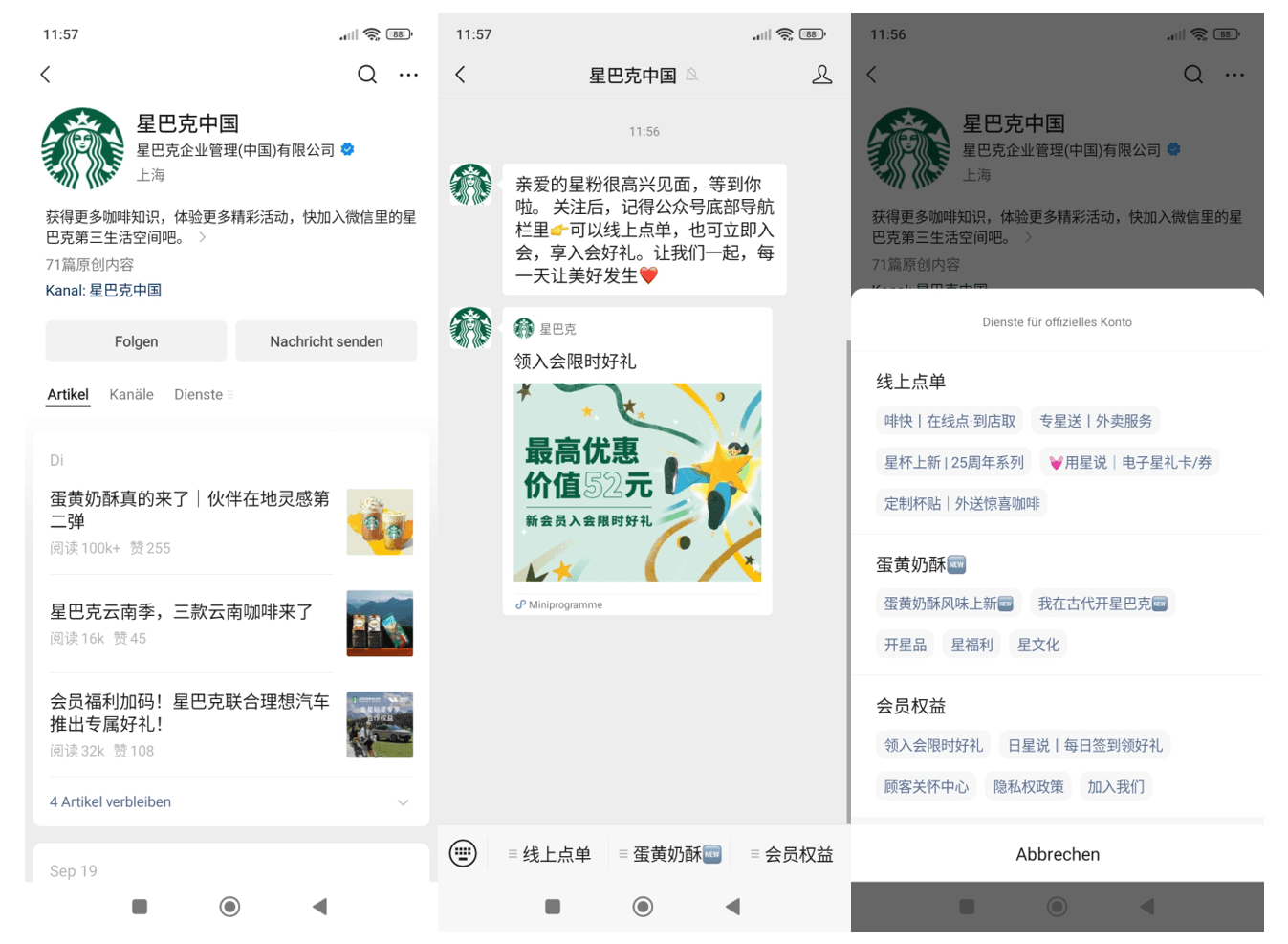
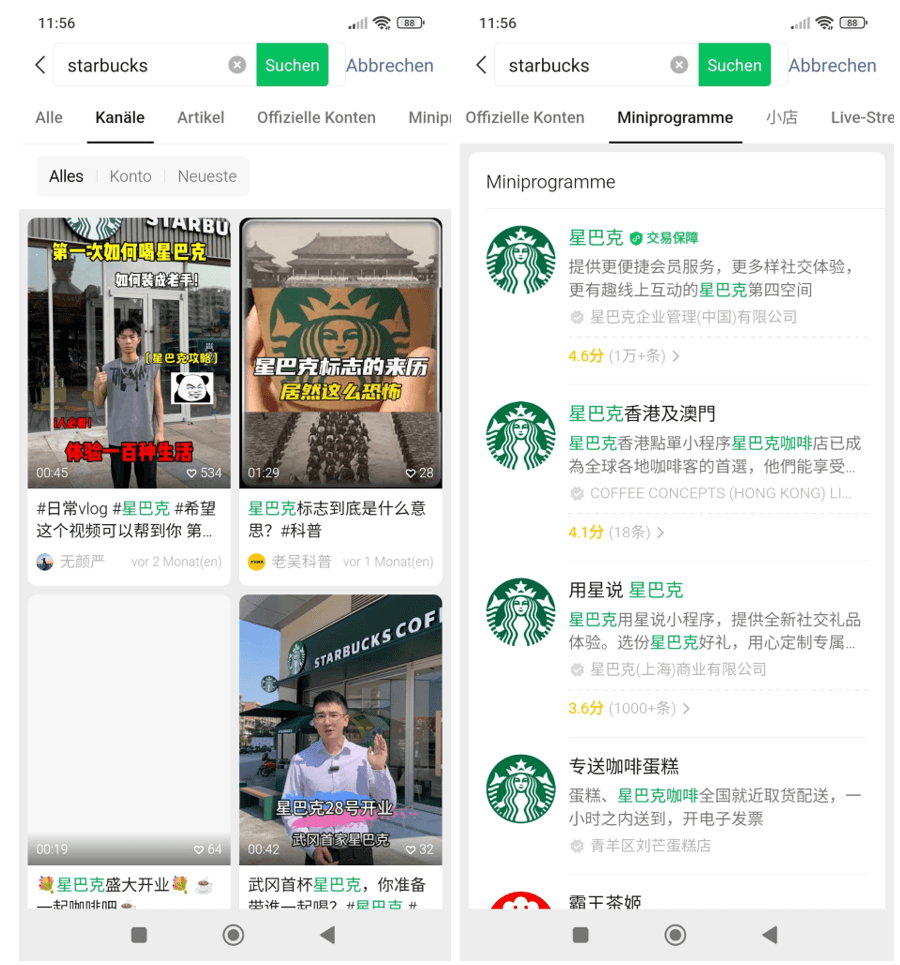
Example: Starbucks on WeChat
The popular US coffee chain leverages WeChat for brand awareness, promotions, customer support, and more.
Next, let’s take a look at China’s lifestyle and community commerce app, The Rednote.
Rednote (Xiaohongshu)
Also known as Rednote or simply RED, Xiaohonghsu is an immensely popular and social commerce platform among young Chinese women. Established in 2013 by private entrepreneur Miranda Qu, Rednote thrives on user-generated content.
Comparable to Instagram and Pinterest in the West, Rednote is China’s leading lifestyle app that caters to 312 million monthly active users. Take a look at this video tour by Tait about the inside of Rednote.
Rednote Key Functionalities
Discover RED’s unique community commerce model which seamlessly blends UGC with online shopping.
- Social sharing (photos, and recommendations)
- Short videos
- Product reviews and lifestyle recommendations
- Integrated social commerce (direct shopping through links in live streams)
- Influencer collaborations
Now which areas within RED are most popular?
Rednote Key Features
The most used features of RED are
- User-Generated Content (UGC)
- Brand, Product and Social Discovery
- Community Interaction
- Shopping Features
- Influencer Posts
So, who can benefit from being on RED?
Who should (NOT) be on Rednote
With its unique blend of social interaction and shopping, RED is THE platform for lifestyle brands looking to engage with younger consumers (Millennials, GenZ) in China who are tend-conscious (details about Rednote user demographics here). Particularly brands in lifestyle industries like fashion, beauty, cosmetics and luxury can benefit from exposure on Rednote.
RED is a platform that users trust and value for its authenticity of product reviews and recommendations. This kind of credibility is a very important quality in Chinese culture, and therefore relevant to businesses seeking to connect with Chinese consumers.
As such, Rednote is ideal for B2C companies offering lifestyle products. It is also suitable for smaller brands. Authenticity is key on Rednote! Purely promotional or insincere content is not appreciated by the community.
Keep in mind that, as on every social media, there is an overwhelming amount of information, promotions, and bids for attention from users and brands. Therefore, standing out requires a smart strategy with high-quality, engaging content and precise targeting. To achieve this, brands – especially foreign ones – often work with specialized agencies to navigate Rednote’s complex digital landscape.
Problems that Rednote Marketing Can Solve
Brands wanting to increase visibility and credibility in China, especially among a younger, more open and informed audience, might face challenges.
This is where RED has added value for global and domestic brands. Its highly engaged user base is open to authentic reviews and lifestyle content. They are eager to purchase the next trendy, feel-good product that underlines their personality, makes them feel better, and get closer to their ideal self. Basically, they want to make their Pinterest mood board a reality.
Therefore, RED is ideal to capture new audiences in lifestyle niches and turn them into loyal customers, ultimately growing sales in the Chinese market.
Rednote Opportunities
A presence on RED is beneficial for Western brands to
- Build trust (UGC, organic product discussions and reviews,, influencer collaborations)
- Engage with a highly targeted and ready-to-buy active user base (young women)
- Drive sales (integrated shopping links in live streams, posts, etc.)
- Boost brand visibility (organic and paid strategies)
How Rednote Works for Brands
From a Western perspective, here’s how content and commerce work on RED:
- Social sharing => Brand Account serves as official presence
- Product discovery and recommendations => UGC
- Influencer collaborations => authenticity, trust, increase reach
- E-commerce => Integrate direct shopping links
- Community engagement => comments, likes, reposts
Now, let’s explore ways to promote a brand on RED.
Rednote Advertising
In terms of paid strategies, RED offers several options:
- In-Feed Ads: native discovery feed, blends with organic content
- Search Ads: Sponsored listings
- Banner Ads: Key areas, high visibility
- Live Streaming Ads: real-time interaction and shopping
While these ads allow for precise targeting, there are further ways to promote a brand.
Rednote Marketing
The best marketing strategies on RED for foreign brands include:
- Fostering user-generated content
- Influencer collaborations
- Integrated shopping features
Now, with all this in mind, let’s take a look at the key drivers for success on RED.
Summary: Key Strategies for Rednote
- Register a Rednote Brand Account
- Create authentic posts
- Engage users with lifestyle-driven and relatable content
- Work with influencers to enhance visibility and credibility
- Integrate shopping links for direct sales
Let’s take a look at a real-life example.
Example: Starbucks on Rednote
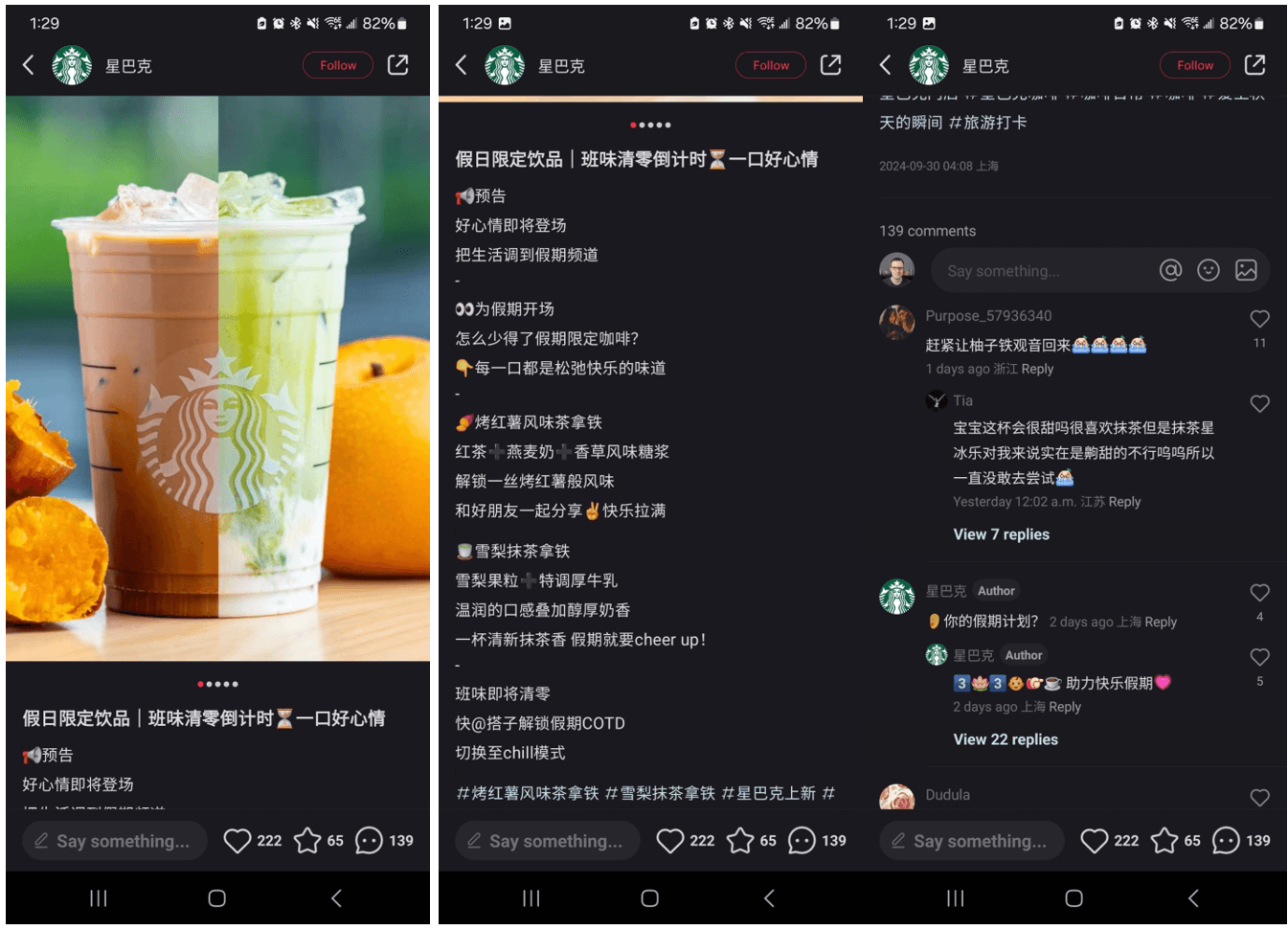
In fall 2024, Starbucks is promoting drinks on Rednote on their official account, which has 214,000 fans. The beverages are available during the October 1-7 national day holiday: Snow Pear Mocha Latte and Fried Yam Tea Latte.
The post has 5 images at the top, which can be swiped through, as well as text below, followed by user comments. It has 222 likes in the two days since it was posted, which is a good number for an organic post. However, the likes could be a lot higher if it was promoted with advertising, or there was a catchier topic.
As an example, our founder Tait took a video of him and his friends, family chatting and drinking Coco Bubble Tea, and it had 4,600 likes, even though he only had ~20,000 followers at the time. Why so much more? It was an interesting topic, “which Chinese brands do Canadians know?” It also felt real as opposed to corporate. It wasn’t a promotional video for Coco, but if it was we would’ve integrated some clearer footage and explanation of the drinks.
Next, let’s take a closer look at Zhihu, China’s equivalent to Quora.
Zhihu
Similar to Quora in the West, Zhihu is the largest question-and-answer platform in China. Established in 2011, it has become a go-to hub for knowledge-sharing, in-depth discussions, and expert opinions.
With more than 81 million monthly active users, Zhihu fosters meaningful conversations around a large variety of topics, making it a driver for thought leadership in tech, education, finance, healthcare, and professional services.
Anybody can ask a question. And anybody can answer. The best answers get upvoted to the top. Zhihu is a platform with a high authority, reputation and credibility in China.
In terms of users, Zhihu is primarily used by white collar workers, entrepreneurs, and students – mainly over 30 years old. Video content that can be embedded with answers is gaining popularity. To sum this all up, here is Tait’s tour of Zhihu.
Zhihu Key Functionalities
High-quality content and knowledgeable user base stand out on Zhihu:
- Live Discussions
- Expert Panels
- Podcasts
- Paid services (consultations, courses, exclusive content, “Zhihu University”)
Overall, you will find in-depth answers around trending topics, current events, and evergreen questions.
Zhihu Key Features
Zhihu is known for:
- Asking questions
- In-depth answers
- Lively discussions
Keep in mind that content must be useful to the reader, and somewhat evergreen, so that it can stay on the platform for a longer time (not just a day or two).
Who Should (NOT) Be on Zhihu?
With its focus on business, expertise, and serious discussions, Zhihu is suitable for companies and individuals in knowledge-driven sectors:
- Tech & Innovation: from startups to established companies
- Healthcare: medical professionals, wellness brands
- Education: universities, online education providers
- Professional Services: consulting, legal, finance
As such, Zhihu is more suitable for B2B brands, offering products and services (usually those that require more research, e.g. in tech, education, finance, and healthcare).
Smaller and larger brands can benefit from a presence on this app. However, purely lifestyle and entertainment-based brands that rely on direct sales may struggle to reach their goals on Zhihu.
Problems that Zhihu Marketing Can Solve
With its intellectual community, Zhihu fills a gap in China’s social media space, and serves to:
- Build thought leadership in key industries
- Establish credibility and consumer trust
- Raise brand awareness
So, what are the opportunities of Zhihu?
Zhihu Opportunities
Western brands can leverage Zhihu to:
- Reach high-quality audience: Also for premium and niche products (watch out: no direct sales)
- Establish authority: Showcase their expertise by participating in Q&A discussions or publishing in-depth articles
- Educate customers about products and services
How Zhihu Works for Brands
Brands can take advantage of Zhihu’s perks as follows:
- Q&A Engagement: respond to user questions related to their industry or product
- Content Marketing: create long-form articles to build trust and visibility
- Paid Content: Offer useful courses or paid consultations
Zhihu Advertising
The platform offers several advertising options, although this should not be overused:
- In-Feed Ads: blend in the user feed
- Display Ads: traditional banners or sidebar ads
Here is some additional information on Zhihu advertising.
Zhihu Marketing Strategies
Successful marketing on Zhihu involves:
- Creating valuable and informative content that solves a specific problem or answers a specific question
- Host live discussions on specific topics irrelevant to users
- Partner with industry thought leaders (intellectuals, academics) to add credibility to your brand
Zhihu would be considered less of a social network compared to many other platforms. Therefore, we would advise against overly promoting your brand and content to avoid a “spammy” and “promotional” look vs. an established thought leader, who has something important to say.
Summary: Key Strategies for Zhihu
- Set up an official Institutional Account
- Publish high-quality answers and content
- Participate in discussions, add value with your expertise
Example: Starbucks on Zhihu
Starbucks does not have an official brand presence on Zhihu.
Bilibili
This video-sharing platform is very similar to YouTube, and includes elements of Twitch and TikTok. Bilibili offers diverse content for a young Chinese audience – teens to early thirties (336 monthly active users), including vlogs, tutorials, and product reviews.
The most popular genres are ACG (Animation, Comics, and Games) as well as pop culture, tech, and lifestyle. Most of the videos on Bilibili are made by fans. Interestingly, users watch videos of people playing games, much like other people watch sports on TV or e-sports.
This video tour by Nanjing Marketing Group’s founder Tait shows the Bilibili environment. He shows how Bilibili stands out with “bullet comments” (Damu) which users can post over videos.
Regular users (non-verified) can upload up to 2 hour long videos, whereas verified or premium users have no limitation (you have to take a test to become such a higher-rank user). Likewise, live streams are also not limited to a certain time. Find out how to set up a personal Bilibili account.
Bilibili Key Functionalities
These are the key functionalities of Bilibili:
- Long and short videos
- Live streaming (similar to Twitch)
- Gaming
- E-learning (freemium)
Anyone can comment, like, share, or favorite videos. Besides, Bilibili allows users to give “coins” to videos to upvote a video (stronger than a like, because coins are limited).
Bilibili Key Features
The most commonly used features on Bilibili include:
- Bullet comments
- Direct shopping
The platform places a strong focus on community engagement through user-generated content. Bilibili’s distinctive mix of content, community involvement, and interactive experiences sets it apart in China’s social media landscape.
Who Should (NOT) Be on Bilibili
Bilibili is ideal for brands that appeal to a younger audience who enjoys trendy video-based content. Companies in industries like gaming, entertainment, tech, fashion, streetwear, and education can engage with China’s digital-savvy consumers on Bilibili. Global B2C brands with products and services can benefit from a presence on Bilibili.
However, brands that lack strong visual content or are not able to engage with a fast-paced video culture may struggle on this platform. Bilibili users value authenticity and creativity, and overly promotional or corporate content might underperform.
Problems that Bilibili Marketing Can Solve
Western brands aiming to reach a younger Chinese audience might find other Chinese platforms restrictive or formal. Bilibili offers a more relaxed, community-driven space where users spend considerable time discovering new products and engaging with content creators.
Bilibili Opportunities
Western brands can benefit from a Bilibili presence:
- Boost brand visibility
- Engaging a youthful, digital native audience
- Direct sales through links in videos
As on every Chinese social media platform, keep in mind to localize your content to resonate with local culture and trends.
How Bilibili Works for Brands
Get the most out of Bilibili by:
- Creating visually engaging and shareable video content
- Adding value for the viewer (entertain, educate)
- Engaging your community through comments, with giveaways, and fan art
- Adding interactive elements (leverage bullet comments)
Bilibili Advertising
Generally, there isn’t much advertising on Bilibili, but these are the options:
- In-Feed Ads: blends with native content
- Pre-Roll Ads: Short ads that play before videos
- Banner Ads: in strategic locations
- Live Stream Ads: best for real-time engagement
As always, you can target your ads based on user demographics to reach your ideal audience.
Bilibili Marketing
The best strategies for marketing on Bilibili include:
- Content marketing (freemium content!)
- Interactive live streams
- Product reviews and tutorials
- Influencer collaborations
Remember to tell a story that is fun to watch or educational. Adding value for viewers is key. This can be exclusive behind-the-scenes content, tutorials, or product demonstrations and reviews.
Summary: Key Strategies for Bilibili
- Get a verified or premium account
- Share valuable/exclusive video content
- Engage your community (comments, events, competitions)
- Monetize through freemium content or in-video direct sales
So, what does Bilibili actually look like?
Example: Starbucks on Bilibili
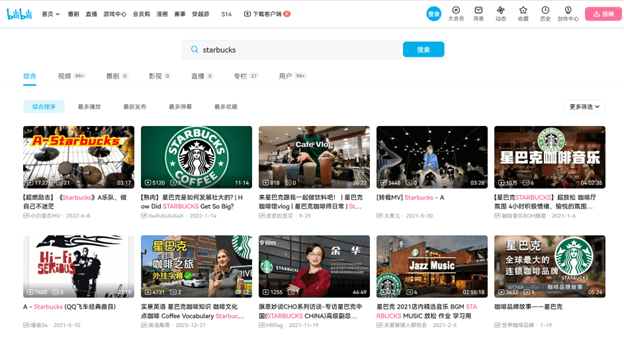
Even though Starbucks has a verified Bilibili account with a little more than 2,000 followers, not much has been posted on it. It seems they publish English videos with Chinese subtitles there, and some Chinese videos too, telling the stories of their beans.
What’s interesting is that Starbucks hasn’t customized the channel with a banner of their own, so one could wonder about the intent behind this. Perhaps they haven’t noticed that short vertical videos can do well there too. One approach could be to start by reposting successful content from Douyin onto Bilibili.
Now, let’s analyze Douyin, China’s TikTok.
Douyin
As the original TikTok and Chinese counterpart (both created by the same company), Douyin has become the leading short-video app in China.
750 million monthly active users value Douyin’s entertaining nature. The app’s algorithms make doomscrolling basically impossible to resist. Most clips and memes on Douyin are 60 seconds or less long (15 seconds – 3 minutes is possible; 10 minutes for verified users).
Tait gives you a quick tour of Douyin in this video.
Douyin Key Functionalities
Douyin is known for its powerful video-first approach:
- Short videos
- Live streaming
- Shopping integration
The user-generated content thrives on the app’s easy editing application and many features like filters, music, and so on.
Douyin Key Features
Some of the most popular features of Douyin include:
- Short video content (UGC).
- Livestreaming with integrated shopping
- Influencer content
- Challenges and hashtags
- Discovery function (search based on user preferences)
So, who can benefit from a presence on Douyin?
Who Should (NOT) Be on Douyin
Douyin is the go-to platform for B2C brands with products in fashion, beauty, lifestyle, and entertainment. Brands with a younger target audience (Gen Z and Millennials) will find success here, but dynamic video content and quick production pace are important to resonate with them.
Brands with more complex products and long-form content may find it difficult to get engagement on Douyin. Lighthearted and highly visual content (humorous or provocative) is ideal for Douyin.
Problems that Douyin Marketing Can Solve
Western brands may connect with a younger, trend-conscious audience on Douyin to
- Build brand awareness
- Increase engagement (sharable content)
- Boost direct sales (integrated in live streaming)
Douyin is an ideal platform to push e-commerce and digital marketing for your brand as users basically expect promotional and branded content.
Douyin Opportunities
Benefit from Douyin as a global brand to
- Reach a broad, youthful audience
- Drive visibility
- Boost sales
- Increase engagement
- Build brand loyalty
So, how do businesses get started with that?
How Douyin Works for Brands
Douyin is powerful for brands
- Short videos => Core marketing content for entertainment and storytelling
- E-commerce integration => Direct product sales through clickable links
- Livestreaming => Real-time engagement and flash sales
- Influencer collaborations => Boost reach and credibility
Now, how do you promote your brand on Douyin?
Douyin Advertising
Advertising on Douyin is very popular, and these are the options:
- In-Feed Ads: seamless organic integration
- Opening Screen Ads: when users open the app
- Livestreaming Ads: for real-time interaction
Douyin creators may also use DOU+, which is a paid promotion feature to boost video content for more visibility through demographic-based targeting.
Douyin Marketing
Reach GenZ and Millennials by:
- Creating fun, shareable, and visually appealing short videos – this has viral potential
- Collaborating with popular creators (influencers)
- Utilizing branded challenges for user participation
- Leveraging real-time interaction via live streaming
- Incorporating product links for direct sales
Don’t worry, brands can push for more promotional content and harder sales on Douyin.
Summary: Key Strategies for Douyin
These are the best ways to get started with your brand on Douyin:
- Set up a verified Douyin brand account
- Create entertaining, creative, trendy short videos
- Use integrated shopping features
- Collaborate with influencers
- Incorporate livestreaming
Now, let’s take a look at what Douyin actually looks like.
Example: Starbucks on Douyin
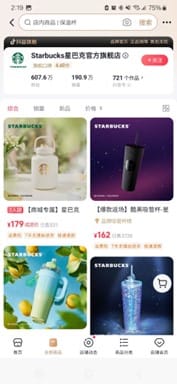
Interestingly, Starbucks has multiple accounts on Douyin. They also have a store with over 1.9 million sales so far. Seems like they are really pushing Douyin. This video perfectly shows Starbucks nestled into traditional Chinese architecture.
What is also notable is that different drinks are promoted compared to Rednote. Besides, on WeChat Channels, six episodes of a short drama series centered around Starbucks have been published already, but only one has been posted on Douyin. It seems like the various Chinese social media platforms are not ideally coordinated, and synergies are not optimally leveraged.
Finally, let’s take a look at Weibo, China’s top microblogging app.
Often referred to as China’s X, Weibo was launched in 2009 by the Sina Corporation. Since 2014, Alibaba holds 30% shares of Weibo.
Today, Weibo is China’s top microblogging platform in China with more than 588 million monthly active users. It is an important space for news, social interaction and discourse on current events. Besides, it has lots of entertaining, fun and cute content as well as sales. This is Tait’s video tour of Weibo.
How Weibo Stands Out
- What’s special is that in China’s highly regulated online world, Weibo is relatively uncensored and allows for more expression compared to other Chinese social platforms.
- Did you know that Weibo has entered a strategic partnership with Alibaba’s Tmall? This e-commerce integration allows users to browse and purchase products directly in Weibo.
- Weibo has the most official celebrity accounts out of all Chinese social media platforms (due to its original design to attract KOLs). This makes it a primary hub for fans of Chinese pop culture.
Posts on Weibo typically contain text descriptions and images or videos, often accompanied by trending hashtags to enhance visibility.
Weibo Key Functionalities
The main functionalities of Weibo center around microblogging:
- Short posts (up to 2,000 characters vs. 280 characters on X)
- Real-time news
- Trending topics (hot searches) – news, celebrities, lifestyle, other viral content
- Polls and surveys
So, is Weibo used most for news, information, and fact-based discourse? Yes…but it also serves as a space for lively discussions around entertainment and other trending, culturally relevant topics.
Weibo Key Features
Most commonly, Weibo users access:
- Real-time news and users/brand feeds
- Trending topics and hashtags
- Corporate communication and announcements
Next, let’s find out which Western brands can benefit from a presence on Weibo.
Who should (NOT) be on Weibo
With a largely young audience (GenZ, Millennials), Weibo is ideal for global brands in the fashion, beauty, luxury, and entertainment sectors that want to establish themselves authentically in the Chinese market.
However, these businesses must have the resources to respond timely in a fast-paced environment that is driven by news and hot trending topics. Otherwise, they may struggle to keep the attention of users and maintain credibility and thought leadership.
B2B and B2C companies with products that are focused on brand awareness and community engagement can particularly benefit from Weibo’s USP.
Problems that Weibo Marketing Can Solve
With X and many international news platforms blocked in China, brands may find it difficult to connect with a Chinese user base interested in current events, lifestyle, and entertainment.
Weibo is also an ideal space to connect to Chinese consumers via popular celebrities as influencers.
Overall, Weibo is a great platform to find out what people in China are currently interested in and their take on certain events or issues.
Weibo Opportunities
Western brands can benefit from a Weibo presence:
- Connecting with partners and businesses through Official Accounts
- Organic mass reach of a broad audience; potential for viral content
- Jump on the bandwagon of hot topics, trending hashtags, and viral campaigns
- Interactive formats for community engagement and interaction
Next, let’s take a closer look at how to promote a brand on Weibo.
Weibo Advertising
In terms of paid strategies, Weibo offers multiple options, which can be described as follows:
- In-Feed Ads: organic look & feel
- Trending Ads: maximum visibility
- Video Ads: appear in users’ feeds
- Live Streaming Ads: real-time engagement and interaction
- Search Ads: sponsored listings
- Fan Headlines: aka fan tunnels, fanstop
Remember to align campaigns with important Chinese holidays and shopping festivals – something that is relevant for all Chinese social media platforms!
Weibo Marketing
The key strategies to promote brands on Weibo include:
- Apply content marketing: post, contests, giveaways, interactive campaigns (organic strategy) => with enough users reached these become hot topics or super topics (managed by hosts; diamond symbol)
- Try Weibo stories (similar to Instagram stories)
- Link to a Taobao or Tmall store
- Utilize live-streaming platform Yizhibo Live, which is integrated into Weibo
Find out more on how to use Weibo for China marketing here.
Summary: Key Strategies for Weibo
- Register a Business Account and verify it
- Create fresh, sharable content (e.g. polls) to gain reach
- Engage with your audience through comments, likes, and shares (convert leads to sales).
- Collaborate with influencers
Next, let’s see what our example of American coffee looks like on Weibo.
Example: Starbucks on Weibo
Interestingly, the official Starbucks account on Weibo only shows little content and there are only 1,347 fans.
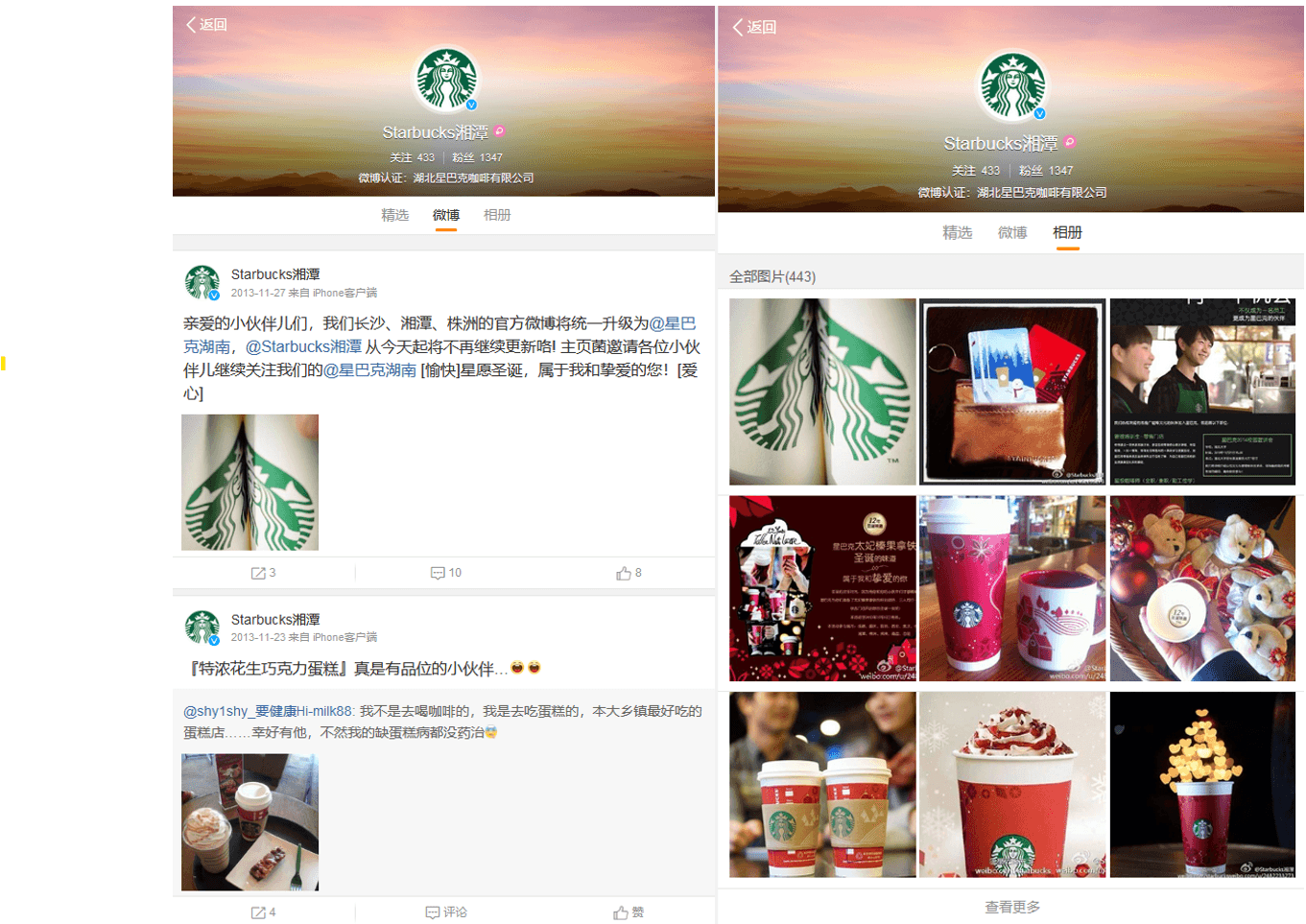
Now that we know the key functionalities of the most popular six Chinese social media platforms, and how Western brands can leverage their potential, let’s look at them side-by-side.
Marketing Comparison – Chinese Social Media Platforms
In comparison, the unique features, niches, and benefits for global and domestic brands become evident.
| Rednote | Zhihu | Bilibili | Douyin | |||
| USP | Largest user-base, multi-functional super-app | THE lifestyle app, UGC, reviews, social commerce | Mature microblogging app, most celebrity accounts | Reputable Q&A platform, beyond entertainment | Most popular video-platform, ACG content, digital-native | Top short-video app, essential for China marketing, viral potential |
| MAU (Q3/24) | 1.3 billion | 312 million | 588 million | 81 million | 336 million | 750 million |
| Available in English | Yes | No | No | No | Partial | No |
| Key Functionalities | Messenger, Newsfeed, Shopping, Payment | Social sharing, product reviews, direct shopping | Short posts, real-time news, trends, entertainment | Live Discussions, Expert Panels, Podcasts, Paid services | Videos, Live-streaming, Gaming, E-Learning | Short Videos, Live Streaming, E-Commerce |
| Key Features | Personal Account, Official Account, Moments | UGC, Brand Discovery, Shopping | News, Trending Topics, Corporate Communication | Questions, Answers, Discussions | Bullet Comments, Direct Shopping | UGC, Live Streaming, Discovery, Challenges, Hashtags |
| Who is it for | All brands, B2B, B2C, products, services | Lifestyle brands, B2C, products, also smaller brands | Fashion, beauty, and entertainment brands, B2B, B2C, products, also smaller brands | B2B brands, products, services, also smaller brands, especially tech, education, finance, and healthcare | B2C brands, products, services, also smaller brands | B2C brands, products |
| Problems the app solves | Connect with everyone in China, business and private, even if Western social and websites unavailable | Gain visibility, credibility and trust in China; Capture a new trend-conscious audience in China | Identify trends in China, what Chinese people think | Build thought leadership, credibility, and trust, raise brand awareness | Brand visibility, sales, engagement | Brand awareness, engagement, direct sales |
| Opportunities | Awareness, leads, sales, customer support | Build trust, brand visibility sales | Connect with partners, mass reach, virality | Reach high-quality audience, establish authority, educate consumers | Visibility and sales to a young audience, mainly gaming, tech, education | Reach broad GenZ and Millennial audience, ready to buy consumers |
| Advertising | Moments Ads, Official Account Ads, Video Account Ads, Mini-Program Ads, Search Ads | In-Feed Ads, Search Ads, Banner Ads, Live Streaming Ads | In-Feed Ads, Trending Ads, Video Ads, Live Streaming Ads, Search Ads, Fan Headlines | In-Feed Ads, Display Ads | Not much advertising on Bilibili! In-Feed Ads, Pre-Roll Ads, Banner Ads, Live Stream Ads | In-Feed Ads, Opening Screen Ads, Livestreaming Ads |
| Marketing | Content marketing, influencer marketing, loyalty programs | Foster UGC, influencer marketing, integrated shopping | Content marketing, Weibo stories, link to Taobao/Tmall, Use Yizhibo Live (Streaming) | Content marketing (value!), host live discussions, partner with industry thought leaders | Content marketing, interactive livestreams, product reviews, influencer collaborations | Content marketing, influencer collaborations, branded challenges, live streaming, direct sales |
And that’s a wrap!
The Takeaway – Chinese Social Media
When it comes to the best Chinese social platforms for Western businesses to tap into or expand in China, there are hundreds of social apps to choose from.
While there are many overlaps in audience, services, and benefits, these are the most relevant ones with specific USPs for international brands:
- WeChat: China’s all-in-one app, basically a must for brands to have a presence
- Rednote: community commerce, reach ready-to-buy Millennials and GenZ women
- Zhihu: In-depth discussions (Q&A forum), intellectual audience, thought-leadership in professional sectors (tech, education, etc.)
- Bilibili: Reach digital-native and tech-savvy audience (GenZ), relaxed entertainment-focused environment
- Douyin: Short-video and trend focus (creative, viral content), reach a broad, youthful audience, who is ready to buy, influencer-heavy
- Weibo: top microblogging site, from news to entertainment, younger and more educated audience, find out what Chinese people think about current topics
Since we used Starbucks as an example in this post, Nanjing Marketing Group founder Tait sums up our impression of Starbucks’ Chinese social media presence. First we’ll do a brief analysis, then we’ll generate some ideas.
It seems there are a lot of great elements in their marketing.
- They’ve consistently posted many videos of different varieties – product features, celebrity spots, and the new short drama series.
- They have tight integration with Douyin, selling many items directly on the platform.
- The photos and videos are all crisp and ‘delicious’.
- Although not specific to digital marketing, their stores in China are beautiful, and often carefully integrated into traditional Chinese architecture.
But there’s also a lot of missed opportunities.
- Primarily, they do not cross-post enough between platforms. For example, sharing their short videos on Bilibili would be a quick win. Short videos are a particularly easy format to cross-post, and can generally be shared to not only Douyin and WeChat Channels, but also Rednote, Bilibili, and Kuaishou.
- If we were running the social marketing for Starbucks, we’d expand the styles of content even further, and engage with influencers, giving them even more freedom to experiment with new content styles. This would likely be a hard sell to Starbucks global management, but it would drive sales.
- As an example, there’s an up-and-coming Chinese creator named Sun Yanlei that has become popular for asking delivery drivers to take him to the cleanest restaurant they pick up from, then they have a chat. That kind of influencer, with only 300K followers so far, can generally be hired for a steal of a deal. Plus, it would be a win for Starbucks to be seen collaborating with rising Chinese stars. Embed: https://www.instagram.com/reel/DAH-d25SfSp/?igsh=MjJjMnBqajVubTN6 (or YouTube or whatever)
Of course, we merely scratched the surface of Starbucks’ marketing, and they may well have good reasons for holding back.
So, there you have it. These are the best Chinese social media for marketing Western brands. Now, are you ready to grow or expand your brand in the Chinese market? Raise brand awareness, engage audiences, and drive sales overseas with the power of popular Chinese social media platforms.
PS: If you’d like to get a brief overview of even more Chinese social apps, check out this table of 15 of Chinese social apps. Discover their USPs, user base, and marketing potential of the 15 most popular social media platforms in China.