
A common pitfall of content creation that affects influencers and professionals alike is the curse of “low views.”
You’ve spent hours creating solid content, beautifully designed, informative, and full of insight, only to reach a few people.
For overseas brands entering the Chinese market, this is incredibly common. Often, the problem isn’t the content itself. It’s the step before that: The click.
Clicking and reading are two separate actions. In a fast-scrolling feed, users usually see only one thumbnail and a single line of title text. Only when they choose to click does your carefully crafted content get a real chance to be seen.
In this article, we’ll revisit why “thumbnail + title” matters so much on Chinese social platforms, break down the distinct role each one plays, and discuss what brands still need to master today, especially now that AI tools have become powerful enough to generate visuals in seconds.
Key takeaways
- Clicking and reading are not the same. Great content doesn’t automatically earn a click.
- Chinese feeds are denser and faster, making thumbnails and titles even more important.
- The thumbnail’s job is to grab attention; the title’s job is to filter and match the right audience.
- AI makes image production easier, but humans still decide what to highlight and what value to communicate.
- Because user preferences and algorithms keep changing, ongoing testing beats relying on “experience.”
Why are thumbnails and titles so critical in China?
Feeds are designed differently
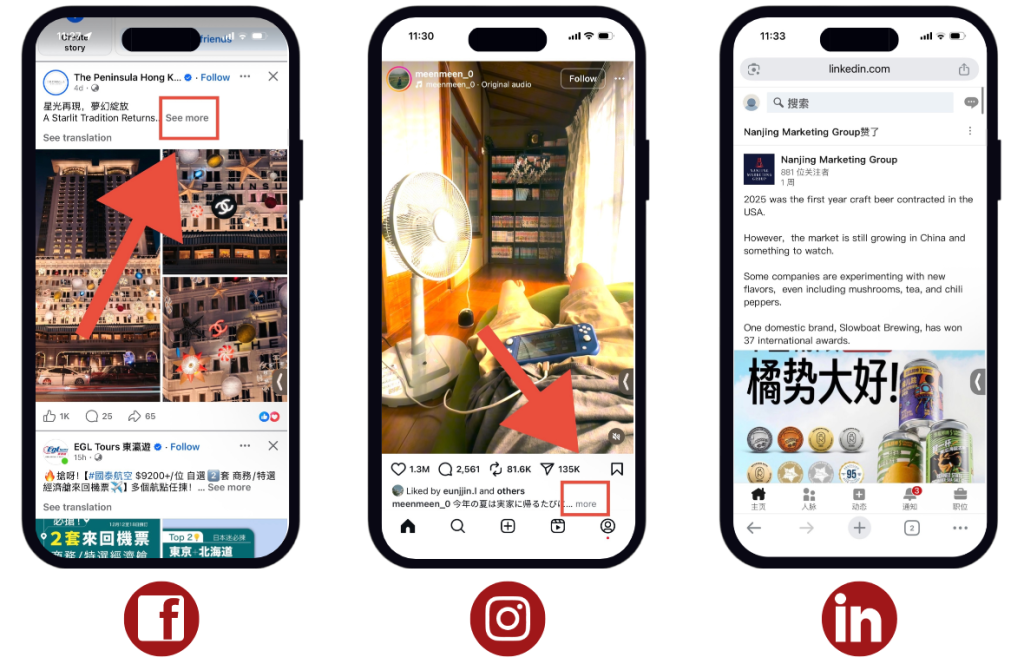
Western brands or companies will already be familiar with the layout of mainstream overseas platforms, such as LinkedIn, Facebook, and Instagram. Their feeds typically give each post more breathing room:
- Without scrolling, you usually see only one or two posts.
- You can often read the title and part of the text without clicking and expand to read more.
- If it’s not interesting, you simply keep scrolling.
Chinese platforms use almost the opposite logic: within limited screen space, they try to display more content and maximize information density.
- You can see multiple pieces of content on one screen.
- Each post’s image is smaller, and the layout is tighter.
- To read the full text or view more images, you usually must click to access a new page.
How major Chinese platforms display content in the feed
WeChat (WeChat)
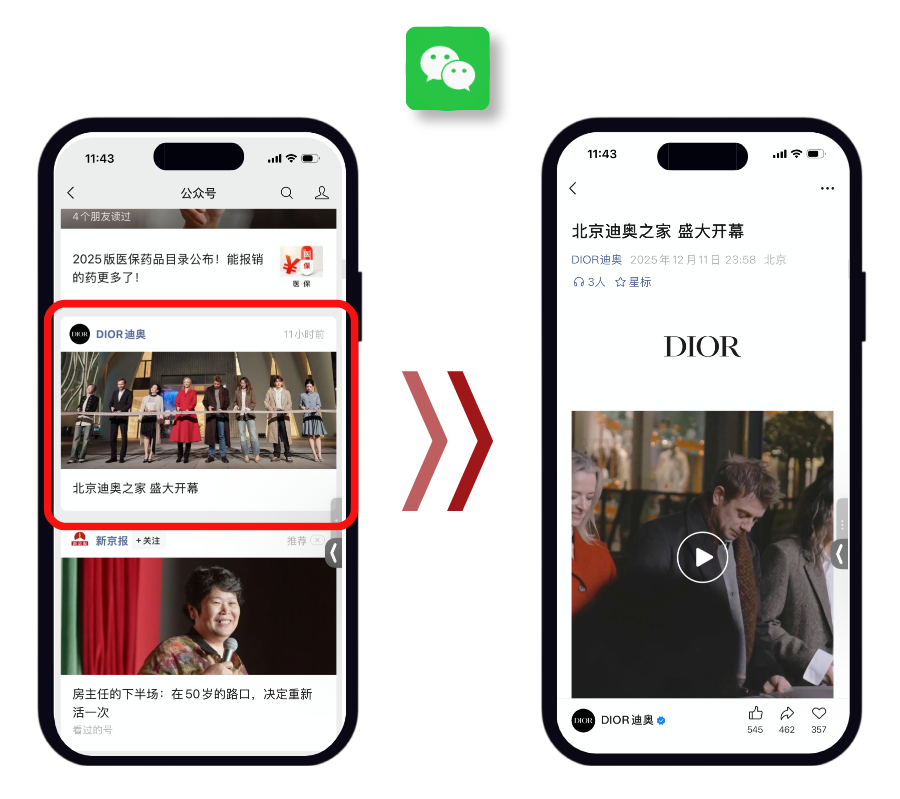
WeChat is fundamentally a messaging app, and content entry points are intentionally limited.
Whether in Official Account lists, message history, “Top Stories/Look,” or search results, users typically see only a thumbnail and a title. To read, they must open a new page, and returning to the feed requires extra steps.
This “navigation cost” makes users more cautious before clicking, which further amplifies how much the thumbnail and title influence the decision.
Rednote

When you open Rednote, you’re dropped into a high-density, two-column feed. Each note shows only a thumbnail and a single-line title. Full content and additional images require an additional click. Whether it’s the recommendation feed, following feed, or search results, the thumbnail and title are the only gateway.
Bilibili

Bilibili is similar to YouTube in that content is presented as a thumbnail and a title, but the overall information density is noticeably higher.
Across these feed designs, one thing is clear: To stand out on Chinese social platforms, content must compete in an extremely intense attention economy, and the thumbnail is the key entrance that determines whether your content gets seen at all.
How do thumbnails and titles split the work?
The thumbnail stops the scroll
On platforms like WeChat, Rednote, and Bilibili, thumbnails take up far more visual space than the title. That means the first thing users notice (and the easiest thing to influence them) is the image itself.
A strong image can instantly convey emotion, context, and tone. Through color and composition, it can claim attention in a crowded feed in a way words can’t do in a fraction of a second. So the thumbnail’s mission is simple: Be seen in the scroll, and make someone pause who would otherwise keep swiping.

Client examples
The title filters the right audience
A title doesn’t just tell the user what the post is about—it also tells the platform what you’re talking about.
By embedding keywords and long-tail phrases, titles help platforms understand the topic more accurately and match the content to the most relevant users. That means traffic coming from search is more precise, and clicks are more “valuable.”
In the client example from NMG below, when users search for the keyword “Churchpark” on Rednote, our content ranks near the top.

Post title: 🎒 Boston Fall 2025 rental, I’m choosing Church Park
Next, let’s look at common pitfalls and optimization ideas you’ll encounter during production.
A closer look at images: common mistakes foreign brands make in China
#1. Wrong fonts and text rendering
East Asia shares a “Chinese character” cultural sphere, but different regions developed different glyph standards. For non-native Chinese teams, these differences can be subtle and easy to miss, leading to the use of inappropriate fonts in visuals. This often creates an impression of “unprofessional” or “careless,” which lowers the willingness to click.
Below is an example illustrating how the same characters can look different across writing systems when using Source Han Sans.

#2. Different visual logic and cultural preferences
Because Chinese users face a much denser feed, each piece of content fights harder for attention. Visual logic often leans toward
- high-contrast colors,
- clear scenes and human figures, and
- enlarged, bold text on images.
This also reflects a broader cultural difference in content presentation: Chinese audiences often prefer fast, direct information delivery, while overseas platforms may favor whitespace and more conceptual expression.

McDonald’s posters overseas

McDonald’s posters in China
#3. AI makes production easier—but the brand must still choose the direction

Common errors in AI-generated images
AI can now generate high-quality visual assets quickly, so making thumbnails is no longer “hard.”
But effective thumbnails and titles work not just because they look good, they work because they communicate a clear message. AI can help execute, but it can’t decide how your brand should speak to Chinese users through visuals and language.
If prompts aren’t precise—or AI is overused—you may end up with unnatural people, an obvious “AI look,” and a worse overall user experience.
A closer look at titles: communicating content and value precisely
Chinese is flexible and expressive. Packing more information into fewer characters—while still being appealing—takes real skill.
#1. Title length limits vary by platform
To catch the attention of users perusing a content feed, titles need to capture the core message of the content in just a few words.

Title length limits by platforms
#2. Thinking in “hooks”
On Chinese platforms like WeChat, Rednote, and Bilibili, a title doesn’t have to explain everything; however, it should encourage a “I want to click and see” response.
Common hook formats:
- Numbers – Makes the promise more concrete and predictable.
- Second-person / first-person voice (“you / I”) – Reduces distance and lowers the reading barrier.
- Strong contrast – Creates tension and curiosity.
- Specific problems/pain points – Helps readers instantly relate.
- Keywords – Makes the topic clear at a glance by using familiar terms.
Examples:
- “15 minutes a day—transform your thinking in 1 month”
- “Do this one thing, and your reply rate jumps from 5% to 85%”
- “Still sending generic greetings? These 3 ‘social death traps’ are ruining your network”
#3. When you shouldn’t use hooks
Hooks don’t fit every situation.
When the main goal is search indexing and long-term visibility (for example, website content), the priority changes. In that case, placing the core keyword directly in the title can matter more than clever phrasing.
Give Your WeChat Article a Distribution Plan
A stronger title helps when someone sees your article. To reach readers beyond your existing audience, plan how the article will reach them as well.
- Work with a relevant partner: A joint event, interview or practical guide gives both organizations a reason to share. Choose a partner whose audience overlaps with your intended customers, and agree on the sharing plan before publication.
- Involve customers and industry specialists: A customer interview or expert contribution can answer questions your sales team hears regularly. Send contributors the finished article and a short explanation they can use when sharing it with their own contacts.
- Use relevant WeChat groups: Share an article where it answers a question or contributes to the group’s topic. Add a sentence explaining why it is useful, follow the group’s rules and make time to answer replies.
- Give readers a specific reason to share: An article that helps a colleague solve a problem is easier to pass along than a general company update. Match the suggested next step to the article, such as sharing a checklist with the person responsible for that task.
Review where the resulting reads come from and whether they lead to useful conversations or inquiries. Our WeChat analytics walkthrough explains the traffic-source and sharing data. Compare the distribution plan as well as the thumbnail and title when deciding what to repeat.
Testing beats intuition
The tips above are practical, but China’s social content landscape is huge, and algorithms and user preferences keep evolving. What worked before may not work everywhere. That’s why continuous testing is the most reliable way to learn which thumbnail + title combinations perform best.
One of the world’s highest-CTR YouTube creators, MrBeast, has shared that he may test 50+ thumbnails for a single video just to find the strongest version.

YouTube creator MrBeast’s thumbnail testing
We use a similar approach when preparing Rednote content and ad creatives. By adjusting posting time, visual style, text density, and title phrasing (and testing combinations), we can identify which versions are more likely to attract the right users and earn more clicks.
Client example: TUM Asia WeChat ads
TUM Asia is the Asian campus of the Technical University of Munich. At the time, they were recruiting international students from China, and Nanjing Marketing Group helped them reach their target audience by running WeChat Moments ads.
We prepared three thumbnail variations and found that image A performed best, then launched it alongside two external creative variants to scale the campaign.

WeChat Moments ad thumbnail testing for TUM Asia

WeChat Moments ad copy testing for TUM Asia
Because Official Account articles have limited publishing frequency, they’re not ideal for high-frequency A/B testing. But for Rednote, WeChat ads, and Baidu ads, testing is often the most direct and practical optimization method.
China’s communication style, user behavior, and visual preferences differ from overseas platforms. New teams need time to adapt—and they need systematic trial-and-error to judge what works and what doesn’t.
Alternatively, you can work with a localized China marketing team, like Nanjing Marketing Group. We will help align content strategy with platform habits and streamline the testing process to help brands quickly find what works (and what doesn’t) for the Chinese market.