
Parasite SEO is gaining significant attention in the SEO community around the world. In this article, our China marketing experts will take a look at the opportunities and things to watch out for when leveraging the power of parasite SEO as part of your China marketing strategy.
Now, why should you pay attention to us? At Nanjing Marketing Group, we have almost 20 years of experience in the Chinese market. We’ve run hundreds of successful campaigns for hundreds of high-profile international clients across all types of niches.
Plus, we’ll tell you what other marketing agencies may try to cover up. We are well aware that not every strategy and every ad works right away. But we know how to adjust and iterate, in order to figure out what does work. This we have proven time and again.
Let’s get started.
What is Parasite SEO?
Usually, SEO refers to optimizing your website and its backlinks in order to help it rank higher on search engines and get more organic traffic.
But sometimes it’s hard to get a new website to rank well soon, and this is especially the case for Baidu. Parasite SEO refers to publishing interesting and keyword-rich content on other websites with strong domain authority (Reddit, Quora, Medium, LinkedIn, WeChat, Rednote, Baidu Baijiahao, Zhihu, etc.) to ride “piggy-back” on their popularity and improve ranking. Parasite SEO is particularly useful for brands that are new in the Chinese market and have a limited budget. In a nutshell: Brands publish content that is optimized for search. This will rank well on Baidu and other relevant places.
Another way to explain it is that Chinese parasite SEO is a type of content marketing that focuses on publishing content in places that will rank highly on Chinese search engines. The key search engine is Baidu, but WeChat/Sogou, Rednote, 360 are all important as well.
Is Parasite SEO in China Effective?
The short answer is yes. 😉
As you know, the Chinese search engine landscape is dominated by Baidu, whose algorithm works differently from Google, which is banned in China.
Baidu prioritizes Chinese content, local platforms, and its own ecosystem, which favors parasite SEO, when publishing content or engaging on platforms like Baidu Baijiahao and Zhihu.
The benefits of using parasite SEO in China include:
- Faster indexing and higher ranking on Baidu
- Higher trust and credibility among Chinese netizens
- Increased brand awareness through exposure on popular platforms
- If posting on Rednote or WeChat, you’ll pickup search traffic there too (although not as much from Baidu)
Now, what about the critics’ voices? Let’s hear it!
Is Parasite SEO Evil?
The wording itself suggests that like parasites who live off another organism, usually at the host’s expense, parasite SEO takes advantage of high-authority websites, often without providing reciprocal value. But let’s take a differentiated look at this.
Critics voices
Some may declare parasite SEO as an unethical black hat technique, because it can sometimes involve keyword stuffing or content scraping (copying and republishing content – often without permission – to manipulate search rankings).
We would like to emphasize that Nanjing Marketing Group does not apply these unethical techniques for ourselves and our clients.
Black hat vs white hat SEO
Conversely, white hat SEO techniques include publishing high-quality content, earning backlinks naturally, and generally optimizing online content and sites for user experience.
Our take on this
At Nanjing Marketing Group, we are using a combination of normal SEO, content marketing and parasite SEO to maximize efficiency. As an experienced and reputable China digital marketing agency, we believe in utilizing a variety of tools and strategies effectively, so that our clients achieve their goals – provided these tools comply with applicable laws and regulations.
Parasite SEO is good for our clients, their potential customers and the platforms we publish so long as the content we publish is truthful and useful, which it is.
Potential Downsides of Parasite SEO in China
Yes, there are a few things to keep in mind when leveraging parasite SEO in China and on Baidu. No, it’s not a one-way street and there are mitigation measures. Let’s take a look.
Limited control
Third-party platforms can delete or de-rank posts, for example, when it’s considered as spam or manipulative, for example, clickbait.
Censorship
Generally, when publishing content in China, it is advisable to stay away from sensitive topics like politics and banned industries like gambling. This also applies to parasite SEO strategies and keeps your publications online and your brand free from content removal and penalties.
Platform dependency
Changes in platform algorithms can affect rankings – both on the sites where the parasite SEO measure takes place, like Zhihu, and the site that is processing this information, like Baidu.
Penalties
While Baidu is not as strict as Google in terms of penalties for parasite SEO, site reputation abuse as well as poor-quality or spammy content can still result in penalties, flagging, or deletion. The way that Baidu (or Google) would detect this is by analyzing link patterns, content relevance and quality.
Website URL’s restricted
Only Zhihu and WeChat principally allow adding a link to your brand website in your content. Brand promotions are usually blocked, so if a post is or looks user-generated that’s a plus. Besides, on Zhihu links from JD or Taobao are sometimes easier to go through the platform’s gatekeeping system.
Baidu Baijiahao, Bilibili, Rednote, Douyin, and many other platforms do not allow adding links at all. You can try, but your account will most definitely be blocked or warned. Focus on working with keywords and valuable content instead – educational (and entertaining).
SEO Ecosystems
WeChat and Rednote have their own SEO systems, separate from Baidu. This means that Baidu typically does not let their content rank highly. It seems that Baidu does not even index Rednote content at all anymore since 2024. You can find more information in this article on Baidu vs Rednote search. In these cases, adding keywords does help for the internal SEO systems of WeChat and Rednote, but not for Baidu.
Conversely, content on Baidu Baijiahao, Zhihu, Bilibili, and Douyin is indexed on Baidu and, therefore, does contribute to improving Baidu rankings. Out of these platforms, Baidu Bajiahao and Bilibili are best for boosting Baidu ranks.
So, what does this mean for your brand?
5 Platforms for Parasite SEO
Based on our experience, the best platforms in China for parasite SEO are those that already rank well on Baidu and have high engagement among Chinese netizens, specifically these five.
Zhihu
China’s Quora, Zhihu, is a Q&A platform with about 81 million monthly active users. Zhihu has a domain authority of 86 (MOZ) and a spam score of 5%.
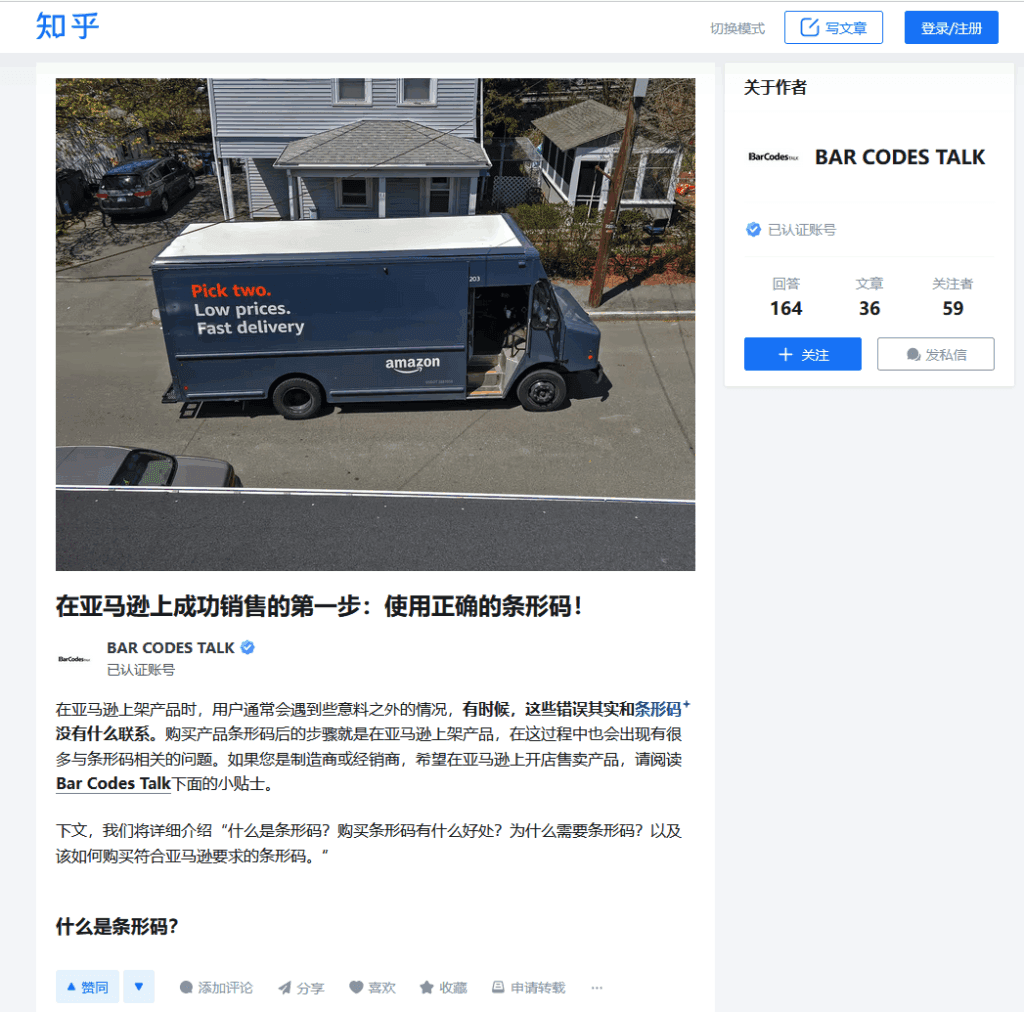
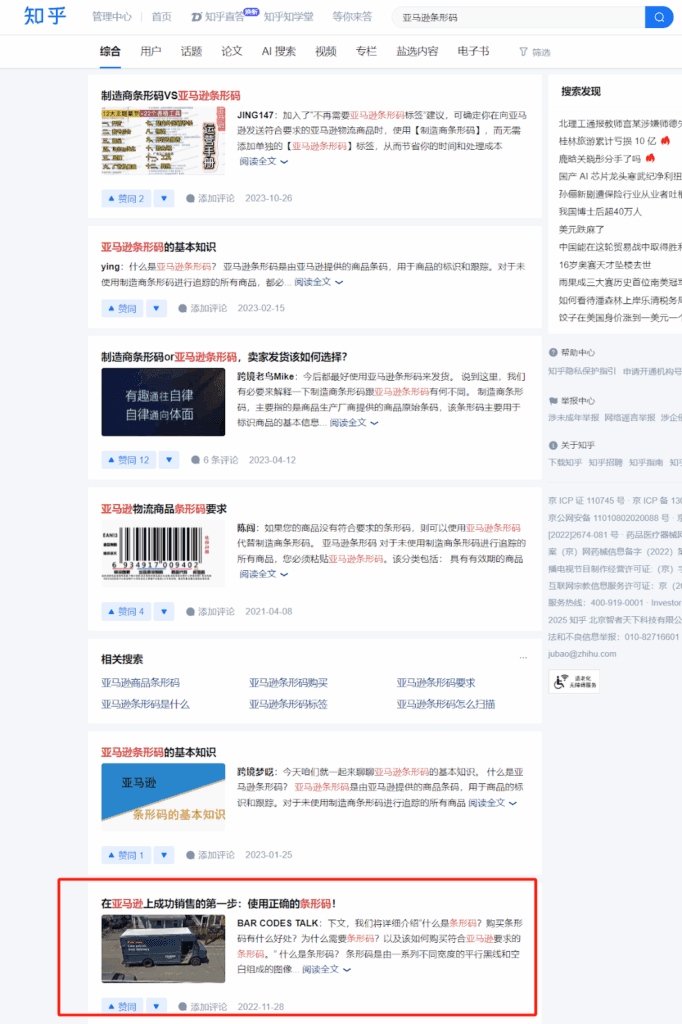
In this example for our client Bar Codes Talk, we optimized a post on Zhihu for the keyword “亚马逊条形码” (Amazon barcode). However, the line between adding value (and adding keywords and related phrases sparsely) and keyword stuffing is fine. A soft approach has the highest potential for success, based on our experience.
Content that does well on Zhihu includes detailed and well-researched answers to questions in your niche and expertise, elaborate case studies and expert insights, behind-the-scenes content, statistics and industry reports, and more.
In our experience, adding images, videos and charts to posts on Zhihu increases engagement.
Baidu Baijiahao
Part of the Baidu ecosystem, Baidu Baijiahao is one of the most popular content publishing platforms in China with more than 4 million publisher accounts.
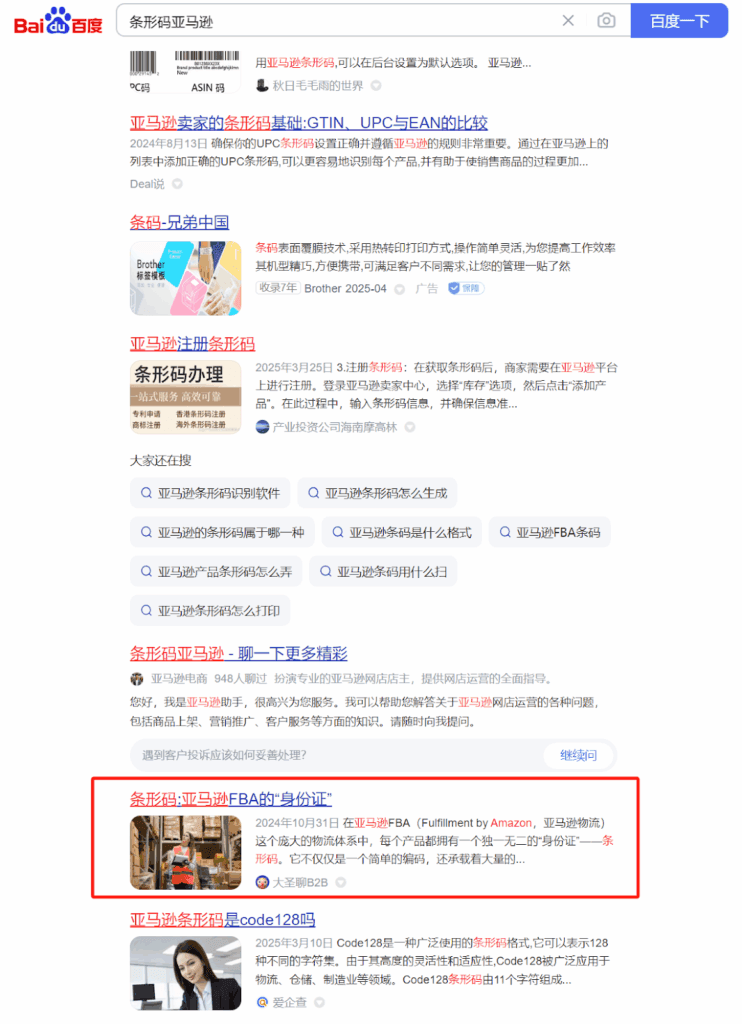
In the screenshot below, we can see an example of the keyword “条形码亚马逊” (Barcode Amazon) being inserted into Baidu Baijiahao for our client Bar Codes Talk.
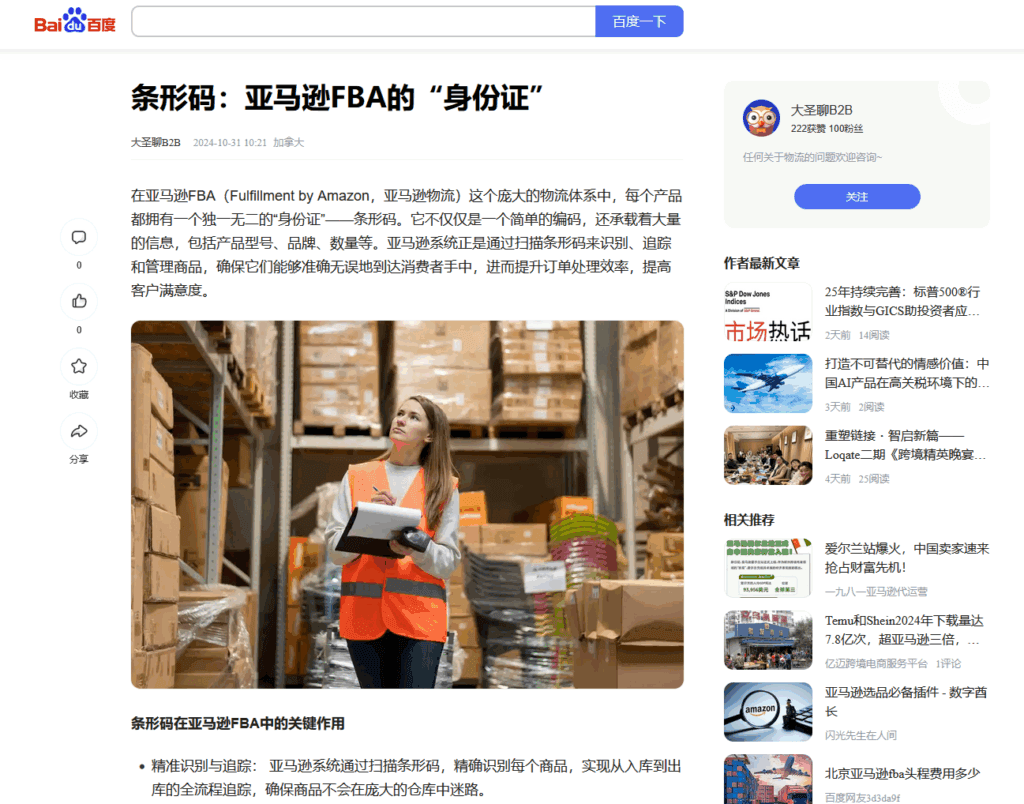
Together with other SEO measures, this resulted in high organic ranking of the term “条形码亚马逊” (Barcode Amazon) on Baidu on the first page for our client Bar Codes Talk.
Brands can publish how-to guides and tutorials, industry thought pieces, analyses of market trends in their niche, product reviews, case studies and testimonials, reports and surveys, FAQs, tips and hacks, and so on.
Keep in mind to use Chinese keywords naturally and to include links to your website or WeChat official account.
As you are well aware, WeChat is THE super app in China, and a presence on it is basically a must for any brand that seriously wants to enter the Chinese market or expand in it. On our separate page, we have compiled everything you must know about WeChat Advertising and have answers to all your burning questions.
With more than 1.3 billion monthly active users (MAU), WeChat is a fantastic place to publish brand content of all sorts.
Some might not call this ‘parasite SEO’ at all, as WeChat is often THE focal point of a long-form content marketing campaign in China AND it has its own search function rather than relying on search traffic from Baidu. But, it fits right in with the way we syndicate Chinese articles so we included it in this article.
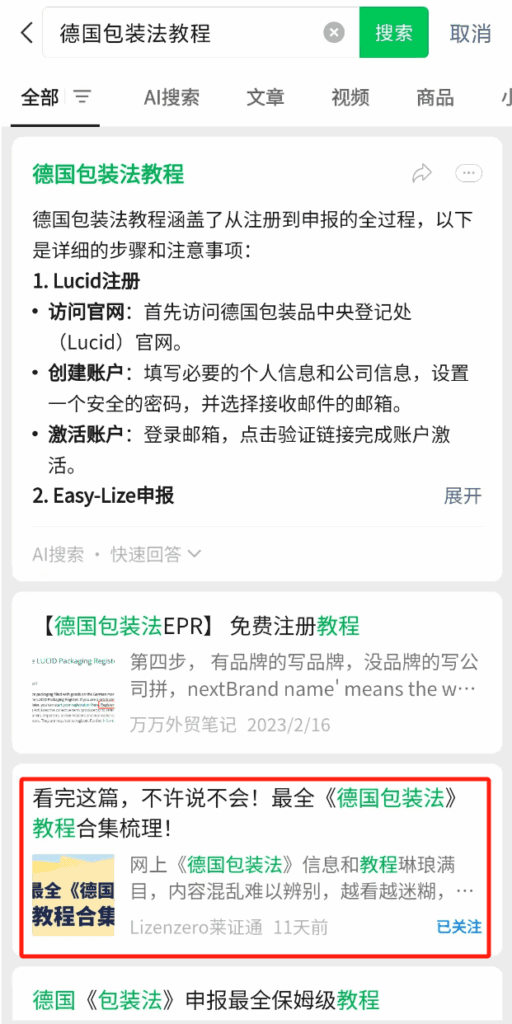
In this example for our client Lizenzero, we optimized WeChat articles for the keyword “德国包装法教程” (German Packaging Law tutorial) by adding it prominently into the title and description. This is a great example of how this marketing measure of keyword enrichment is both content marketing and parasite SEO at the same time.
Since WeChat has its own search function, SEO and search algorithm, this measure directly and positively impacted the visibility of our client.
Great (parasite) SEO content for WeChat includes long-form articles like industry insights, case studies and how-to guides as well as expert interviews. Keep in mind to optimize for keywords and link to other WeChat articles and mini-programs to increase relevance and visibility.
You can also cross-promote these articles across WeChat Moments, groups, and forums. Enhance engagement by adding videos, infographics, and carousel images to your posts. To drive conversions you can use interactive elements like quizzes, polls, and so on.
Bilibili
Often compared to YouTube, Bilibili is China’s leading video-sharing platform with 336 million MAU. The app with a focus on anime, gaming, and pop culture has a whooping MOZ domain authority of 91, but also a spam score of 9%.
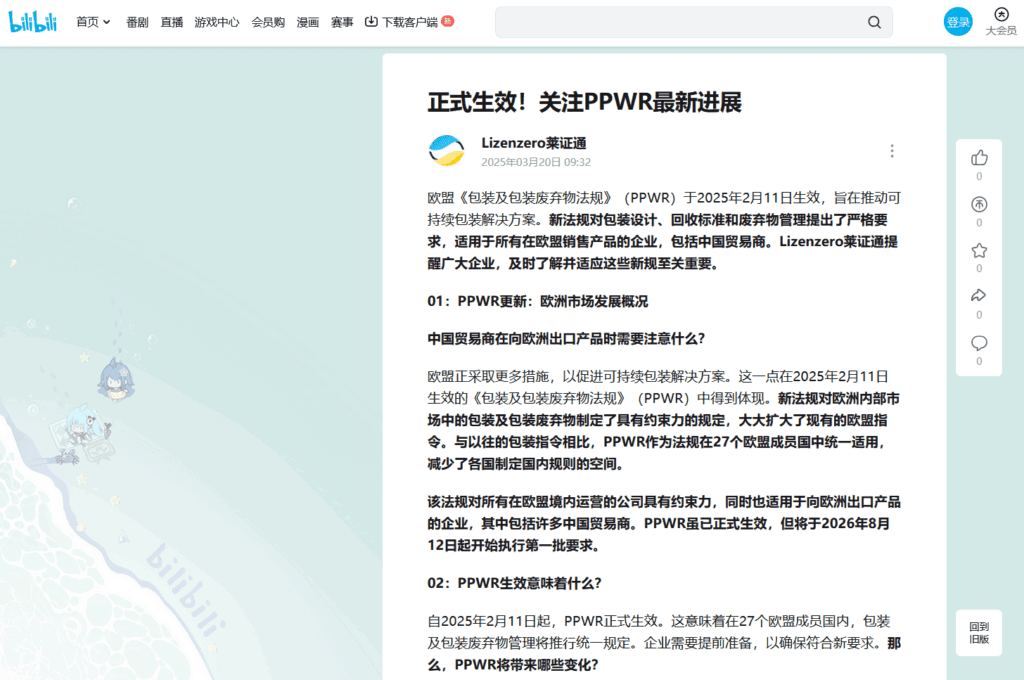
This is an article from our client Lizenzero, which we shared to Bilibili, which is normally a video platform. The article is about the EU Packaging and Packaging Waste Regulation.
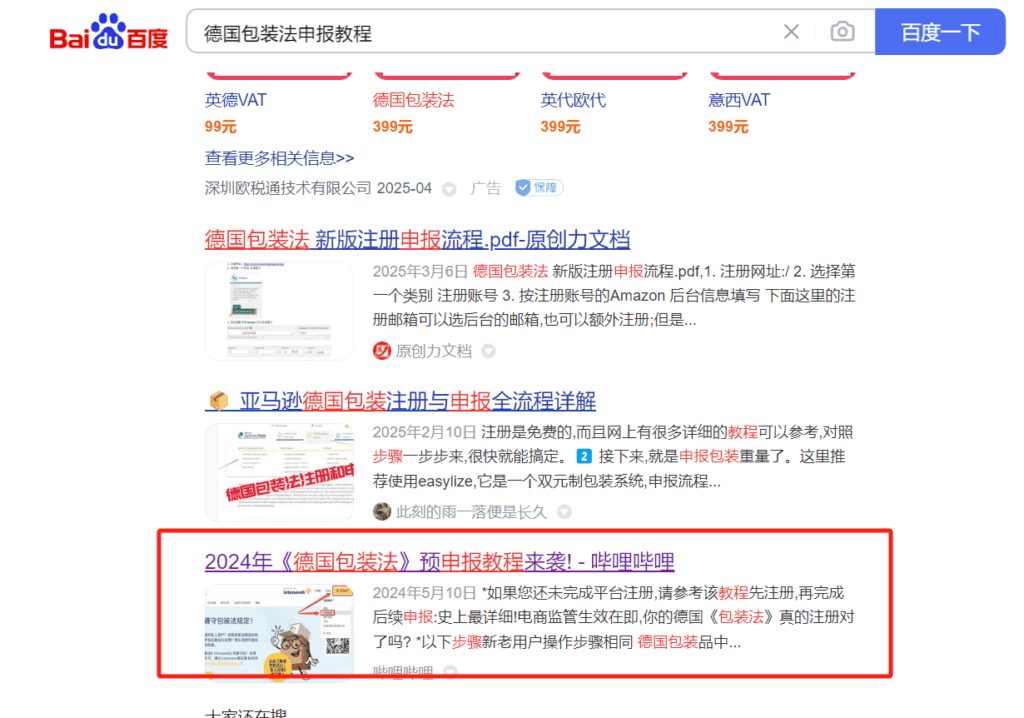
As a result – together with other measures – the term “德国包装法申报教程” (German Packaging Law Declaration Tutorial) ranked high organically – on the first results pages.
For videos to perform well and contribute to parasite SEO, brands can focus on product reviews, tutorials, and trend analysis.
Our tip: Boost visibility by including Chinese keywords in video descriptions and adding Chinese subtitles. Cross-promote Bilibli videos on WeChat, Zhihu, and other platforms.
Rednote
Xiaohongshu or Rednote is a popular lifestyle and e-commerce platform in China with 312 million MAU. It has a high MOZ domain authority of 72% with a spam score of 5%.
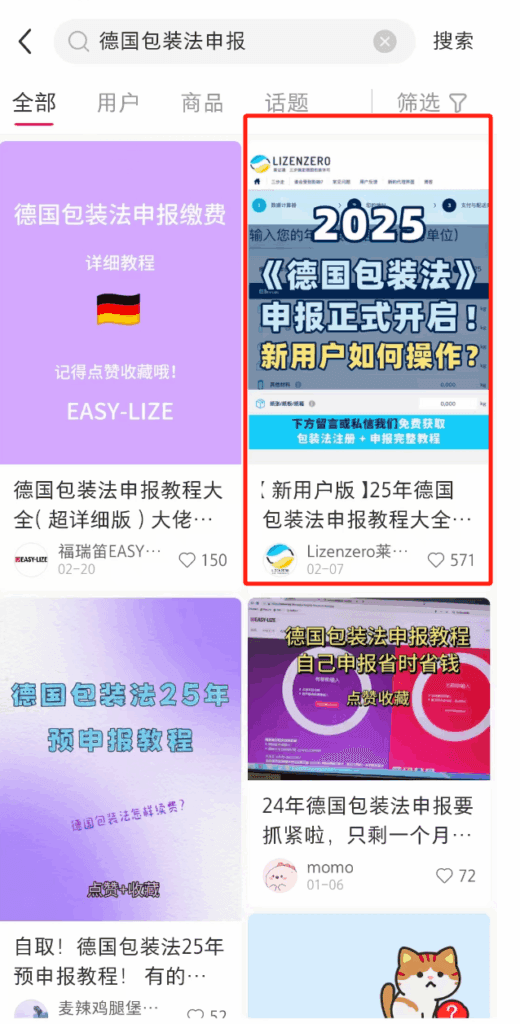
This example is new content for our client Lizenzero. For the 25th anniversary of the German Packing Law, we created a full tutorial for businesses exporting to Germany. Plus, we also promoted this post.
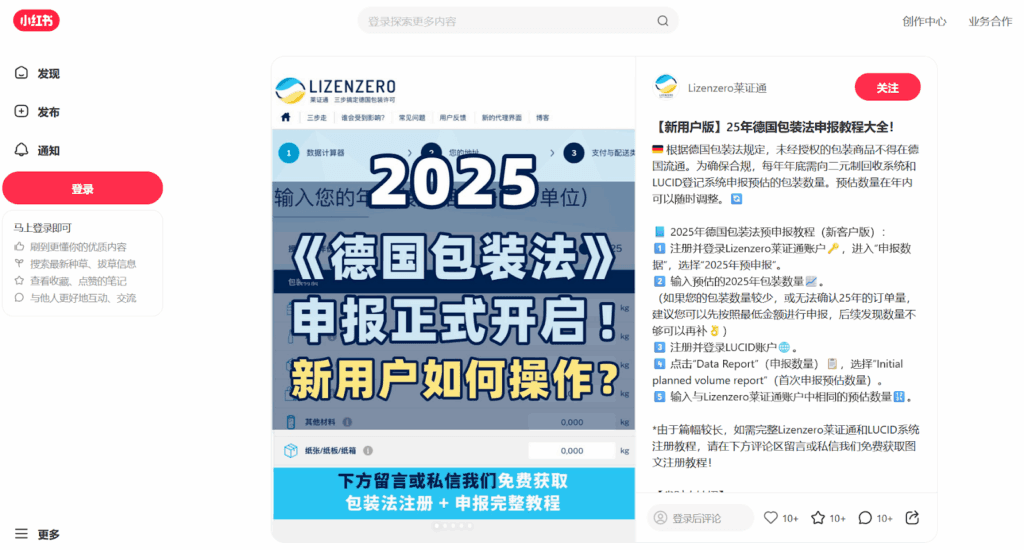
Together with other measures, this resulted in a high ranking of “德国包装法申报” (Packaging Act Declaration in Germany) on Rednote’s search function. We inserted the keyword into the article little and the image.
For parasite SEO, unboxing videos, influencer recommendations, and personal or personalized experiences do well.
Remember to add Chinese keywords in posts and post high-quality videos and images. Finally, cross promotion on Zhihu, WeChat, and Douyin contributes to higher rankings.
AI Optimization
After publishing content to a variety of platforms, it’s very likely to be picked up by AIs.
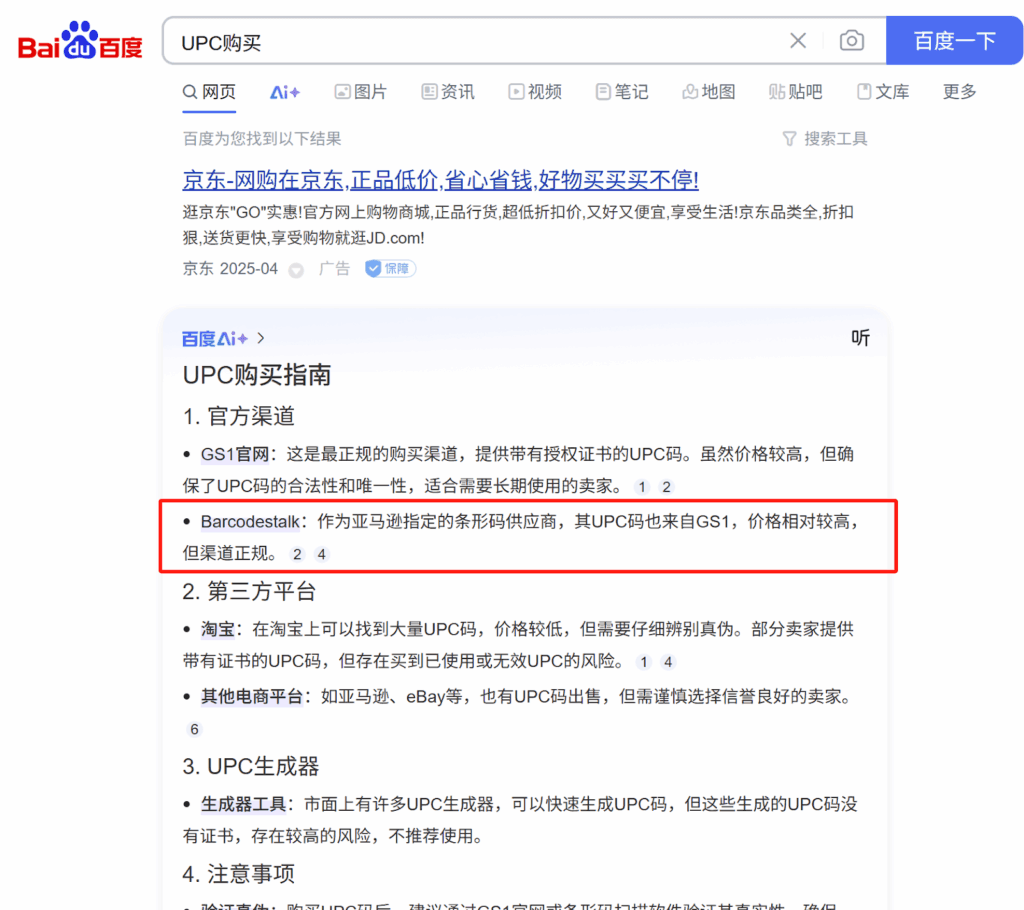
See this search for “purchase UPC”, a valuable transactional keyword. The company we are promoting shows up highly in this AI snippet.
5 Tips to Maximize Parasite SEO Effectiveness
To maximize the effectiveness of parasite SEO in China, we have these five tips for you:
#1 – Optimize your content for Chinese search intent by using simplified Chinese, providing informative, and engaging content, as well as focusing on storytelling rather than direct sales. The key thing is that the content satisfies the search intent of real live humans.
#2 – That being said, there are optimizations to be done for the algorithms too. When writing titles, it’s essential to have the keyword within the title. It’s also advisable to have the keyword at the front of the title, but since this content is also used to attract people browsing rather than searching, we don’t always choose to optimize fully for search. It’s also good to use the keyword again in the content, as well as related topics and pieces of the keyword. This often comes up naturally during the writing process.
#3 – Leverage high-authority websites – you can check on free tools like MOZ (internationally) or on Baidu Webmaster Tools (in China). Make sure that the sites you publish content on or engage as a brand are approved by the Chinese government and have a good reputation in China.
#4 – Link to your Chinese website and WeChat Official Account, wherever possible, in order to improve search engine rankings and credibility. Monitor your placed content, comments, and so on for engagement and further discussion. We monitor rankings on Baidu with DragonMetrics, a suite of Chinese/global SEO tools. Within it, there’s a feature to monitor the rankings of not only your website, but also other URLs on which you’ve published content.
#5 – Finally, stay up-to-date and follow the Baidu SEO guidelines: avoid keyword stuffing, excessive backlinks, low-quality content, and so on. Here’s the latest official information on the principles of Baidu search from 2023.
The Takeaway
Parasite SEO is an efficient way to improve rankings on Baidu, increase trust and credibility, and boost brand awareness. By posting content and engaging on high-authority Chinese platforms like Zhihu, Baidu Baijiahao, WeChat, Bilibili, Douyin, and Rednote, brands can leverage positive effects.
On the flipside, results are short-term and ongoing investment needs to be made to maintain positive effects. That’s why we recommend using parasite SEO not exclusively but always as part of an integrated China marketing strategy.
When we leverage parasite SEO for our clients, we usually take one piece of content (article, video, etc.) and break it down into smaller pieces of content. This new content we publish across high-authority platforms that contribute to Baidu ranking like Baidu Baijiahao, Zhihu, Bilibili, and Douyin (while Baijiahao and Bilibili are most effective). We make sure to add relevant keywords – adding a website URL or link is usually not allowed (except for Zhihu and WeChat – with limitations).
Are you curious to learn more? Chat with our experts about your brand and how to enter the Chinese market. This first consultation is 100% free.