

In March 2026, concerns around AI models being “poisoned”—with companies feeding low-quality or misleading content into AI systems to manipulate outputs—brought attention to a growing issue in the generative engine optimization (GEO) market.
As AI systems increasingly shape how information is discovered, the question is no longer just about ranking, but about whether your brand is included at all.
Key Takeaways:
- China GEO is shifting brand visibility from search engine rankings to AI-generated recommendations.
- Platforms such as Doubao, DeepSeek, and Wenxin Yiyan are becoming major gateways for information discovery in China.
- GEO success depends not only on content quality, but also on whether AI systems can access, structure, and reference that content.
- AI visibility in China can now be monitored through GEO SaaS platforms using metrics such as mention rate, top-position mention rate, and competitor comparison.
- Publishing on AI-preferred content platforms such as Zhihu, Bilibili, and Baidu Wenku has become increasingly important for China GEO.
- As AI systems improve content filtering, low-quality mass-generated AI content is becoming increasingly risky.
- China GEO is emerging as a long-term AI visibility and content marketing strategy, rather than a short-term SEO tactic.
How Search Behavior Has Changed in China
Before understanding GEO in China, it is essential to examine how search behavior has evolved.
Before 2016: People Searching for Information
Before 2016, search was simple: Users would go to platforms such as Baidu or 360 and enter keywords to find what they needed.
During this period, SEO and search advertising were highly effective tools for driving conversions, and search engines matched those keywords with webpages and displayed results.
Brands competed for visibility through two main methods: 1) SEO focused on improving rankings in organic results, while 2) paid search relied on bidding strategies to appear at the top of ad placements.
At its core, the logic was straightforward: Users searched, and brands tried to capture that demand.
2016–2024: The Rise of Content Platforms
With the growth of platforms such as WeChat, Weibo, Rednote, Bilibili, and Douyin, user search behavior was no longer limited to traditional search engines. The years after 2016 saw a significant amount of information discovery shifting to these platforms.
At the same time, each platform continued to strengthen its own content positioning, building more specialized ecosystems to attract users and retain attention. As a result, different platforms developed distinct use cases and ways for users to find information:
- Weibo is often used for real-time news, trending topics, and entertainment content.
- Rednote is commonly used for product research and recommendations before making purchase decisions.
- Bilibili is known for in-depth video content, educational videos, and long-form explanations.
- Douyin delivers information quickly through short videos and algorithm-driven distribution.
- WeChat serves as a platform for in-depth, trustworthy content, where users rely on official accounts, communities, and social connections to access more professional and credible information.
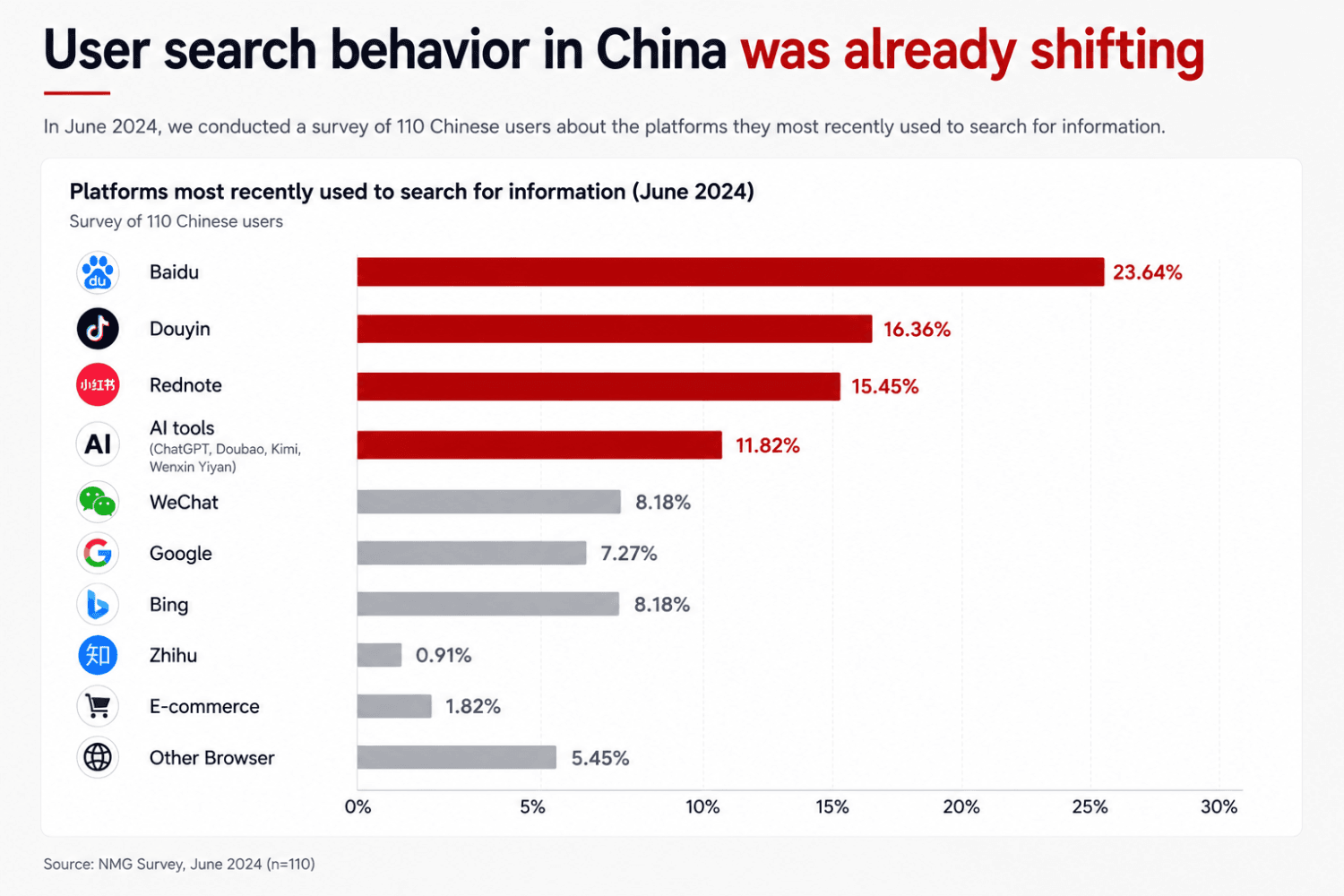
This shift was already visible in user behavior data. In June 2024, we conducted a survey of 110 Chinese users about the platforms they most recently used to search for information.
While Baidu remained the largest single platform at 23.6%, platforms such as Douyin (16.4%), Rednote (15.5%), and AI tools including ChatGPT, Doubao, Kimi, and Wenxin Yiyan (11.8%) had already become important sources of information discovery.
The results suggest that user search behavior in China was already shifting away from traditional search engines and toward platform-based and AI-driven information discovery.
2025 and Beyond: AI Search in China
Today, we are entering a new phase of AI search in China where people are increasingly relying on AI tools for everyday tasks.
According to the QuestMobile Q3 2025 AI Application Industry Report and the CNNIC Report on Generative AI Development (2025), AI adoption in China has already reached a significant scale.
On mobile, the total user base is approximately 729 million:
- Native app users – 287 million
- Plugin-based users – 706 million
On PC, the market includes around 200 million users:
- Web-based users – 192 million
- Client users – 13 million
As adoption continues to grow, search behavior is increasingly shifting toward AI-driven interactions.
Users no longer search in the traditional sense; instead, they ask questions, and AI systems retrieve, summarize, and deliver answers directly.
This is the foundation of China’s AI search.
What Is GEO in China?
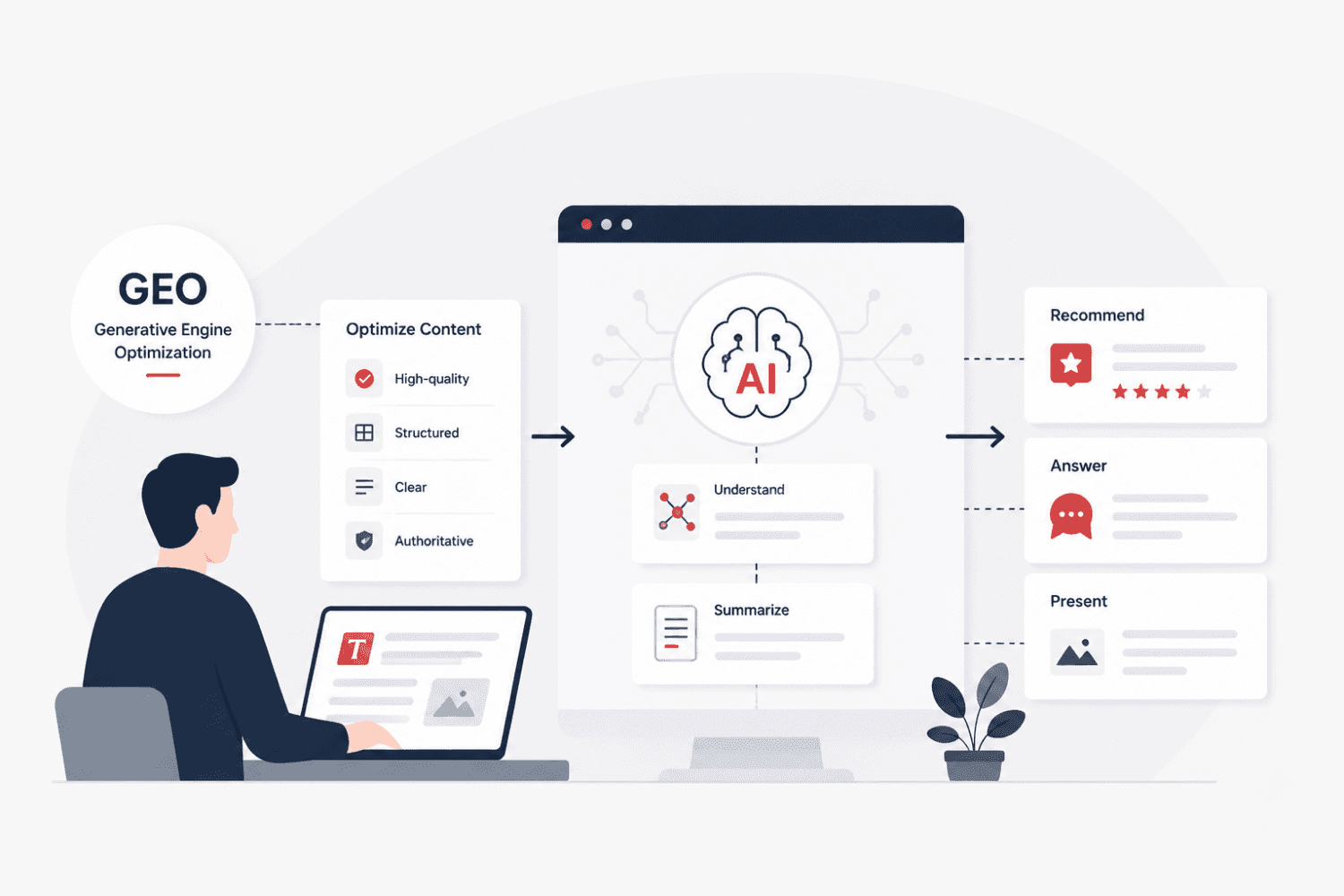
Generative engine optimization (GEO) refers to optimizing content so that it can be understood, structured, and recommended by AI systems. In China, this means aligning content with how Chinese AI platforms retrieve and present information.
This approach moves beyond traditional search engines. Users are no longer completing their journey via search results pages; now, they are getting answers directly from AI tools.
While this may seem similar to the idea that “content is king,” the logic is different. SEO is about ranking higher in search results, whereas GEO is about being included in AI-generated answers.
More importantly, GEO is not just about keywords. It is about understanding how users ask questions and which queries are more likely to trigger AI to include your brand in its answers.
For example, instead of focusing only on broad keywords such as “Industrial OEM supplier,” it is more important to understand how users describe specific needs in AI conversations.
Users are more likely to ask questions like “Can you recommend a PCB manufacturer in Shenzhen with ISO13485 certification for medical devices?” or “Which Chinese suppliers are suitable for low-volume industrial control PCB production?”
Compared to traditional keyword searches, AI systems are more likely to generate direct recommendations for queries that include specific requirements, industry context, and detailed conditions.
This means your content should not only target keywords, but also be structured around real user questions and practical use cases.
Why China GEO Matters
The importance of China GEO becomes clear with a simple example.
When searching on ERNIE Bot (Wenxin Yiyan) for “Can you recommend several cost-effective scribing marking machines?”
The AI recommended five relevant companies and summarized their key features in a comparative format. Our client, Couth, appears as the first recommended result (see image below).
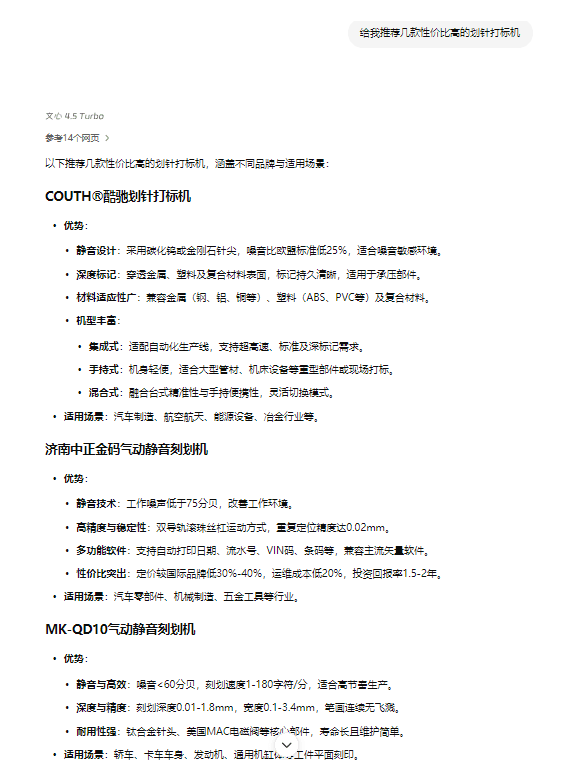
This was not accidental. It was achieved through continuous China GEO optimization, including publishing industry-related content aligned with user search intent.
Unlike traditional search engines, AI systems typically do not return long lists of webpages. Instead, they directly recommend a small number of companies, often with comparisons and explanations.
Most users rely on these answers and rarely continue searching further.
This creates a new reality: If your brand does not appear in AI-generated recommendations, it effectively does not exist at that critical decision-making moment.
Which AI Platforms do Chinese Users Use?
To approach China GEO effectively, the first step is understanding platform differences.
In overseas markets, users rely on platforms such as ChatGPT and Gemini. In China, the ecosystem is different. Platforms such as Doubao, Baidu (Wenxin), and DeepSeek play a central role in AI search in China.
The following chart illustrates the most frequently used AI apps in China, providing insight into where users turn when searching for information or conducting research.
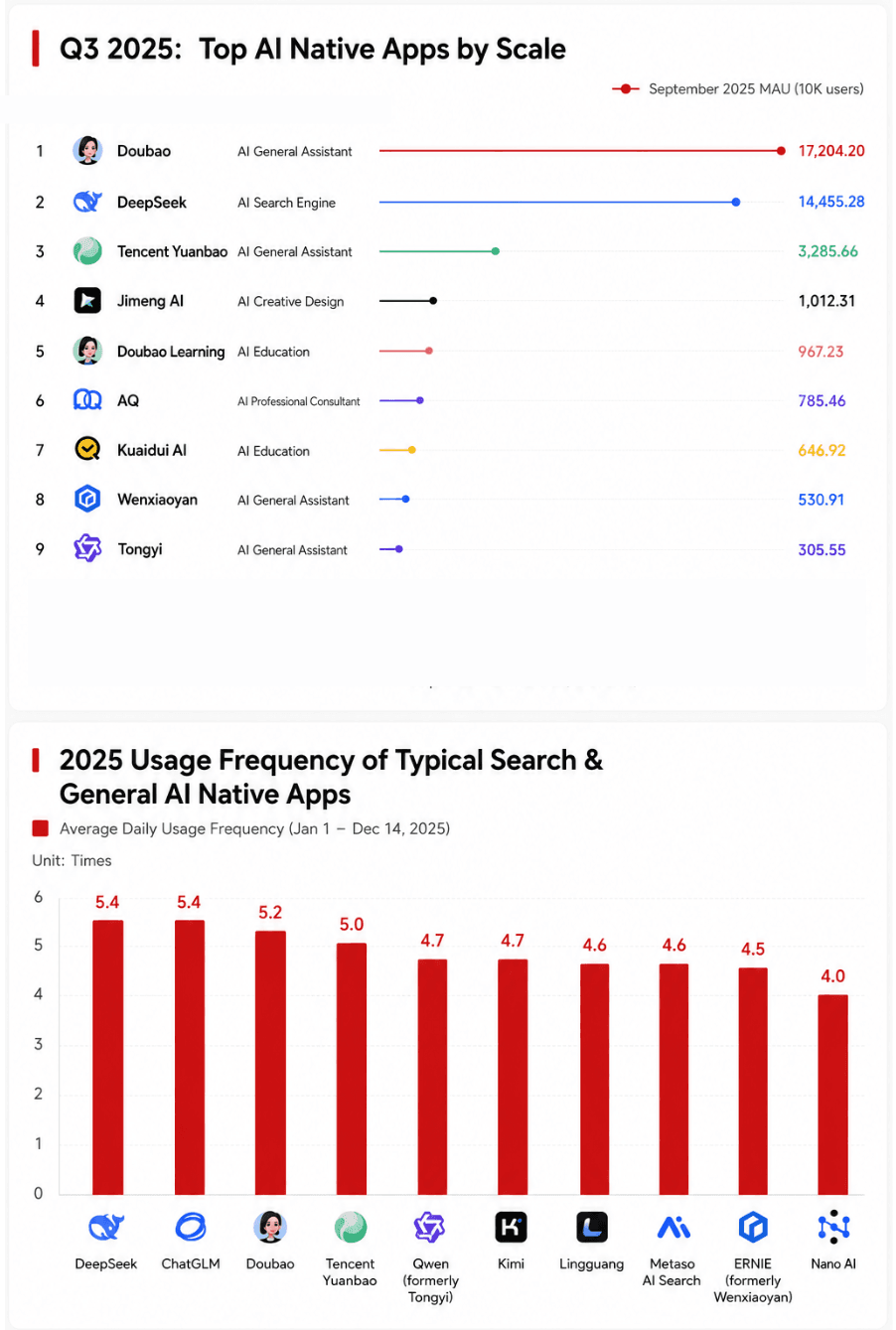
This means your strategy must be localized.
In practice, it is useful to think of two types of platforms.
The first type is AI tools that users interact with directly, such as Doubao and DeepSeek. These platforms serve as entry points where users ask questions and receive answers, determining whether your brand is recommended.
The second type is content platforms that AI systems rely on as data sources, such as Zhihu, Bilibili, and Baidu Wenku. These platforms provide the information that AI systems extract, process, and reference.
In simple terms, if you want AI to mention you, your data needs to be on the source platforms and be chosen for display by the AI tool your potential customer is using.
At a practical level, China GEO is about aligning with what AI systems prefer.
Create AI-Friendly Content – The key to GEO is content that aligns with the way AI platforms process information. Formats such as FAQs, step-by-step guides, and comparison-based content tend to perform well, as they are easier for AI systems to extract, structure, and summarize.
Publish on Platforms AI Prefers – Unlike SEO, where users find your content through keywords, GEO focuses on making your content discoverable and recommendable by AI systems. This requires publishing on platforms commonly referenced by Chinese AI tools, such as Zhihu, Bilibili, and Baidu Wenku.
Below is a simplified overview of the types of content different AI platforms in China are more likely to prioritize and reference (based on research and platform analysis by Wemob).
| Platform | Information Sources | Feeding Strategy |
| Doubao | Content from Douyin, Toutiao, Today’s Headlines, and related encyclopedic entries. | Focus on recommendation and brand-related content to deliver tailored solutions that address user consumption needs. |
| DeepSeek | Official websites, reputable media, industry portals, white papers, and in-depth research reports. | Prioritize technical evaluations and benchmarking data to match users with professional insights on technology products. |
| Tencent Yuanbao | WeChat Official Accounts, Tencent News, QQ, and other Tencent content platforms. | Highlight brand and knowledge content to provide practical and easy-to-understand information that meets everyday user needs. |
| Kimi | Authoritative media, user manuals, developer documentation, industry reports, and white papers. | Emphasize rankings and comparisons to deliver efficient decision-making tools for professional users. |
| Wenxiaoyan | Baidu Encyclopedia, Baijiahao, Baidu Zhidao, Baidu Tieba, and other Baidu ecosystem content. | Focus on recommendations and how-to guidance to match users with optimized experience and usage suggestions. |
| Tongyi Qianwen | Authoritative reports, procurement guides, solutions, and third-party review data. | Combine user intents with application scenarios to deliver actionable recommendations that drive efficiency and productivity. |
The Risk of Low-Quality AI Content
The AI content “poisoning” in early 2026 shows how some companies used AI tools to mass-produce large volumes of low-quality or even misleading content to influence AI-generated results. This essentially feeds unreliable data into AI systems, leading to distorted recommendations and reduced trust.
As AI platforms continue to improve, their ability to detect and filter this type of content is also increasing. As a result, relying on mass-generated AI content is becoming less effective and more risky, potentially leading to wasted investment and damaged brand credibility.
While AI can improve efficiency, a more sustainable approach is to combine AI with human input.
In the wake of growing concerns about the quality of AI content, GEO regulation is expected to become stricter in China.
Well-crafted content that’s been augmented by AI (rather than completely created by it), and then checked by a real person, can avoid issues like false or duplicate content. This allows brands to optimize based on real industry experience and user needs, making content more aligned with how AI systems evaluate and recommend information.
When combined with reliable SaaS tools for content management and data tracking, this approach can significantly improve efficiency and the overall results.
How to Measure China GEO Results
China GEO performance can generally be measured through two core metrics: Visibility/mention and conversion rates.
Currently, the most widely recognized China GEO metric in the industry is visibility/mention rate. This typically refers to the percentage of AI-generated answers in which a brand is mentioned when responding to a specific query or a predefined prompt library on selected AI platforms.
If an AI platform is prompted 100 times with a certain query and the brand appears in 60 of those responses, the visibility/mention rate for that query would be 60%.
For new brands, this metric is especially important because it directly affects exposure opportunities within China’s AI search ecosystem.
For example, we provided GEO optimization for the University of Exeter’s metamaterials program. Before optimization, when searching Baidu for keywords such as “metamaterials study abroad” (超材料专业留学), the University of Exeter did not appear in the results.
After manually creating content and publishing it on platforms commonly referenced by AI systems, we gradually observed that when searching “metamaterials study abroad” in Wenxin Yiyan, the University of Exeter consistently appeared in the generated answers along with cited content sources.
In practice, the visibility rate reached over 90%.
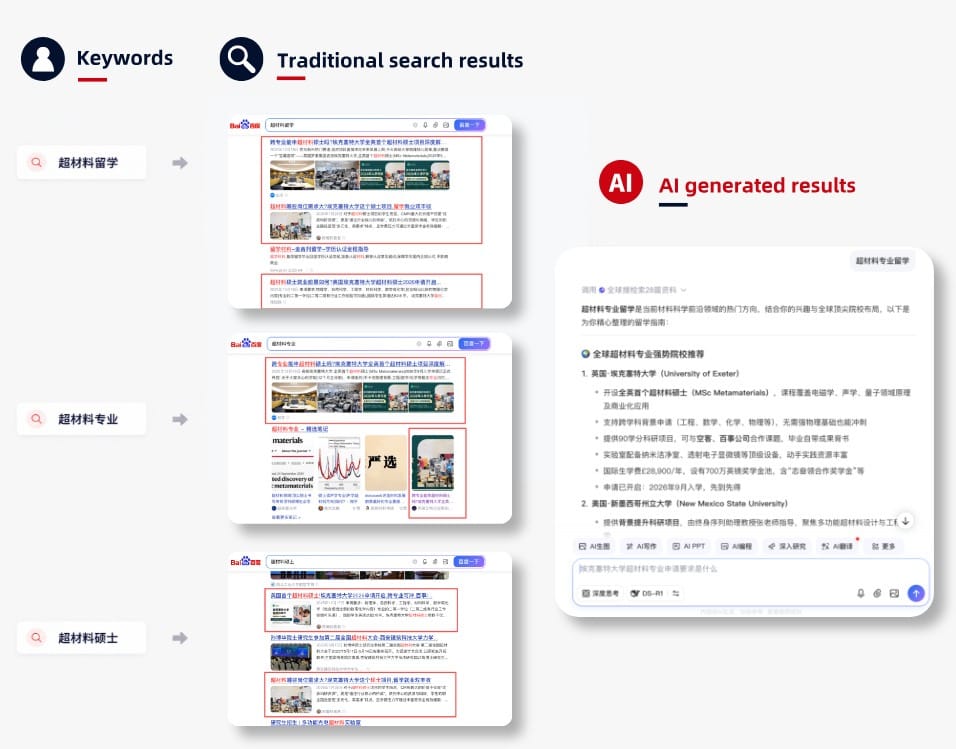
This figure compares traditional search results on Baidu (left) with AI-generated recommendations (right) for different keywords related to “metamaterials study abroad.” It highlights how AI systems consolidate multiple sources and present structured answers, in contrast to traditional search listings.
Click here to view the detailed example.
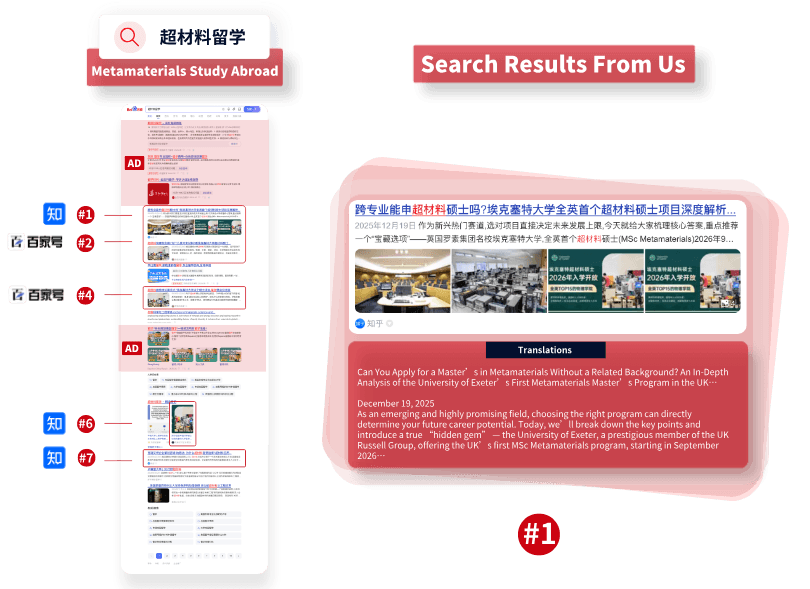
However, manually checking AI results through searches, screenshots, and comparison tracking is only one part of GEO measurement. While this method is useful for reviewing recommendation quality and observing long-term changes, it is difficult to scale efficiently.
As GEO continues to develop in China, more SaaS-based monitoring platforms have emerged. These tools automatically send predefined prompts across multiple AI platforms, such as DeepSeek, Doubao, Kimi, Tongyi Qianwen, and Wenxin Yiyan, then track how often a brand appears in AI-generated answers.
Some platforms can also monitor the following:
- Top-position mention rate
- Competitor comparisons
- Visibility trends over time
- Performance differences across AI platforms
The image below shows an example of GEO monitoring results for the Yili milk brand using the DXGEO GEO monitoring platform.
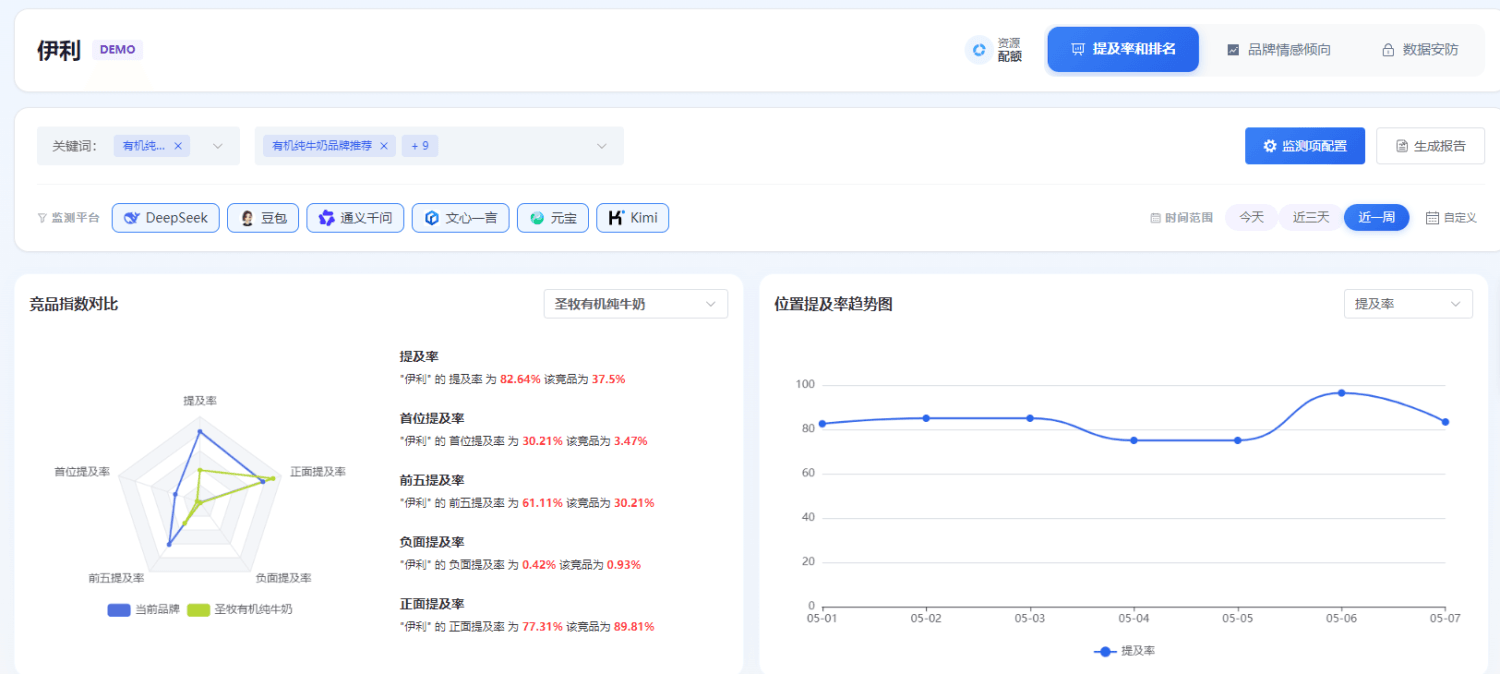
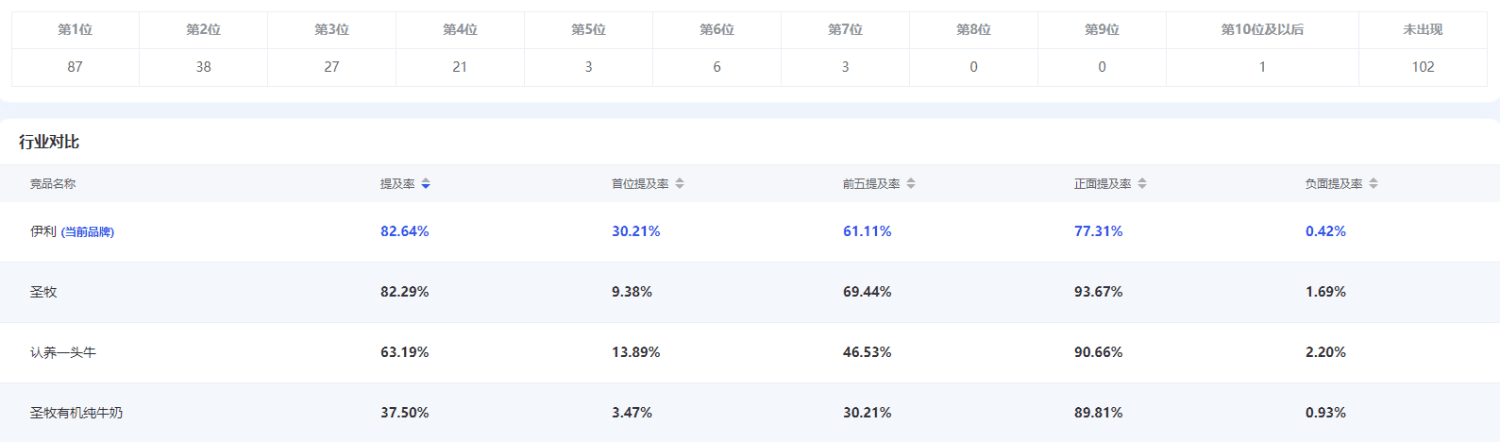
This monitoring logic is conceptually similar to traditional SEO keyword ranking tracking, except the focus shifts from search engine rankings to visibility and recommendations within AI-generated answers (see images above).
At the same time, some SEO platforms are also beginning to integrate AI-related tracking features. For example, Dragon Metrics has started supporting AI visibility monitoring for platforms such as ChatGPT and Google AI Overviews.
For established brands, GEO measurement is not only about whether the brand appears, but also
- whether the AI-generated content is accurate and up to date,
- whether the messaging aligns with strategic priorities, and
- how the brand ranks relative to competitors in AI recommendations.
Of course, beyond visibility, the ultimate goal of GEO is conversion.
By optimizing content and increasing the frequency of recommendations from AI systems, brands can generate more real customer conversions through AI-driven exposure. In other words, GEO is not just about being seen, but about turning visibility into measurable business results.
Although direct attribution remains difficult because not all AI answers include the official website and URLs (they only mention the brand name), long-term changes in organic conversions can still reveal a clear GEO impact over time.
China GEO should therefore be seen as a long-term strategy. AI-generated results constantly evolve due to competition, platform updates, and changes in how AI systems process information.
Consistent publishing and long-term visibility help strengthen brand trust and increase the likelihood of being referenced by AI systems in the future.
Final Thoughts
China GEO is not simply an extension of SEO—It represents a shift in how visibility is achieved in the age of AI.
As AI becomes the primary gateway for information, brands need to adapt their content strategies accordingly. Those who succeed will gain visibility, credibility, and stronger conversion opportunities in an increasingly competitive environment.
If you are looking to improve your presence in AI search in China, now is the time to act.
Want to try China GEO marketing? Contact us to get a customized strategy.