
“China is the world’s factory.” ~ General belief
This statement holds true today more than ever, as China’s production capacity far exceeds the USA, Japan, and Germany.
With approximately two-thirds of “made in China” products exported, extensive logistics infrastructure and expertise are necessary, and this task is often outsourced to specialized logistics companies.
Now, global logistics companies may wonder how to participate in this business and reach Chinese clients – businesses that export their products, like Chinese Amazon sellers, e-commerce brands, and small to midsize enterprises (SMEs).
So, are there specific marketing strategies and expert tips for logistics providers that differ from other niches? You guessed it. There are several unique factors to consider when marketing logistics services in China.
Congrats, you have come to the right place.
Who are we? As an agency, we have almost 20 years of experience in China marketing for foreign brands in various niches. For this article, we’ve summarized the collective knowledge of our team on the best marketing strategies for logistics brands that want to win Chinese sellers.
The Chinese Manufacturing Market
Despite challenges such as the lingering effects of COVID-19 and changes in global import and export policies, China’s manufacturing sector continues to grow and recently surpassed 4.6 trillion USD in 2024.
Cross-border e-commerce (CBEC) continues to grow, driven by Chinese sellers who offer their products on large international platforms like Amazon, AliExpress, and eBay. After an online shopper clicks on the “buy” button, the fulfillment machinery starts.
Here’s an example: Frank lives in Florida. He orders golf clubs on AliExpress. After payment, the factory starts production and ships the product by air or sea (remember that exporting from China and importing to the US requires lots of paperwork). Finally, the golf clubs are delivered. Frank is happy and takes his new “toys” to the golf course.
At the same time, more and more independent Chinese e-commerce businesses (SMEs and larger companies) are discovering foreign markets for their products, and these sellers are seeking solutions for the global fulfillment process, including logistics with specialized companies.
Challenges for Chinese Exporters
Chinese manufacturers want to work with fulfillment providers that can solve their problems. Why would they want to work with international logistics companies rather than Chinese logistics experts? Well, simple. Global companies often have larger networks worldwide, more extensive partnerships, and better compliance and customs handling.
Expected Solutions
Therefore, global logistics providers are expected to solve a variety of challenges for their Chinese clients:
- Specialized knowledge in international trade regulations (from taxation to customs clearance).
- Efficient shipping solutions that minimize delays and costs.
- Communication in Chinese and cultural understanding of business practices.
- Customer support 24/7 and real-time tracking across time zones in a fast-paced environment.
- Established connections with local warehouses and customs authorities to ensure smooth operations and quick problem resolution.
- Providing flexible and scalable solutions depending on the fluctuating exporters’ needs.
- Innovative and technology-driven solutions, leveraging AI, for order tracking, documentation, and more.
All this ensures smooth processes, contributes to customer satisfaction, and minimizes additional costs.
Regulations: Are Logistics Companies Allowed to Advertise Themselves in China?
Before we get onto the marketing advice, we’d better answer some of the top questions that international logistics companies ask us, which are more about the legal side of things.
Are you even allowed to promote your business in China?
The short answer is yes, but you must follow specific regulations as China has strict regulations for digital marketing, advertising, and the internet in general. Foreign companies may face limitations on certain platforms.
To set up social or advertising accounts, you must go through an approval process. Luckily, for logistics, this usually goes very smoothly. In general, you should expect no barriers to getting started with either content marketing or advertising.
The only exception to this is if your company is advertising logistics services for specific industries, which are subject to limitations. For example, a page about shipping medical equipment might be flagged as “medical industry,” and we might need to avoid using that page in Chinese or targeting ads specifically for that niche.
What kind of paperwork do we need to operate in China?
If you plan to serve Chinese clients from abroad, a Chinese business entity is not mandatory, but you’ll need to provide some paperwork to set up an advertising account or verify your social media accounts.
This paperwork varies by platform but usually includes
- A certificate of incorporation from your home country (you don’t need to translate it), and
- A bank flow statement (or a screenshot of your bank account). The goal is to show you have a bank account that matches the business in the certificate of incorporation.
Now, let’s continue with the core topic of this article: marketing strategies for foreign logistics providers entering the Chinese market.
Marketing to Chinese Manufacturers: What Doesn’t Work!
Before we take a deep dive into what actually works and how a China marketing strategy for a logistics company differs from other niches, let’s look at what definitely does not work:
- Running ads on Google and Facebook (they’re blocked in China. Still, they can be useful in reaching clients using a VPN or outside of mainland China).
- Providing slow or unresponsive customer support.
- Having no information in Chinese.
- Ignoring WeChat and Baidu.
- Creating branding for the Chinese market that is unrecognizably different from the global branding.
- Assuming that Chinese manufacturers will proactively reach out.
Funny, when you look at it this way, isn’t it? So, what does work?
Logistics Brands: Do This Instead to Reach Chinese Manufacturers
Unlike consumer-focused industries such as tourism and education (B2C), China’s logistics sector is predominantly B2B, requiring a highly specialized marketing approach. Here’s what you can do specifically as a logistics brand to win the hearts (and business contracts) of Chinese clients.
Success in the Chinese logistics industry isn’t just about increasing brand awareness – it’s about building trust and reliability, and fostering long-term business relationships. We recommend using case studies, industry certifications, and testimonials to establish your brand in this niche. Chinese business partnerships and relationships are founded on mutual trust and support rather than hard facts and figures.
You also need to provide useful information for the audience and prospective clients. Do so predominantly on WeChat—the all-in-one Chinese super-app. If your brand is somewhat bigger, it makes sense to transcreate and localize your international website for the market beyond just adding a “Chinese button” on your existing website. This has the additional benefit of giving you space to provide real value for your potential clients and enrich that content with keywords to show up on search engines like Baidu.
Besides, Chinese manufacturers and logistics buyers heavily rely on personal referrals and connections. Even as a global brand, you can participate in industry trade events, conferences, and forums (ideally in person), but virtual meetings are also an excellent starting point.
Given the complexity of global logistics, potential clients actively seek actionable insights from expert sources. Companies can leverage content marketing by publishing informative WeChat articles and blog articles as well as answering Zhihu posts that address common industry pain points, such as how to avoid customs delays or optimize shipping routes. Short explainer videos or expert interviews in Chinese can further establish thought leadership and improve engagement. You can read more about the power of videos in the section below.
Furthermore, logistics-related searches in China tend to be highly technical and problem-specific. Run ads on Baidu, WeChat, and/or Rednote with well-researched, localized long-tail keywords to gain higher visibility among decision-makers.
Due to long B2B sales cycles, logistics companies are advised to nurture leads over time with continuous engagement. WeChat can serve as a CRM tool, allowing brands to provide ongoing customer support, send updates on shipping regulations, and offer personalized service directly to potential clients.
Finally, cost predictability is crucial for Chinese manufacturers competing in global markets. Offering free online tools such as freight calculators, customs duty estimators, and route optimization planners can be a game-changer. These tools generate leads and position your company as a valuable resource, simplifying complex logistics challenges.
Here are a few other considerations based on our experience:
- Google ads can be used to reach Chinese-reading users abroad (sometimes).
- Even though there are still limitations, AI translations can be useful.
- WeChat Pay and Alipay can be useful to have for smaller transactions.
Now, let’s take a closer look at how videos can help elevate your brand.
The Power of Videos
Videos are powerful tools to engage audiences and are above-average growth drivers compared to other marketing tools. Short-form videos, typically under 90 seconds, have become vital in capturing consumer attention, generating more than twice the engagement of longer videos.
In the logistics sector, videos can
- simplify complex regulations with animated explainer videos,
- build trust and credibility through testimonial videos, and
- make ads stand out and increase engagement.
If you work with us, we can either take the whole video process off your hands—from concept to realization—or if you can create the videos on your own or with a partner agency, we are happy to provide our insights and briefing from a local perspective, so you know what will work in the Chinese market.
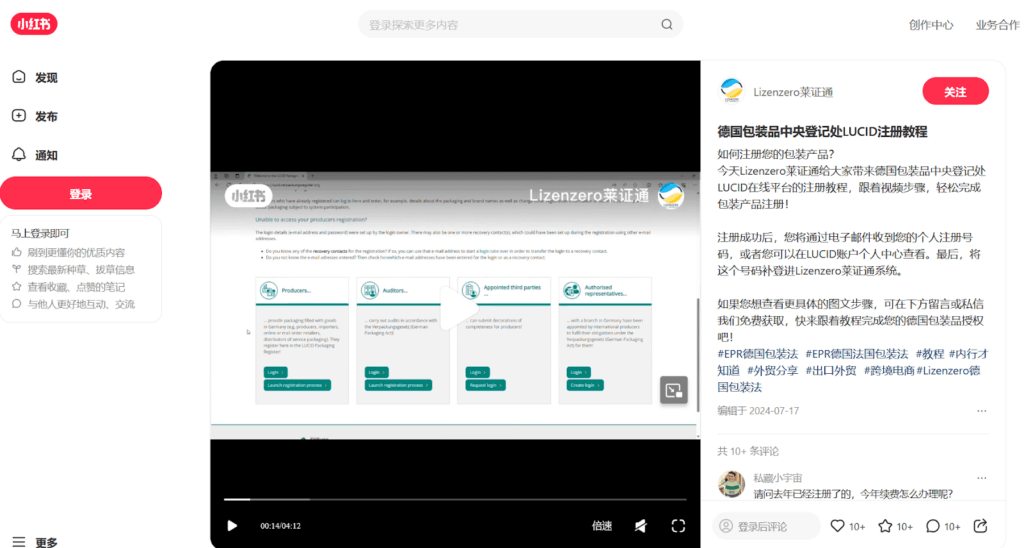
For the B2B cross-border e-commerce specialist, Lizenzero, we created an informative explainer video on Rednote that walked audiences through the complex German Packaging Central Registry (LUCID).
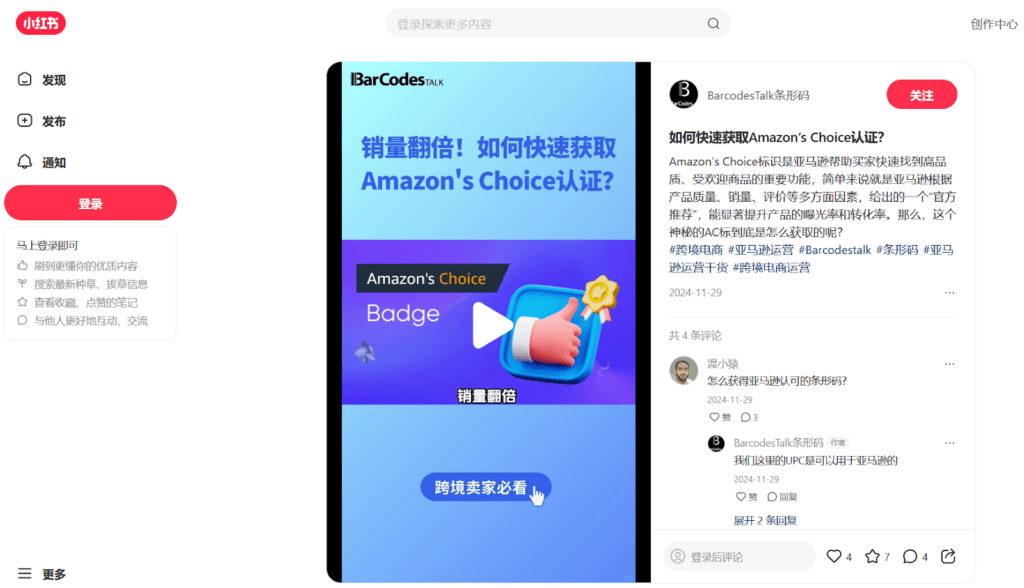
The following explainer video (again on Rednote) is for our client, the barcode and labeling specialist, BarCodesTalk, explaining how to get Amazon’s Choice certification.
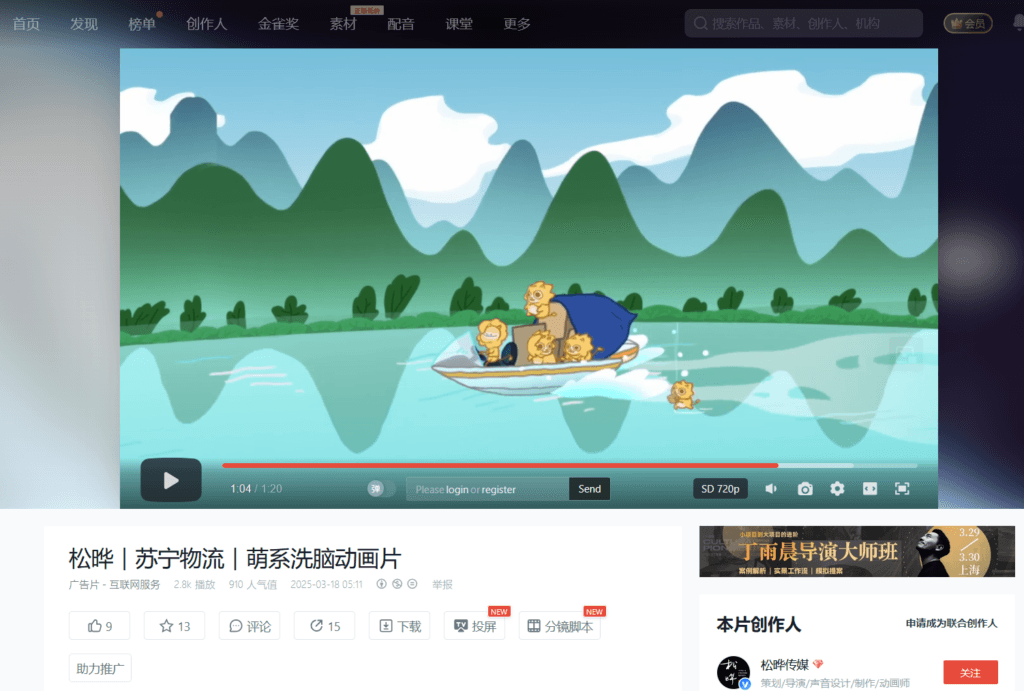
Chinese logistics company Suning produced this great animated explainer video and published it on Xinpianchang.
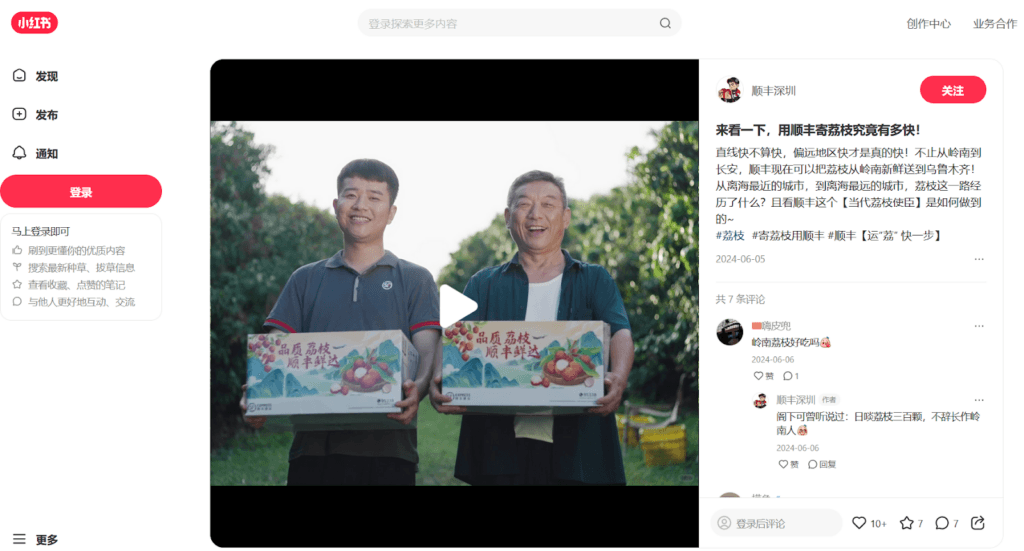
And it’s not just tutorials and explainer videos engaging audiences and driving growth, as we see in this Rednote video ad for delivery company 顺丰 (SF Express).
Next, we have a more detailed example of our work.
Case Study: Meest
Founded in 1989, Meest is a global postal logistics provider and leader in its niche. In 2014, Meest successfully expanded into the Chinese market, establishing a large receiving warehouse in Guangzhou, amongst other things.
Problem Description
However, a decade later, Meest felt like they were leaving potential behind and hired Nanjing Marketing Group to analyze the status quo of their Chinese online presence, identify specific actions for improvement, and implement these.
Meest’s goals for the Chinese market were to increase brand awareness, generate more leads, improve their industry reputation, and increase customer trust.
Our Investigation
In March 2024, we comprehensively reviewed Meest’s official Chinese social media accounts and online presence.
Because the logistics industry has an extremely high number of competitors in China and the battle for customers is so intense, we opted for a strong strategy to achieve relevant rankings on Baidu and gain more exposure on high-quality social media platforms.
Our Strategy
We developed a user-friendly visual report template to integrate data, streamline workflow, and enhance interpretability, helping Meest understand long-term marketing trends in the country:
- Website: We localized the content to cater to user preferences and optimized the site for Baidu (SEO).
- Social media and search: We took over the management of Meest’s Baidu, Rednote, and WeChat accounts, and allocated a higher budget to create and distribute content across these platforms. We also ran ads, using engaging images and videos.
As a result…
- The number of followers increased significantly: 3x on Rednote and 4x on WeChat.
- The reach of articles surpassed 10,000 reads per month.
- Lead generation increased by 100%, reaching more than 1,500 leads per month.
Within six months, Nanjing Marketing Group successfully generated more than 10,000 leads (an increase of 26%) and facilitated the signing of several key contracts.
Throughout the process, we never lost sight of who we wanted to reach with Meest’s message.
Meest Target Customers in China
- Cross-border e-commerce platform sellers: On platforms like Amazon, AliExpress, and eBay.
- Independent station sellers: E-commerce sellers with their brands and websites.
- Small and medium-sized enterprises: SMEs seeking cost-effective international logistics solutions.
- Personal cargo transportation: Delivering items for international students, etc.
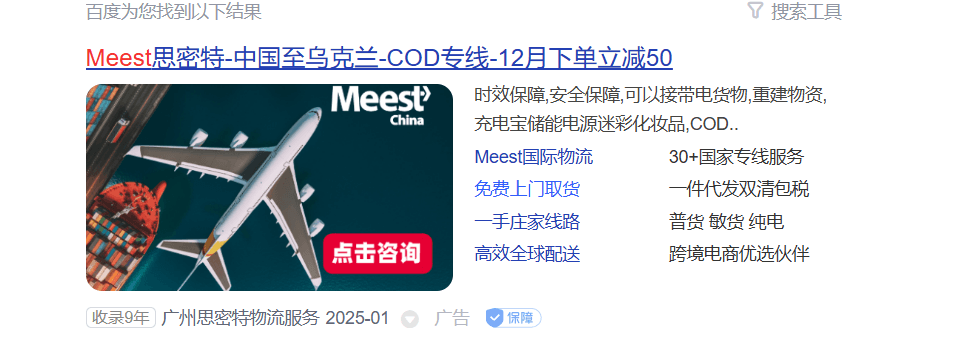
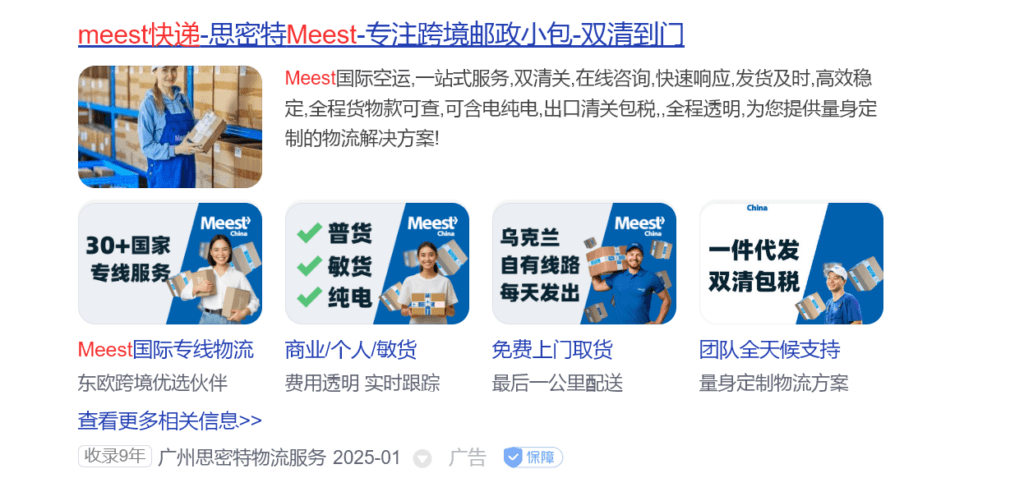
Example: Baidu ads
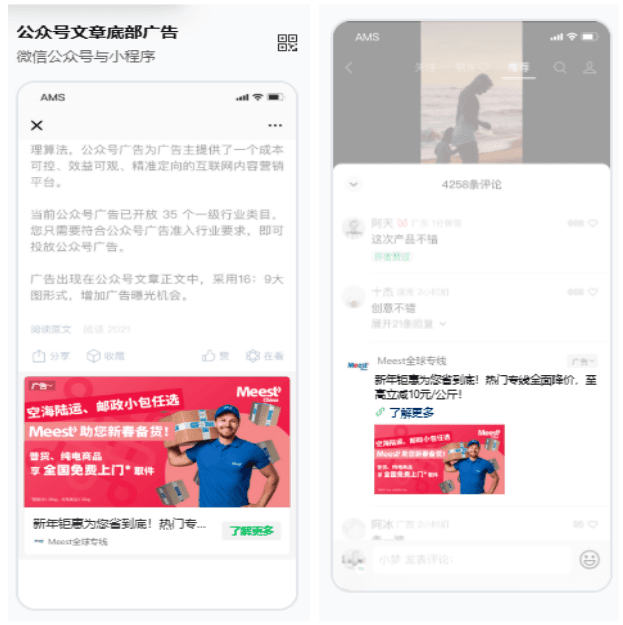
Example: WeChat ads
And with that, we have come to the end of this guide for global logistics providers to reach Chinese clients.
The Takeaway
Marketing logistics services in China requires a localized strategy and understanding of the needs of Chinese business customers. In the B2B sector, this allows global logistics companies to effectively attract and convert these clients.
Our key tips:
- Offer information and assistance in Chinese.
- Publish useful information and case studies on WeChat, Baidu Baijahao, and Zhihu.
- Run targeted ads on Baidu, WeChat, and Rednote.
- Use animated videos for complex processes and engagement.
- Localize your website and optimize it for search (SEO).
- Provide real-time customer support via WeChat.
Now it’s your turn. Contact us for your free consultation and tell us about your project!