
In the West, the phrase “Google it” is synonymous with a web search, and in China, there’s an equivalent.
When Chinese Internet users find themselves looking for information or the answer to a question, they will say, “Go Baidu it” (“百度一下”).
To put it simply, Baidu is essentially the “Google of China.” The search engine is a central pillar of the Chinese Internet and the go-to search engine for hundreds of millions of people online every day.
In this article, we will examine Baidu’s user demographics and then analyze how brands can use Baidu as a marketing tool to attract and convert Chinese consumers.
Key Takeaways
- Baidu is at the core of Internet search in China, with over 700 million monthly active users (Baidu App) and coverage of 97.5% of Chinese Internet users (Baidu’s entire ecosystem).
- The main users are aged 25–45
- Users mainly come from Tier-1, Tier-2, and Tier-3 cities.
- Baidu search is now integrated with AI search, helping users obtain results more quickly and accurately, which in turn is driving increased search interest in entertainment, technology, travel, and other topics.
Baidu’s ecosystem of products can strongly influence purchase decisions and offers unique advantages when it comes to reaching high-intent audiences.
User Profile
According to Baidu Marketing’s Commercial Value of Baidu Creators Report released in 2023:
Age and geographic distribution
The main users of the Baidu app are from the post-80s and post-90s generations, with users aged 25–45 accounting for 62%.
In terms of geographic distribution, approximately 67% of Baidu’s app users are from first, second, and third-tier cities.
Representative cities include:
- Tier-1: Beijing, Shanghai, Guangzhou, Shenzhen
- Tier-2: Chengdu, Hangzhou, Chongqing, Nanjing
- Tier-3: Zhuhai, Xiamen, Haikou, Huizhou
Representative user segments
Baidu marketing classifies the app’s core users into nine typical segments:
- Newly married homemakers – Young couples who have just started a family.
- New parents – Parents with babies or toddlers whose lives (and spending) largely revolve around childcare.
- LOHAS lifestyle seekers – Consumers who pursue a healthy, sustainable, and organic lifestyle and are willing to invest in it.
- Knowledge elites – Highly educated, high-income users who value in-depth information and cultural consumption.
- Office professionals – White-collar employees working in urban offices.
- Style-conscious men and women: Young men and women who care a lot about their appearance and actively follow fashion and trends.
- Generation Z – Those born between 1995 and 2009 who grew up natively in the Internet age and have been strongly shaped by digital technologies and instant communication tools.
- Students – Student groups who are highly active online and quick to adopt new things.
- New silver generation – People who are gradually entering retirement. They usually have stable savings, an open attitude toward consumption, relatively good health, and an active lifestyle.
User Scale and Structure
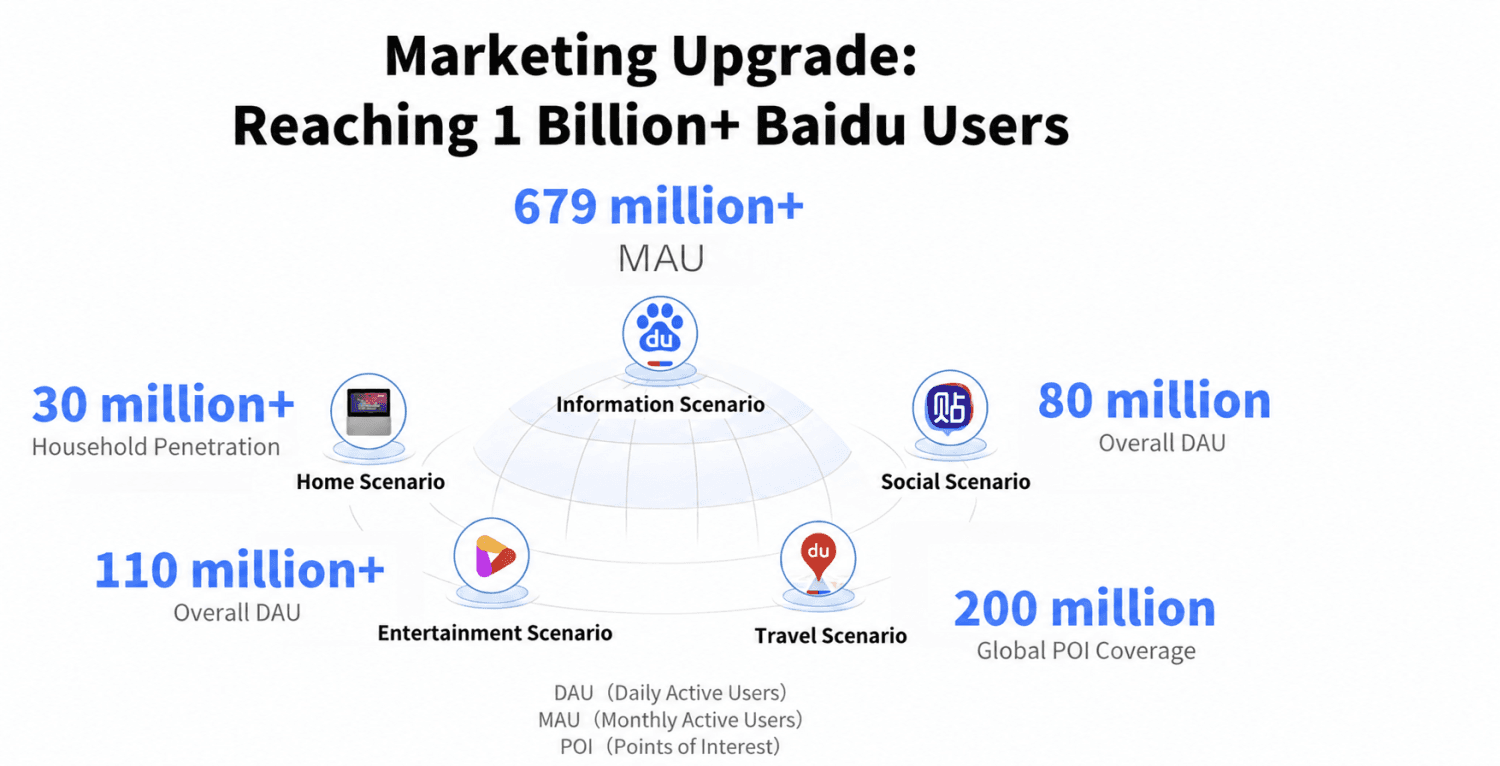
According to Baidu‘s 2025 annual report, the Baidu App reached over 679 million monthly active users (MAU) in 2025 Q4, while Baidu’s entire ecosystem reaches 97.5% of China’s Internet population.
In today’s highly developed Chinese Internet environment, where users have plenty of products and platforms to choose from, maintaining this scale is no longer something a simple “search engine” can achieve. Now, it is supported by a coordinated, multi-product Baidu ecosystem.
Baidu Ecosystem
The figure below shows several core Baidu ecosystem products, their functions, and roughly comparable products in overseas markets.
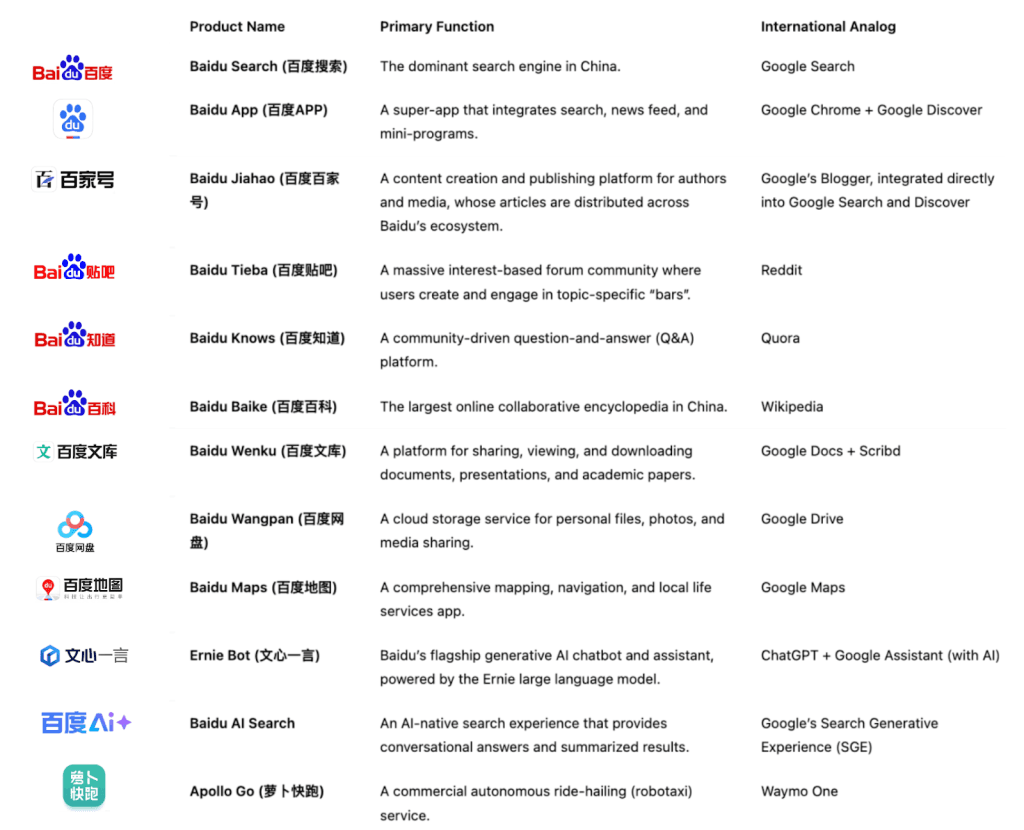
These products do not exist in isolation; instead, they function like a well-organized team, with some focusing on distributing news and content, some supporting search and Q&A, and others providing community interaction and content accumulation.
From mobile to desktop, they jointly shape how hundreds of millions of users acquire information, socialize, and make purchase decisions.
For businesses, such a large and multi-layered user ecosystem has two implications:
- The coverage is broad enough to efficiently reach the majority of Chinese users.
- The touchpoints are rich enough to cover the entire path from “seeing information and developing interest” to “further research and making decisions.”
As Baidu’s ecosystem keeps expanding, user journeys inside the Baidu environment are becoming more multidimensional. From scrolling news feeds and watching videos, to browsing Tieba forums and checking reviews, then searching specific questions, comparing prices, and finally placing orders, more and more behaviors are being integrated into a single ecosystem.
In this process, the role of search itself is also changing.
It is no longer just the starting point for acquiring information; it has become the central hub that connects and supports the user’s entire decision-making journey.
For this reason, when AI technology began to enter the search field on a large scale, Baidu chose to deeply embed AI into its existing search and content ecosystem, instead of building a completely separate product that is disconnected from its core experience.
Baidu AI Search
In the global wave of AI search, ChatGPT has received massive attention overseas, but it is not available in mainland China. This has given domestic products a valuable window to evolve natively.
Against this backdrop, Baidu began fully integrating AI into its search system in 2024 and officially launched Baidu AI Search in April of that year.
The following images compare Baidu’s current search interface with earlier versions. You can clearly see that the information density on the search results page has increased significantly in recent years, and AI assistants, AI summaries, and similar modules now occupy far more prominent positions on the page.
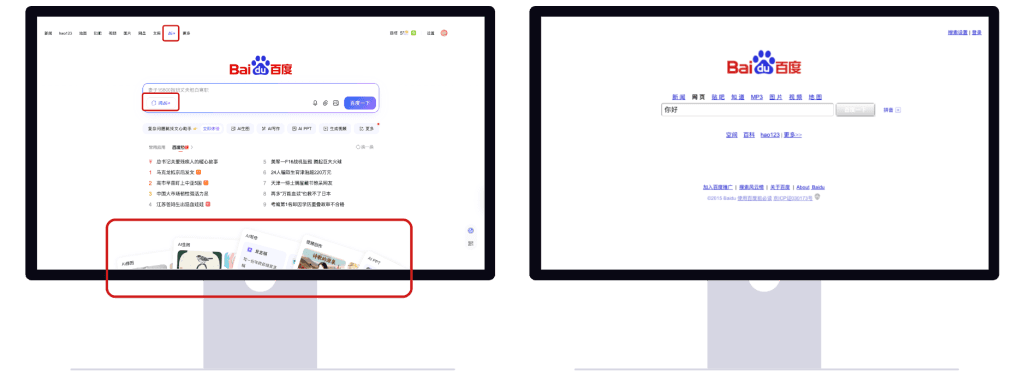
Current Baidu search interface (L) and Earlier Baidu search interface (R)
According to QuestMobile’s Q3 2025 AI Application Industry Report, as of September 2025, Baidu AI Search has reached 382 million monthly active users, with a quarter-on-quarter growth rate of 18.6%.
IDC’s 2025 report notes that the global AI search market exceeded 28 billion USD in 2024, with China being the fastest-growing region.
Baidu ranks first among Chinese search products in terms of product capabilities, and in Silicon Valley VC firm A16Z’s Global Top 100 AI Applications list, Baidu is the only Chinese search engine in the global top 10.
The rapid growth of Baidu AI Search has changed the way users search in two important ways.
On the one hand, user behavior is evolving from “keyword retrieval” to “conversational problem-solving.” On the other hand, it is reshaping how businesses connect with users. Instead of passively waiting for users to search for their brand, companies can now join the conversation earlier by integrating with Baidu AI, even before users’ needs are fully formed.
In this new paradigm, Baidu AI Agent has become a typical new entry point.
Baidu AI Agents
Baidu Intelligent Agents are similar in concept to Custom GPT on ChatGPT. Essentially, they are “branded intelligent advisors” that companies can train, deploy, and operate themselves.
By feeding in product documentation, customer service FAQs, technical documents, and other materials, a business can build its own dedicated intelligent agent on the Baidu AI platform.
Externally, this agent can serve as a 24/7 intelligent customer service agent, product consultant, or brand assistant.
Internally, it can help teams organize knowledge, answer standard questions, and improve operational efficiency.
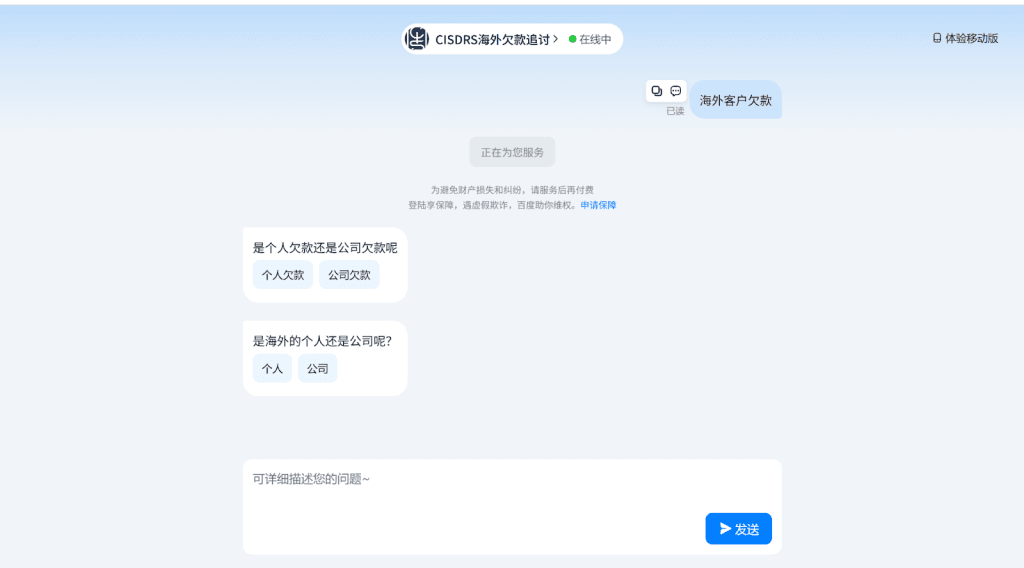
For example, for our client CISDRS, we deployed a customer-service intelligent agent that has already handled more than 400 inquiries in total. In the early stages of the project, it effectively helped human agents with initial screening and triage:
- Automatically answering common questions
- Structuring more complex questions before passing them on to human agents
- Addressing the traditional challenge that human support cannot be online 24/7, ensuring that users receive instant responses at any time
From a marketing perspective, this type of “brand intelligent agent” is becoming a new way for businesses to connect with users in the post-search era. It is no longer only about “being discoverable in search,” but about appearing in front of users before their needs are fully articulated.
What Are People Searching for on Baidu?
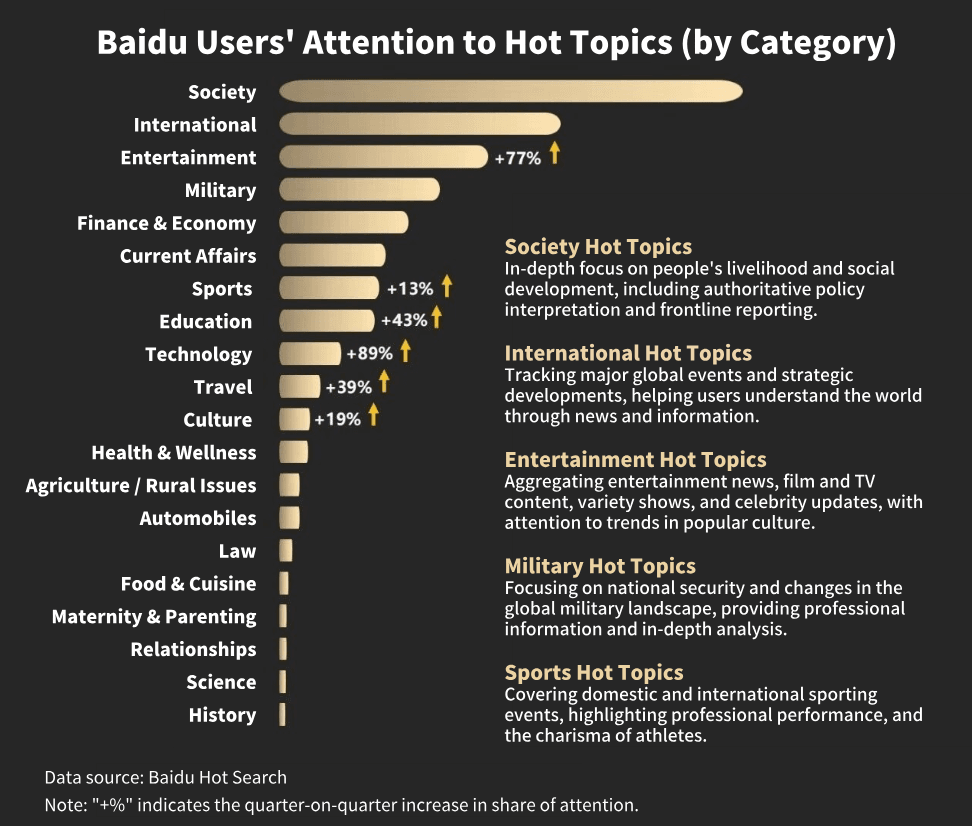
According to the 2025 H1 Baidu Hot Search Report jointly released by Baidu Hot Search and China CSM Media Research in July, Baidu user searches are mainly in the following:
- Entertainment
- Sports
- Education
- Technology
- Travel
- Culture
All of these areas have seen a clear increase in attention over the past year.
At the same time, under the influence of AI, the very nature of search is evolving.
Search behavior is more closely tied to personal interests, spending plans, and lifestyle, and users are less likely to type just a few keywords; instead, they are more inclined to use everyday language to describe their queries.
Before making a decision, the same user often searches the same topic multiple times and from different angles.
This means that if you only look at aggregate numbers, it is difficult to get a true picture of your users, as different user groups within the same industry will have different requirements.
For example, within “education,” the search paths of K12 parents and adult learners in vocational or professional training differ significantly.
To truly understand Baidu’s user profile, you need to look at specific industries. To illustrate, we will use the recently popular outbound tourism sector as an example.
Industry Search Case: Outbound Tourism
Market context
According to Baidu’s 2025 Overseas Tourism Board Marketing Playbook, in the post-pandemic era, countries and regions around the world have been gradually relaxing entry policies for Chinese tourists.
International routes are being restored and expanded, and outbound travel demand is steadily recovering. Overall, the outbound tourism market is rapidly returning to a multi-trillion-RMB scale.
In this context, Baidu has naturally become a key information gateway for Chinese users planning overseas trips, researching destinations, and wanting to understand policy restrictions.
Who is searching for outbound travel?
The Overseas Tourism Board Marketing Playbook reports:
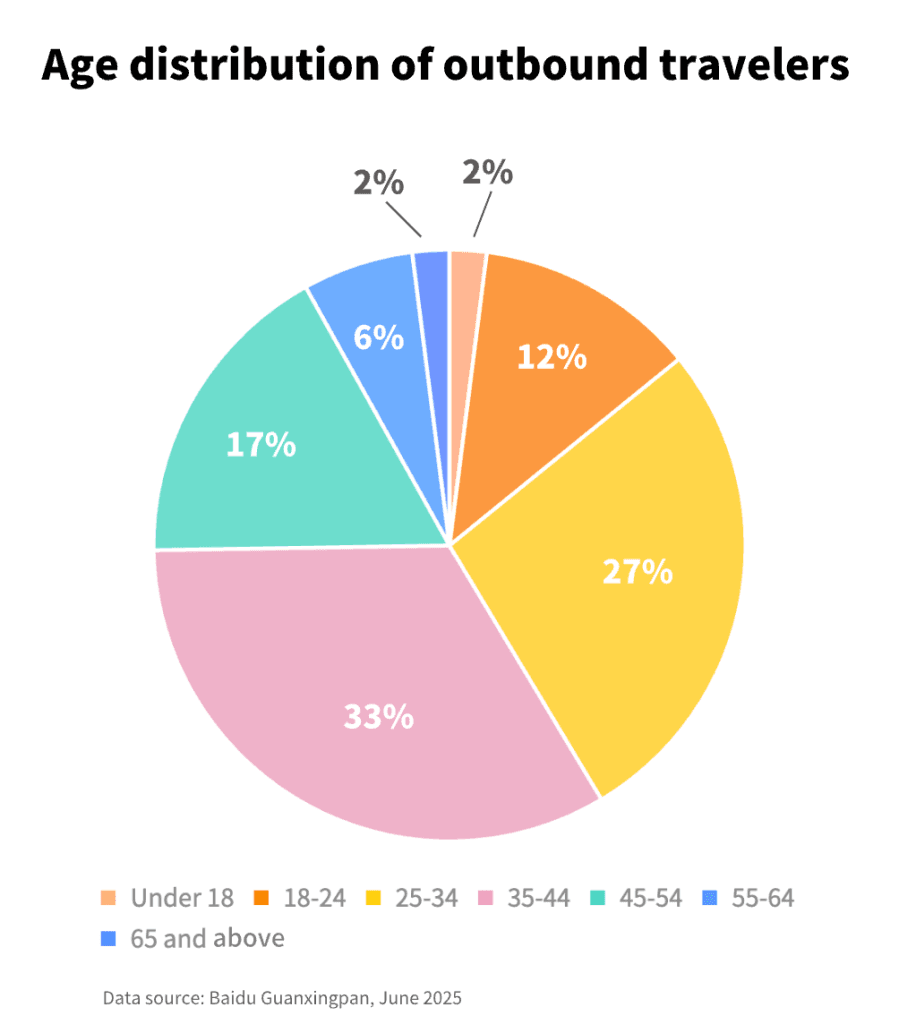
- Users searching outbound travel-related content on Baidu are mainly aged 18–44.
- This group tends to “love experiences and novelty,” and 94% of them fall into the medium-to-high spending segment.
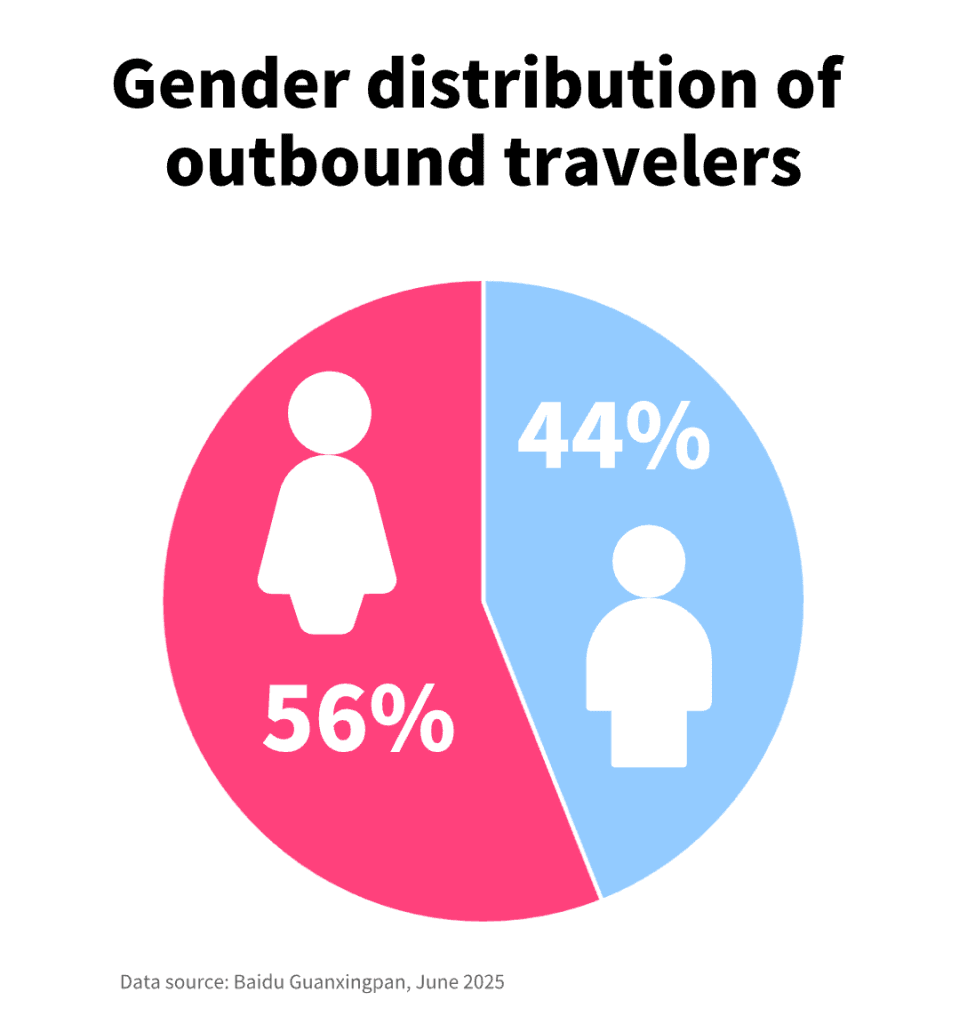
- The gender ratio is relatively balanced.
- In terms of geography, demand is strongest in tier-1 cities such as Beijing, Shanghai, Guangzhou, and Shenzhen, as well as in economically developed coastal provinces.
Baidu’s outbound travel audience consists of users with strong spending power, value experience, and are willing to pay for quality services. For destination countries and tourism service providers, they are a very high-potential segment.
Destinations
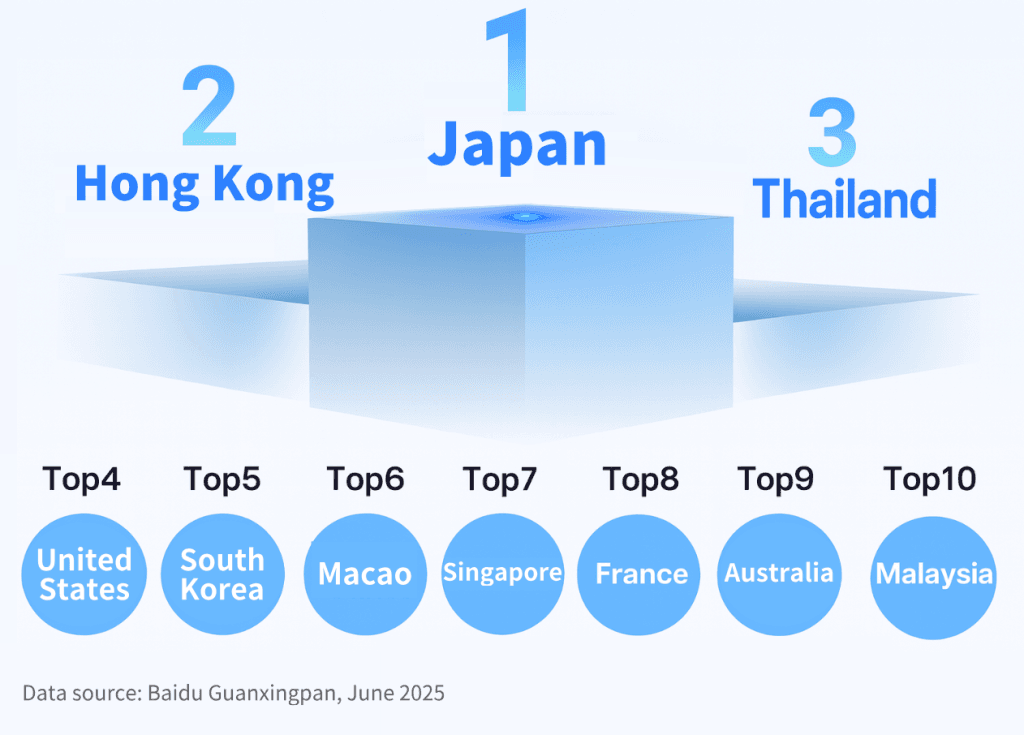
According to Baidu Guanzingpan (Baidu’s insight and analytics platform), Chinese outbound travelers still primarily choose nearby Asian countries and regions as their main destinations.
For long-haul trips, the United States, France, and Australia are currently the three most popular countries.
Popular outbound travel queries
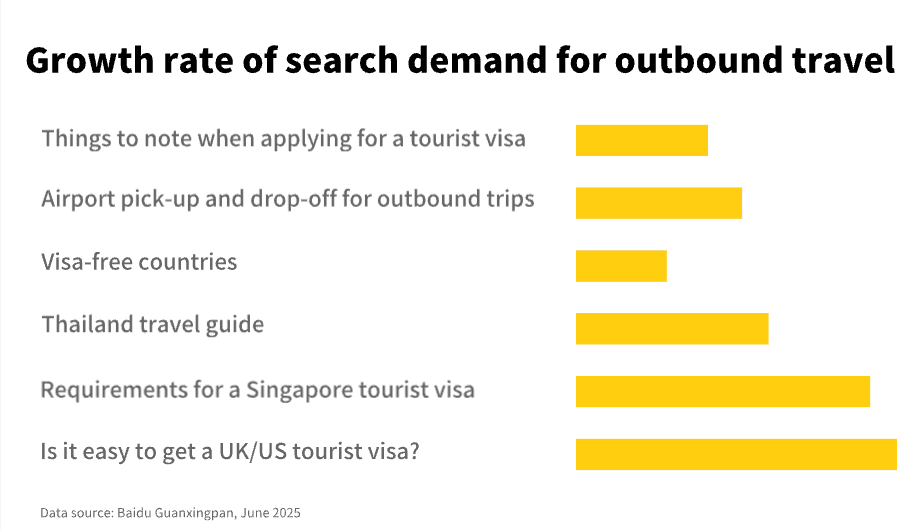
Around the topic of “outbound travel,” user search questions can be grouped into several categories:
- Destinations – Country or city, recommended attractions, and itinerary planning.
- Requirements – Visa requirements, length of stay, and entry policies.
- Travel methods and costs – Airfares, group tours vs. independent travel, and local price levels.
- Safety and opinion – Safety conditions, authentic travel reviews, “avoid the pitfalls” tips, and word-of-mouth evaluations.
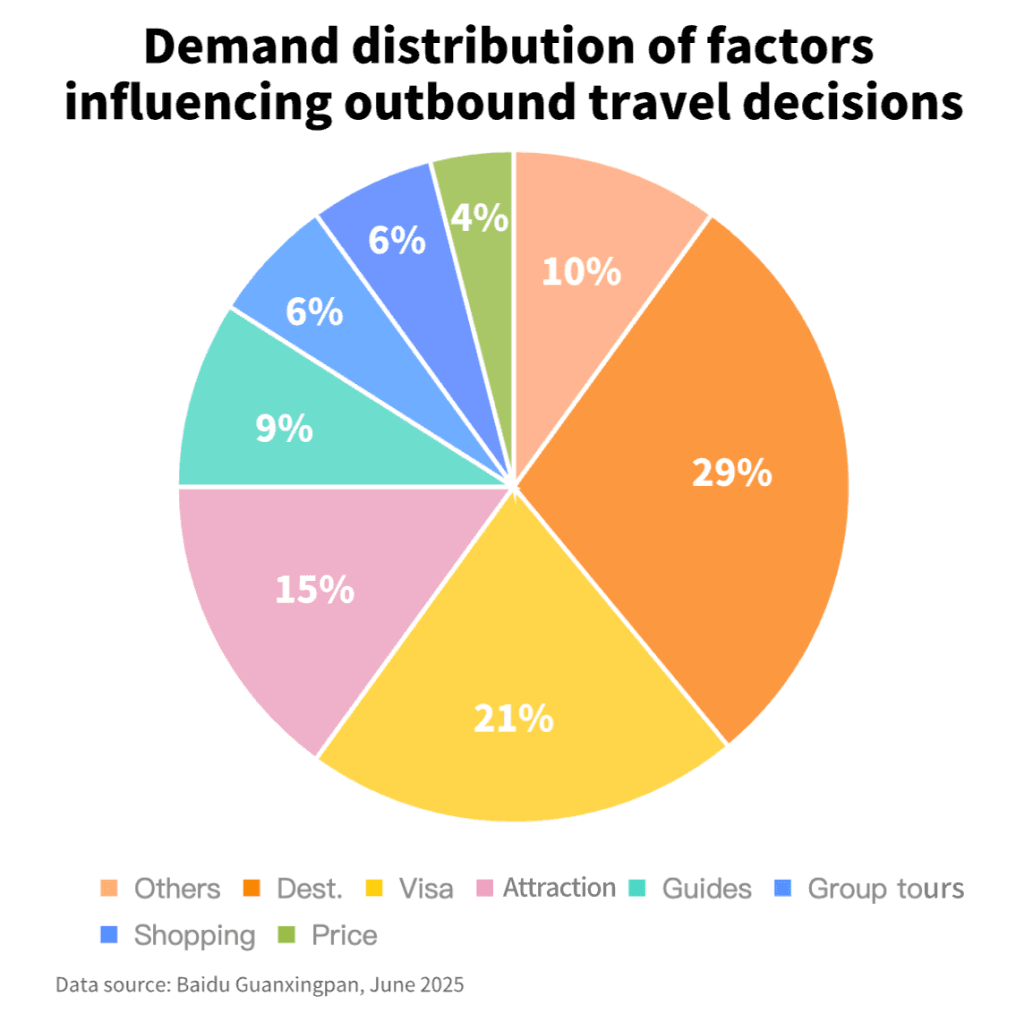
Among these, destination choices and visa/policy constraints are the two most central and earliest search topics.
For destination tourism boards, airlines, online travel agency (OTA) platforms, and local service providers, offering systematic, clear, and trustworthy information on these questions within Baidu’s ecosystem greatly increases the chance of being discovered at an early stage, before users have fixed their preferred brand.
A Practical Case
For overseas tourism businesses—whether destination tourism boards, local experience providers, hotels, travel agencies, or car/charter services—it makes sense to run ongoing advertising and content marketing in Baidu’s ecosystem to capture this search demand.
Here is an example of how we executed tourism-related campaigns on Baidu.
Economy Bookings
Since November 2023, we have been continuously managing Economy Bookings’ China-market promotion. This well-established car rental platform operates in many countries and regions; when expanding into China, they chose to work with NMG to jointly improve their brand visibility and conversion performance within the Baidu ecosystem.
Our strategy:
- Using Baidu Ads for precise campaigns, covering core and long-tail keywords to reach users with clear rental intent.
- Providing practical and executable localization optimization suggestions for their Chinese website to improve the on-site experience and landing page performance for users.
Results (as of October 2025):
- An average of 81 valid conversions per month from China.
- An average monthly ROAS of 391%.
For other tourism clients seeking to attract Chinese travelers, this model serves as a strong reference point. By combining “search demand capture” with “landing page optimization,” it is possible to build a stable customer acquisition funnel inside the Baidu ecosystem.
Click here to learn more about our Chinese tourism marketing solutions.
Baidu Advertising
Within China’s digital ecosystem, Baidu remains a key entry point for accessing information and decision-making. As AI becomes more deeply integrated, this entry point is gaining even more influence.
According to Baidu Marketing Service Contact Center data, 42.4% of users complete their product or service purchases directly through the Baidu app. This demonstrates that Baidu is no longer just a starting point for traffic; it is increasingly capable of supporting a full transaction loop from search to conversion.
For brands, the value of Baidu advertising lies in two main aspects:
- When users are actively searching, you can accurately capture existing intent.
- In information feeds and app launch (splash) screens, you can build wide coverage and continuously strengthen brand awareness.
If you would like to promote your brand through Baidu, you can visit our Baidu marketing service page to see the services NMG can provide.
Main Baidu Ad Formats
Search Ads
Search ads appear when keywords are used in a search. These types of ads are perfect for precisely targeting high-intent users.
Feed Ads (Information Flow Ads)
These ads are natively distributed in news feeds, video feeds, and similar content streams. They are more focused on interest-based exposure and brand awareness, ideal for expanding reach and driving “brand seeding.”
Brand Zone
Appears at the top of the search results page as an official brand entry, typically with logo, brand name, and navigation links. Brand Zone can be used to strengthen trust and present an authoritative brand image.
Splash (Opening) Ads
A full-screen display when the Baidu app is launched. These ads have a high visual impact, suitable for major campaigns, important moments, or brand image promotion.
If you want more detailed information on implementation, media strategy, and case studies, please visit the Baidu advertising page to see NMG’s service descriptions and client success stories.
Conclusion
Overall, Baidu is no longer just a search engine; it is a comprehensive digital ecosystem that can systematically influence users from initial interest all the way to purchase.
For brands, marketing on Baidu is not simply a matter of running a few ads. It requires combining multiple capabilities within the Baidu ecosystem—AI search, content publishing, SEO, intelligent agents, and various ad formats—to build a coherent user journey. This allows you to guide users step by step from “initial interest,” to “clear intent,” and finally to “completed transaction.”
Only by managing this full journey can brands truly maximize their marketing impact on Baidu.
For companies that want to seriously engage with Chinese consumers, understanding Baidu and using it well is no longer optional. It is a core capability that must be mastered.