

In our previous article, China GEO: How AI Search Is Changing Content Visibility, we explored how AI search is changing how users discover brands online.
The next question is obvious: How do you measure China GEO performance?
For SEO, marketers can usually monitor:
- Organic traffic
- Keyword rankings
- Leads
- Conversions
GEO is different.
A user may discover a brand through DeepSeek, Doubao, or Baidu AI Search long before they visit a website.
When they eventually convert, analytics platforms often attribute that conversion to organic search, direct traffic, or another channel.
The AI recommendation itself may never appear in reporting, making GEO significantly harder to measure than traditional SEO.
Key Takeaways
- China GEO is becoming an important marketing method for brand visibility in AI search.
- GEO often influences customers before they visit a website, making attribution difficult.
- GEO has not created a new attribution problem; it has simply exposed an existing one.
- AI visibility, ranking position, and sentiment are among the most widely used China GEO metrics.
- GEO performance should be evaluated through long-term trends rather than individual scores.
- Businesses should assess GEO alongside search demand, website traffic, and lead generation metrics.
Why GEO Is Harder to Measure Than SEO
Imagine a company that wants to sell products in Germany and learns that it may need to comply with the German Packaging Act (VerpackG).
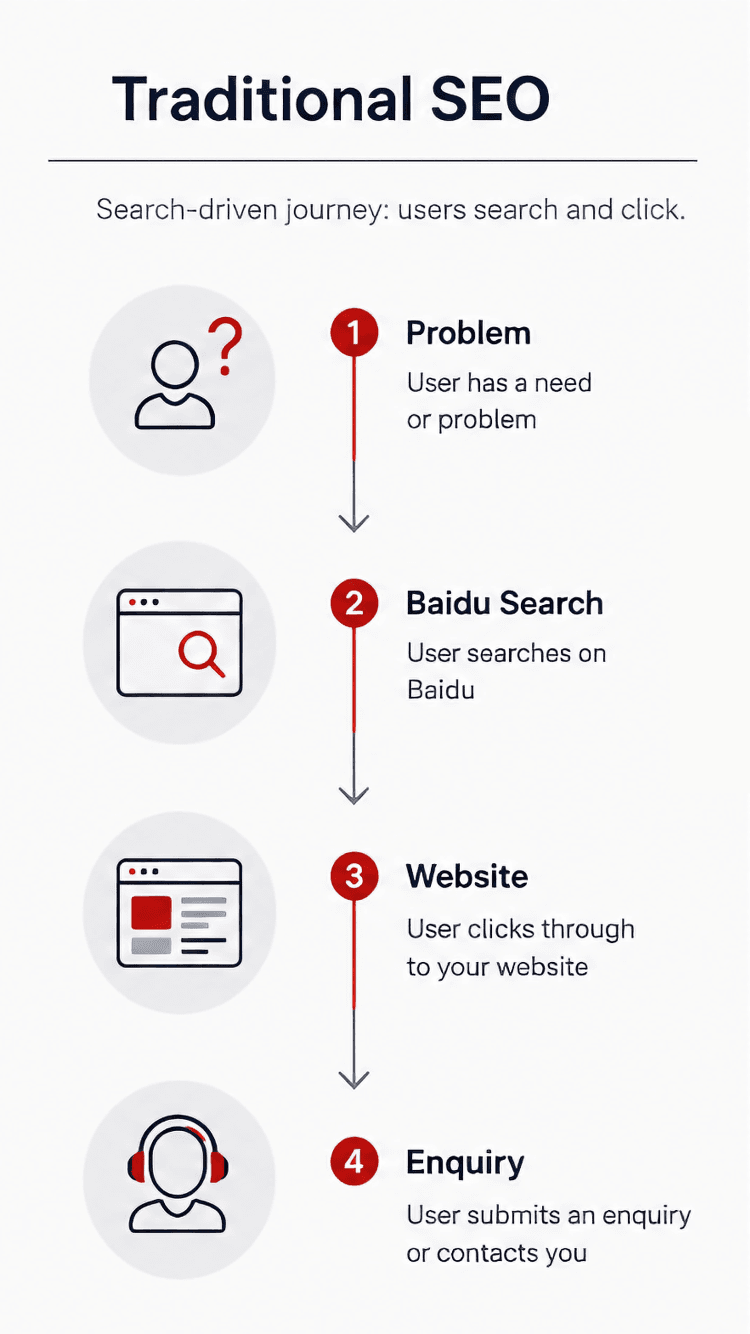
In a traditional SEO journey, the user might search for information on Baidu, visit a website, and eventually submit an inquiry.
In reality, however, the buying journey is often much more complex. A potential customer may first try to understand the problem by asking questions:
- What is the German Packaging Act?
- Do I need VerpackG registration?
- What happens if I don’t comply?
As they continue their research, they may move into the comparison phase and ask things like “Which companies provide Germany Packaging Act registration services?” or “Which is better? Lizenzero or Green Dot?”
AI platforms may introduce or recommend brands at multiple stages of this process.
The user may then continue their research on the following platforms and websites:
- Baidu
- Industry articles
- Rednote
- Company websites
Only then do they submit an inquiry.
The conversion may still appear as Organic Search inside Google Analytics.
However, AI may have influenced multiple stages of the customer journey, from problem discovery to supplier comparison, which makes GEO significantly harder to measure than traditional SEO.
Content marketing and social media have faced similar attribution challenges for years. GEO simply makes those challenges more visible.

How Does the Industry Measure China GEO?
Unlike paid advertising, GEO cannot be measured through click-through rates, conversion rates, or return on ad spend.
As a result, the GEO industry has gradually developed a new set of visibility-focused metrics.
It is important to note that GEO remains a relatively new field. Different platforms use different methodologies, and there is currently no universal standard.
However, most China GEO monitoring tools follow a similar approach.
GEO Monitoring Starts With Prompts
Just as SEO monitoring revolves around keywords, GEO monitoring revolves around prompts designed to simulate the questions potential customers may ask AI systems.
At Nanjing Marketing Group, we generally divide prompts into three categories: Generic, brand, and competitor.
Generic Prompts
Questions focused on industry topics or solutions, e.g., “Which companies provide Germany Packaging Act registration services?”
Brand Prompts
Questions focused on a specific company. For example: “How much does Lizenzero cost?”
Competitor Prompts
Comparing one company against another: “Lizenzero vs Green Dot: Which is better?”
Most GEO monitoring platforms regularly submit these prompts to AI systems and record
- whether a brand is mentioned,
- where it appears, and
- how competitors perform.
The results are then converted into GEO metrics.
To reduce brand bias, most GEO platforms place greater emphasis on generic prompts when calculating visibility scores.
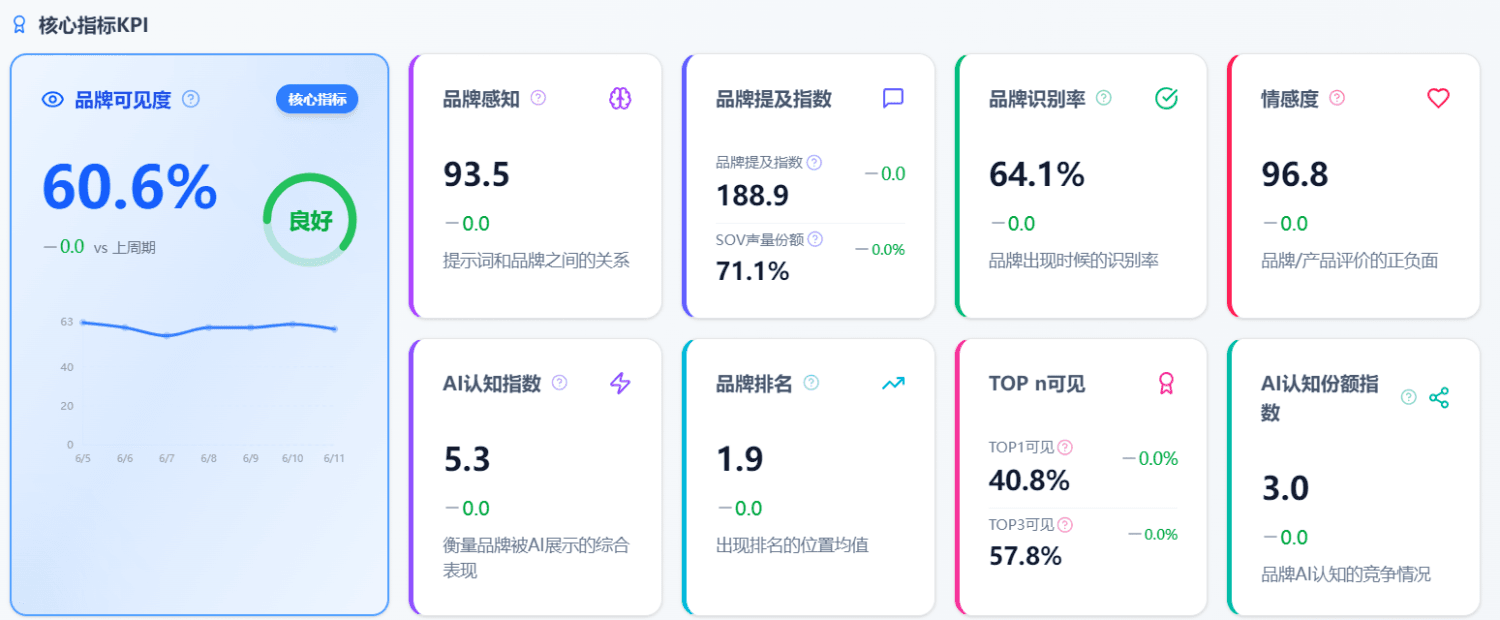
Note: The screenshots shown throughout this article are taken from ImpetaAI, a GEO monitoring platform currently being tested by NMG. They are included for illustrative purposes only
AI Visibility
Many GEO practitioners consider AI visibility (how frequently a brand appears in AI-generated responses) as the most important GEO metric.
For example, if an AI platform is asked 100 relevant questions and mentions a brand in 60 of its responses, that brand would have an AI visibility score of 60%.
It serves a similar role to search visibility in SEO, but focuses on AI-generated answers rather than search engine rankings.
For businesses, trends are often more important than individual scores.
If visibility consistently increases over time or remains higher than competitors’, it usually indicates that a brand is gaining more exposure in AI search environments.
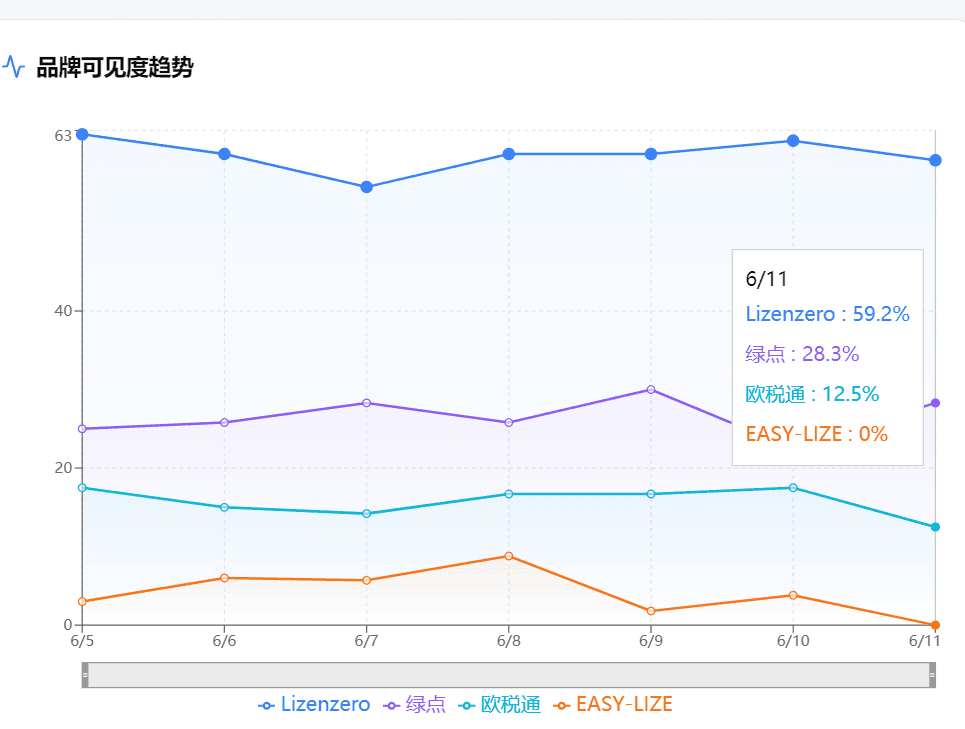
Visibility trends for Lizenzero and competing providers displayed in a GEO monitoring platform
Ranking Position
If visibility measures whether a brand appears, then ranking position measures where it appears.
This might seem obvious, but if AI is recommending multiple brands, appearing near the top of the response is generally more valuable than appearing near the bottom.
Businesses that consistently rank near the top of AI recommendations are more likely to be seen by potential customers.
For this reason, many GEO monitoring platforms track the average position at which a brand appears across a set of prompts.

Results generated by Baidu AI Search for the query “Which Germany Packaging Act compliance providers are available?”
Sentiment
Some GEO monitoring platforms also analyse sentiment, and a higher sentiment score generally indicates fewer negative references to a brand.
Low sentiment scores may reveal recurring concerns related to the following areas:
- Pricing
- Customer service
- Product quality
- User experience
These insights can help businesses identify reputation issues that may influence how AI systems describe or recommend their brand.
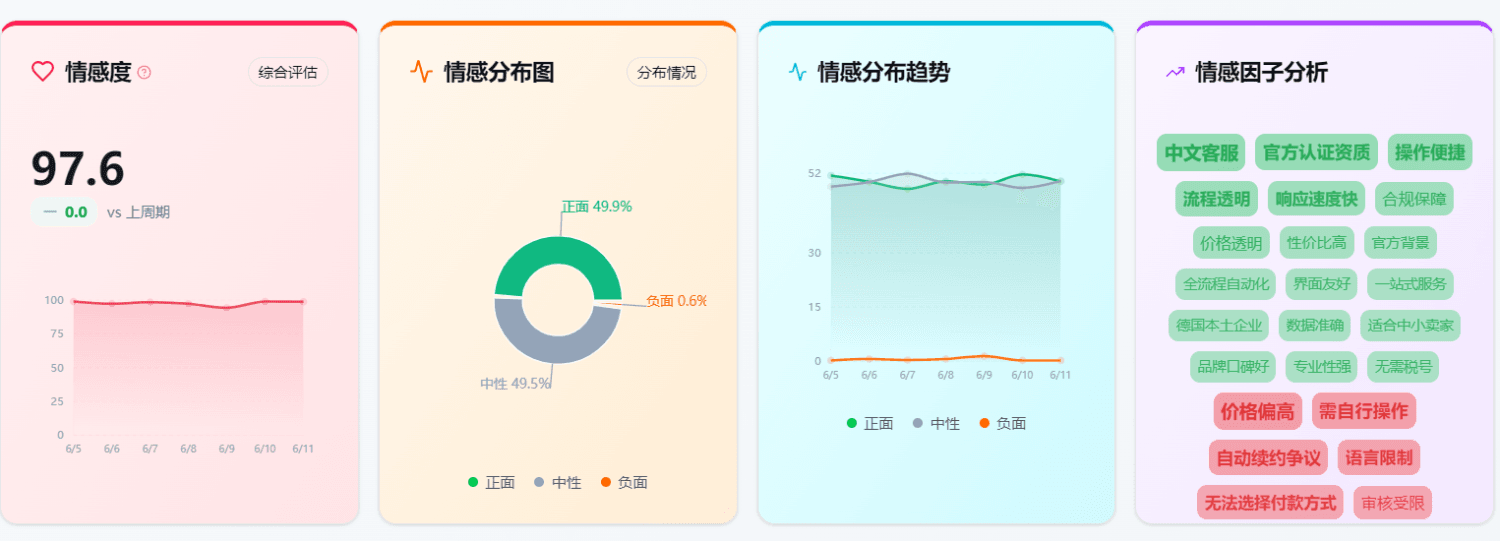
Sentiment analysis of Lizenzero displayed in a GEO monitoring platform
Understanding GEO Metrics Over Time
Individual GEO scores are useful. A visibility score of 50%, for example, indicates a brand is already appearing in a meaningful share of AI-generated responses.
However, the score becomes more useful when compared against competitors or tracked over time.
If a brand’s visibility increases from 20% to 50%, or consistently outperforms competing providers, that provides a clearer indication of progress.
The same principle applies to ranking position and sentiment.
For this reason, GEO metrics should be evaluated through both competitive comparisons and long-term trends, rather than viewed as isolated numbers.
We recommend evaluating China GEO performance alongside broader business indicators:
- Brand search volume
- Website traffic
- Inquiries
- Conversion rates
No single metric can tell the full story; instead, businesses should look for patterns across multiple data sources.
How Can Businesses Improve China GEO Performance?
Although GEO is still evolving, several best practices are already becoming clear.
Publish Content Where AI Finds Information
Different AI systems rely on different information sources. In addition to company websites, AI platforms frequently reference:
- Zhihu
- Baidu Baike
- Baidu Baijiahao
- Sohu
- News websites
- Industry publications
As a result, content distribution is becoming increasingly important.
Businesses should focus on publishing content on platforms that are most likely to be referenced by the AI systems used by their target audience.
Below is a simplified overview of the types of content different AI platforms in China are more likely to prioritize and reference (based on research and platform analysis by Wemob).
| Platform | Information Sources | Feeding Strategy |
| Doubao | Content from Douyin, Toutiao (Today’s Headlines), and related encyclopedic entries. | Focus on recommendation and brand-related content to deliver tailored solutions that address user consumption needs. |
| DeepSeek | Official websites, reputable media, industry portals, white papers, and in-depth research reports. | Prioritize technical evaluations and benchmarking data to match users with professional insights on technology products. |
| Tencent Yuanbao | WeChat Official Accounts, Tencent News, QQ, and other Tencent content platforms. | Highlight brand and knowledge content to provide practical and easy-to-understand information that meets everyday user needs. |
| Kimi | Authoritative media, user manuals, developer documentation, industry reports, and white papers. | Emphasize rankings and comparisons to deliver efficient decision-making tools for professional users. |
| ERNIE | Baidu Encyclopedia, Baidu Baijiahao, Baidu Zhidao, Baidu Tieba, and other Baidu ecosystem content. | Focus on recommendations and how-to guidance to match users with optimized experience and usage suggestions. |
| Tongyi Qianwen | Authoritative reports, procurement guides, solutions, and third-party review data. | Combine user intents with application scenarios to deliver actionable recommendations that drive efficiency and productivity. |
Create Content Around Real User Questions
According to a 2025 search behaviour report by TopKlout, 51% of users have changed their search habits due to AI, with more people using conversational, question-based queries rather than traditional keywords.
The best GEO content helps users solve problems, understand complex topics, and make informed decisions. Therefore, rather than producing purely promotional content, focus on answering genuine customer questions.
When planning content, consider the types of questions potential customers may ask AI systems during their research process.
This approach often improves both GEO and traditional SEO performance.
Prioritise Original Content
As AI models become better at evaluating information quality, originality will become increasingly important.
Businesses should avoid relying entirely on mass-produced AI-generated content distributed across multiple platforms. Instead, original insights, case studies, research, and industry expertise are more likely to be referenced by AI systems than generic content.
AI can assist with content creation, but genuine expertise remains a key competitive advantage.
Conclusion
As AI search continues to develop, the way people discover brands is changing.
At the same time, the boundaries between SEO, content marketing, social media, and GEO are becoming increasingly blurred.
The challenge with GEO is not optimisation—it is attribution.
GEO has not created a new problem; it has simply made marketers more aware of one that has existed for years.
For businesses today, the goal should not be finding a perfect GEO metric; it should be building a long-term framework for monitoring AI visibility and understanding how their brand appears in AI-generated answers.
In an era where AI is becoming a primary gateway to information, being seen by AI is often the first step towards being seen by your future customers.