
This article is the second in a series of posts explaining how private schools can improve their marketing within China. In the first one, I talked about the market: where Chinese students were coming from and going for their further studies, as well as their country’s economic goals and how schools can tailor their marketing to align with them.
In this article, I’ll talk about marketing: partnerships, social media, websites, video, SEO and more.
Key Takeaways
- Even if you have an English website, a Chinese website will boost your branding in China.
- A website that is “transcreated” provides the benefits of custom localization with the cost benefits of translation.
- China’s firewall and general Internet structure can slow down load times if your website is outside of China.
- International schools can advertise on apps like WeChat, Douyin, Rednote, and BiliBili.
- WeChat is an all-purpose app used by everyone, offering schools the ability to post articles and videos. Important updates will appear in a user’s conversations on their chat interface. Next to your website, this app should be the central axis of your marketing plan in China.
- Douyin is TikTok for China, but it caters to a wider range of people in terms of age. This should be your main app for video content.
- Rednote’s users are mainly young adults to middle-aged women. Content for this app should appeal more to mothers.
- BiliBili’s users are much younger, but many of the categories focus on education, which your school can use to promote brand recognition.
Why Should You Partner With a Chinese Education Institution: Building Trust
The first reason schools should be looking to collaborate with counterparts in China is that it builds trust.
It seems obvious, but don’t take it for granted that just because your school is celebrated in your native country, the same is true elsewhere.
As a British American, I’ve experienced firsthand how something with a lot of reputation in one country may have no prestige in another. For example, growing up in my hometown in New Jersey, I witnessed how everyone loved Notre Dame, a Catholic school famed for its football team. During my time in the United Kingdom and China, I met people who had never heard of the university or its team.
Did the fact that most people who had some kind of attachment to the university were also Catholic and American matter? Perhaps. My personal experience here highlights something important to marketing: familiarity creates trust, and trust fosters customer-business relationships.
The best thing about trust is that, once you’ve established it, your business will continue to see benefits in the future, providing you retain that trust, of course.
The main challenge, however, is establishing that trust in the first place.
To answer this, pay attention to what I said above about Notre Dame: while it had a similar culture to people from my hometown, it was largely unknown to people from other countries.
How can something unfamiliar become more familiar? By connecting it to something people already know!
Data shows people are more likely to attend a university or school if they know someone who has already experienced it. Other studies have stated that 88% of people worldwide are more likely to buy products from brands they already trust.

The findings in the same study also align with my last article on how geopolitics affects school branding, as Chinese citizens consider a company’s country of origin when making a purchase.

As much as we’d like to live in a world based on mutual understanding and cooperation, it takes longer for people to trust strangers. And this is also true for schools and businesses.
Therefore, one of the main questions for schools is how they can create trust with families in a foreign country.
The answer to this goes back to what I said earlier about the relationship between familiarity and trust. Partnering with schools or educational institutions in China may be one pathway to this. Chinese families may already be more familiar with them, so by working with one of these organizations, some of this trust may rub off on you.
After addressing the question of trust, the next issue is the ways they can partner with Chinese schools or organizations.
How Can I Partner With a Chinese Education Institution? Helping With Educational Goals
In my last article, I explained how schools can tweak their marketing to align with China’s economic goals, and the same could be said about the country’s educational objectives.
Marketing is about aligning with a customer’s problems to find a solution, and the best marketing happens when a school or company shows another why their services or product can help them achieve a target. This can also build trust since it shows one cares for another.
Plus, schools and educational organizations already in China will be more aware of the country’s objectives concerning education.
So, what are some of these goals?
Earlier this year, the Chinese government unveiled its plan to build a “strong education nation” by 2035, which is something the country has been discussing for a while.
Let’s outline some of the key objectives and how your school could build its branding in China by working with schools within the country.
1) Health Education
Due to concerns over a rise in obesity, the Chinese government made physical education a core subject this year and wants to ensure all primary and secondary students get at least two hours of physical activity every day.
The United States, Canada, the United Kingdom, Australia, Denmark, Japan, and Finland have been ranked as having the best education systems for physical education. Given this, your school may have resources and knowledge that counterparts in China find useful.
To use Notre Dame as an example again, in 2018, the university sent fencing coaches to Shanghai to run a camp for teachers and students. This program entered Chinese news and brought more awareness of the university.

Schools may also build awareness for themselves by forming friendly competitions. Last year, a friendly match between youth teams from China and France became a popular story on social media.

2) Popularizing Mental Health
China has been trying to tackle this issue for a while, but has faced headwinds due to prevailing cultural stigma. Even today, only 40% of primary and secondary schools have full-time mental health education teachers.
However, the government recently moved to make mental health education mandatory in some schools. Even before this, international schools were at the forefront of improving mental health awareness in China.
In 2022, BASIS International School Guangzhou led classes to teach children and parents about how random acts of kindness can help people adapt to new communities.
Wellington College has placed mental health as a centerpiece of its curriculum by dedicating time to a weekly well-being program promoting healthy attitudes and emotional stability.

While your school may not have a presence in China, consider reaching out to organizations within the country to see if there are any opportunities to share insights into understanding how to incorporate mental health research into education.
This doesn’t even need to be another school. After all, it’s understandable that you may think that working with “competition” may undermine your ability to attract students. Organizations in China may love to partner with a school outside the country to offer online or offline seminars on mental health within the classroom.
In Shanghai, for example, there is the Shanghai Mental Health Center.

Many universities have also set up centers to focus on the subject.

Working with organizations connected to China may also be a chance for you to gain more insight into mental health to improve the services you provide for international students, and you could also try reaching out to Chinese-speaking mental health groups in your own country.

Crossing national boundaries to tackle a common challenge is nothing new. The American non-profit PTC is one organization specializing in educating teachers and school professionals globally.


3) Narrowing the Gap Between Rural & Urban Schools
While China has made huge leaps over the past 40 years, some parts of the country have not seen the same economic achievements. To tackle this, the government is hoping to improve the accessibility of education for people in these areas.
Improving educational services to the impoverished parts of society is a universal challenge. During my time growing up in the United States, I was surrounded by organizations that would plan trips to less well-off parts of the country to offer educational services.
Below are a few examples of these.


Like China, the United States has some impoverished areas, most notably Appalachia. The Appalachian STEM Collaborative is one organization that goes to this region to teach science, technology, engineering, and mathematics.

In recent years, China’s hopes of eradicating educational disparity and creating more opportunities in rural areas have spurred the growth of new organizations resembling those I knew back in the United States.
Shanghai-based Beyond the City is one of them. Formed in 2017, the group takes students to rural parts of China to experience life and teach children there, and children from rural villages and towns are also given an opportunity to visit Shanghai.

The joint goal of bringing education to less-fortunate areas may be a route that schools wanting to draw more attention to themselves can take. Perhaps consider reaching out to organizations like Beyond the City or even organizing joint trips with schools in China, where students can work together to teach or get involved in different communities.
Some American schools have done this in the past. For example, the Asia Society explains its own story of working with a school in Harbin on its website.
4) Attracting More International Students
China is still well behind the United States in terms of international students attending school in the country, but not too far behind the United Kingdom.

This objective is actually in line with the last one concerning volunteer work, as establishing more grassroots relationships between schools and organizations in two different countries will naturally get individuals interested in different cultures.
(I would not be here writing about China or have studied Chinese if I hadn’t discovered a company focused on helping people find internships in Shanghai a decade ago.)
Chinese schools are also in a similar situation of wanting to attract more international students; therefore, this is a reason to think of other cross-cultural events and programs that could encourage more international enrollees. Relationships formed this way can increase your school’s branding in China.
The above are a handful of ideas you can use to connect with a counterpart in China to build trust and brand awareness.
Another (more costly) option is to set up a school campus or program in China.
Setting Up a School Campus in China
I am including this section here as setting up a campus within China often involves partnering with organizations within the country.
When China became a member of the World Trade Organization in 2001, it did so on the promise that foreign businesses could only get involved with the education sector if schools or companies partnered with Chinese entities.
The report, Doing Education Business in China, released by the Shanghai office of Hogan Lovells LLP, stated:
“Under the 2020 Negative List, foreign investors are not allowed to engage in compulsory education institutions or religious education institutions, and foreign investment and engagement in preschools, senior high schools, and HEIs are restricted to Chinese-foreign cooperative education and must be under the control of the Chinese partner.”
In the past, many schools and universities formed partnerships to set up campuses or run curricula in China.
For example, Shanghai Qibao Dwight High School was formed in 2014 as the first independently run Chinese-foreign cooperative high school in Shanghai. It was created through a partnership between Shanghai Qibao High School and Dwight Public School in New York.

Other examples of joint-education partnerships include
- Kean University (US) and Wenzhou University,
- Barstow School (US) and Zhenhai Middle School in Ningbo, and
- Monash University (US) and Central South University in Changsha.
And why would schools consider setting up campuses or running school programs within China?
Kean University benefited from the publicity its joint partnership brought, and recently announced a record number of enrollments, partly thanks to a 15% uptick in students attending its Wenzhou campus.
This example shows how the Wenzhou campus increased awareness of the university and got more Americans interested in studying in China, something in itself that may lead to more personal relationships across national boundaries that could generate more interest in Kean.
Another option is building a campus from scratch, as many other schools have. However, due to the changing nature of China’s laws recently, remember that wholly-owned foreign private schools can only cater to children of expats now.
This does not mean this is a bad strategy for building branding in China, but it would be a lot more expensive!
Chinese Websites and SEO

For private schools wanting to improve their marketing strategy in China, having a Chinese website and understanding search engines like Baidu is a good place to start.
Nanjing Marketing Group has been helping companies brand themselves in China for close to two decades and knows this topic inside and out. Today, I’d like to share some of that knowledge with you!
Create a Chinese Website
You’d be surprised how many schools and universities have not created a Chinese-language version of their website. There are four main reasons foreign schools should consider making one to advertise themselves:
- Building brand awareness
- Avoiding poor communication
- Reducing website loading times
- Creating a hub for your overall marketing strategy
Let’s break these down individually.
Build More Brand Awareness for Your School in China
Even if you are a high-flying school in the English-speaking world, it’s better not to assume everyone in China knows who you are. It isn’t uncommon for schools or universities famous in one country to be relatively unknown in another.
For example, how many Americans have ever heard of the well-known and respected Jiaotong University, Nankai University, or Tsinghua University?

Therefore, one of the first questions a school should ask itself when creating a marketing campaign for China is, “How well does my target audience know my school?”
If the answer to that question is “not well” or “I am not sure,” a Chinese website may be the best next step. By having descriptions of your school online in Chinese, your website is more likely to appear when anyone in China searches using keywords like English education or private schools.
Common sense tells us that consumers are less likely to know about a product if it’s in a foreign language. Moreover, a survey of 10 non-English nations, including China, found that 75% of consumers prefer buying products in their native language and 60% rarely or never buy from English-only websites.
Chinese search engines are also optimized for a native-speaking user base. While some boarding schools will appear at the top of Baidu’s searches in English, others will not.
Below, we see two boarding schools based in New Jersey, United States. While the Lawrenceville School appears directly at the top of the search results, a search for the Harvey School brings up other websites than the school’s official landing page.


Given that there is a chance that the lack of an official Chinese website can lead to other search results appearing above your official landing page, do you really want there to be the potential that Chinese families get their information about your school first from other people?
All schools with marketing departments have probably spent a great deal of time thinking about tailoring their website to attract domestic students. Why should their approach be any different for Chinese students?
First impressions matter, and a website is often the first place parents encounter a particular school. With this in mind, the next procedure a school’s marketing strategy will need involves translation.
Improve Your Communication With a Chinese Website
Translating your website does more than just increase the chances of Chinese families discovering your school.
Put yourself in the shoes of parents based in China. How would you feel if you were applying to a school in a foreign country but found it difficult to find websites that offered information in your language?
Even if parents can tap an “auto-translate” button to turn a website into Chinese, schools should be wary of the pitfalls of relying on an outside source to convey an advertising message. These include
- missing out on an easy opportunity to create trust, and
- increasing the chance of losing your intended meaning.
For the first point, by making potential clients go an extra step to understand your website clearly, you may be inadvertently implying that “making Chinese students feel comfortable at my school is not a priority.” At the very least, translating your content demonstrates more care for the client than those who do not.
Showing consideration for others is one of the best ways to increase trust, and trust breeds business opportunities.
To ensure your meaning literally doesn’t get lost in translation, it’s important to transcreate your translated content. Basically, this involves further adapting your website’s words to fit the target culture, industry, and audience.
Nanjing Marketing Group offers this service.
In our eyes, artificial intelligence tools like ChatGPT or DeepSeek do a decent job of translating websites, but they can only go so far in communicating a school’s messaging. After translation, it’s best to have a native speaker check that the initial meaning has been preserved.
According to translation agency Lokalise:
“While it’s fast and convenient, automatic translation isn’t perfect. It may struggle with complex ideas, specialized terms, or cultural nuances. That’s why it works well for casual use or getting the gist of a message, but might not be the best choice for critical or detailed translations, or for marketing campaigns.”
Below are two screenshots of Lanzhou University’s main page: One is the original Chinese, and the other has been auto-translated by Google.


While the English translation gets the point across, the tabs don’t have the best appearance (notice how some words are not capitalized). Additionally, the main picture has remained in Chinese.
We can auto-translate the school’s history. Again, while the basic meaning hasn’t been lost, the translation comes across as wordy and full of jargon.


You may say, “It looks good enough,” but would any top-tier school settle for things just being adequate?
Words have meaning, especially when it comes to marketing. Outsourcing your messaging to an auto-translation add-on, instead of working with trusted individuals who understand how to preserve your original meaning in another language, risks miscommunication.
Just take my above example again. The auto-translation of Lanzhou University’s website uses words like “system” and “cultivate” in ways that don’t sound natural in English. Sentences that begin with “it is” or have a run-on structure also make them harder to understand.

A Chinese parent asking how to change the language on the Harvard website.
Besides, translated content is easier for Chinese readers to absorb, even if they have good English skills.
Reduce Your Loading Time
A third reason your school should make a Chinese website is that it will speed up the load times.
This is important, in general, because people are more likely to abandon opening a website if it takes more than two seconds to load, but also because China’s Internet is a special case.
Unlike many other countries, China follows the concept of Internet sovereignty. Basically, the Chinese government believes the Internet should work like a nation-state, in that policies should be put in place to prevent certain unwanted websites from being accessed within the country.
As a result of this philosophy, parts of the Internet have been blocked within the country, and this is known colloquially as “The Great Firewall.”

This shouldn’t be a big concern for most schools, but they should be aware that it could affect how quickly their website opens within China.
Additionally, despite being a huge country, China still only has four main Internet service providers and a limited number of Internet exchange points, or physical locations where different networks connect and exchange Internet traffic directly. As a result, traffic can become congested, and connecting with service providers can be very expensive for websites outside the country.

Thoughtworks has also explained that limited cross-border bandwidth may be a reason for slow speeds:
“China has established cross-border connections with twelve of its fourteen neighbors through terrestrial cables, but submarine cables still play a leading role in international communications. There are over 400 submarine cables in the world, but only nine reached mainland China through five landing stations as of 2020, much fewer than the US and UK; by comparison the US had over forty landing stations. The 2020 Global submarine cable engineering technology report from the China Institute of Communications stated that ‘existing submarine cable resources are not sufficient to meet future requirements.’”
Nanjing Marketing Group has a long history of dealing with this problem. To remedy this, we prefer to host Chinese websites for private schools in China or nearby in Hong Kong, which improves the loading speed considerably.
We also make additional tweaks to websites. For example, WordPress is the most-used content management system globally, but its websites can encounter issues in China. To circumvent these, we use special plugins, themes, and change other elements to ensure nothing gets blocked by China’s firewall.
Centralize Your Overall Marketing Strategy
Although Nanjing Marketing Group uses a variety of content marketing methods to reach Chinese students and their parents, we tend to think of a Chinese website as the hub of the overall strategy.
Some marketers will say websites are not as important because of the ubiquity of social media. That’s partly true because social media will help you reach far more viewers; however, as you’ll see in our upcoming articles, we syndicate content across multiple social platforms, which means a website is a relatively inexpensive component.
By acting as a central location where students can find the most important details and contact information concerning your school, a website can be linked to from several different social media sources.

Optimize for Search Engines
There is still one more step to consider after creating a Chinese website: Making it easier to find via search.
In China, Google is blocked, and as a result, Baidu is the most popular general search engine. Other Chinese search engines, such as 360 (So.com), Sogou, and Bing, all drive enough traffic to be relevant.

Finally, although Google is blocked, it’s still useful for private school marketing because many families use VPNs, and family members abroad tend to use Google.
For search engine optimization (SEO), we focus mainly on Baidu and Google. As a rule of thumb, if a website does well with these search engines, it’s very likely to do well with the others.
You probably have extensive experience with Google, so it’s easier to explain Baidu by comparison, but how do the two differ?
- It is generally harder to get a small or new website to rank very well on Baidu within a few months.
- Baidu tends to place web pages from its own websites higher in results.
- While Baidu is similar to Google, it is still not as dominant.
For these reasons, we use Baidu as part of the marketing mix but not as the campaign’s core pillar.
Plus, we prefer to invest more of the marketing budget into syndicating the content on multiple places indexed by search engines, including websites like Zhihu or Bilibili, school listing websites, and more.
Using a multi-channel approach is key to our best practice strategy. You’ll understand that even better as we explain social and video marketing in our upcoming articles.

Social media is the best way in the modern era to advertise to Chinese families interested in sending their children abroad. Have you mastered the ins and outs of WeChat, Douyin, Rednote, and others?
As one of the longest-running cross-border marketing agencies in China, Nanjing Marketing Group knows how confusing it can be to get started using Chinese social media. We also know that relying solely on Google or other non-Chinese methods may not always be enough for top-class advertising strategies.
This series of articles is aimed at helping private schools understand Chinese consumers better and improve their campaigns.
Why Should Chinese Social Media Be Included in Your School’s Marketing Strategy?
This question may seem silly to some, but you’d be surprised how much Western companies, let alone schools, neglect Chinese social media.
Below are screenshots of a search for the prestigious British boarding school, Eton, on several Chinese apps. The school either doesn’t show up, or other companies (with related keywords) show up.


While it is right to assume that Chinese parents looking to send their children to study abroad can speak English and use Google to search for your school, as discussed in the previous section about search engines, not everyone prefers to read in a foreign language. Catering to one’s customers is an extra step that creates trust.
With 1.1 billion social media users in China, 74.68% of the population, why not take advantage of apps like WeChat, Rednote, and Douyin? With many Chinese users preferring to search for information on these apps rather than Baidu, why wouldn’t your school try to increase the chances of potential customers coming across your brand?
How to Use WeChat for Private School Marketing

WeChat is not just a social messaging app but a place to book hotels, manage finances, and keep up to date with the brands, companies, and private schools they might like to attend one day.

Given its importance, WeChat is used by basically everyone in China. Parents with children at the same school can create chat groups with other parents to make sure they are on their way home.

WeChat is used almost equally across all age groups

WeChat is used across all of China (percent means # of all WeChat users)
Because of this, schools should understand the atmosphere of WeChat. Since children know their parents can see the content they post on the app, they are probably less willing to use the app for sharing anything related to teenage culture.
Think of WeChat as Facebook pre-2010. It’s a place for close connections to share general information and what they get up to daily. People who meet in real life also add one another to group chats related to hobbies, business, or activities.


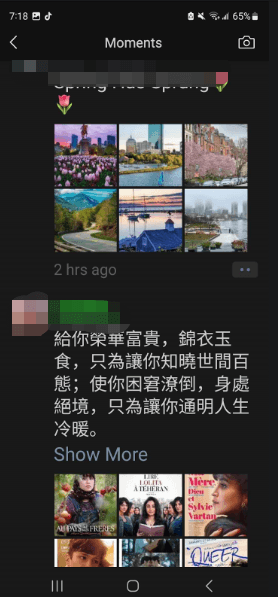
The easiest way, however, for schools to communicate with families on WeChat is by creating an Official Account.
Using an Official Account to Advertise Your School on WeChat
Official Accounts are similar to pages on Facebook or business accounts on WhatsApp.

A Facebook page for a private school in Florida, USA


Instagram accounts for boarding schools

A WeChat Official Account for a school in Hong Kong
Yet, that comparison only goes so far. Given WeChat’s multifunctionality, private schools can do more than just post pictures or links to other websites.
Any private schools wanting to capitalize on the benefits of an Official Account will need to familiarize themselves with its key features before setting one up.
#1. Types of Official Accounts
Normally, companies can sign up for a subscription or service Official Account. However, schools outside of China can only set up the latter.
This shouldn’t be a concern for you as it will mean less work and, therefore, stress on your end. For example, service accounts do not require a business license to set up.
#2. Basic Interface of Service Accounts

The basic interface of a service account is pretty straightforward. Every school that creates an account will be able to give it a title, and below that will be your official school name.
The main interface will also show your school’s location, and you’ll be able to write a brief paragraph describing yourself.
The first tab users see when they access your Official Account’s main page is labeled “articles,” and every service account can publish up to eight articles four times a month.

The next tab is titled “Channels,” which shows any video a school has published on WeChat.

The final tab is “Services.” Here, schools can redirect users to their official website or elsewhere.

#3. How Do Users Access Your Service Account?
One benefit to having a service account is that whenever your school publishes an article or announcement, it will appear as a message in the main chat interface.
Below is an example showing Wellington College.

Alternatively, users can find your school’s account by using the search bar at the top right of the chat interface.


All service accounts a user follows will show up under a tab in their contacts.

#4. Send Important Messages to Followers
Whenever a user taps the chat associated with a school’s service account, they will be greeted with a chat interface, as we see below with Wellington College’s account.

The above picture reveals another upside to service accounts: Users who follow your school will be greeted with an automated message that makes your relationship feel more real.
The opening interface has a few buttons allowing schools the ability to talk about themselves.

For example, clicking on “我们的故事” (our story) sends the user to a page where the school talks about its history.

“我们的愿景” (our vision) and “惠玲顿价值观” (our values) are similar as they both discuss what the school is about.


The other two buttons on Wellington’s service account may not be relevant to schools not looking to set up campuses within China, but just in case you were interested, parents can tap on “招生” (admissions) to apply to the school. “工作机会” (work opportunities) is for anyone in China hoping to work at the school.
Whenever a school publishes an article, it will appear as a chat message.

You may also choose to post announcements or ask survey questions using this chat.


Lastly, a user can tap on the icon at the top right for the school’s Official Account main page.

When it comes to Official Accounts, there are a few other features you can take advantage of.
WeChat Mini-programs
A mini-program is an app within WeChat. While it is uncommon for private schools to use these, companies and educational institutions certainly do.
For example, below is a mini-program that helps WeChat users learn about schools and summer camps.

Another assists students in preparing for their college entrance exams.

One Chinese university has set up a mini-program that helps alumni form chat groups in different parts of the country.


For this, schools don’t need to get too creative. Take Harrow’s Official Account, for example. On their chat interface, parents are taken to a mini-program when they click “马上申请” (apply now) to make applying easier.


WeChat Channels
As already mentioned, WeChat Official Accounts are capable of posting videos underneath a tab entitled “Channels.”
In the image below, users can see all the videos an Official Account has published, but this is not the only area a user will encounter your videos. On the main WeChat interface, users can go to the “discover” tab, and here they can select the “Channels” option.

The “Channels” interface resembles Instagram or TikTok. It’s divided into three parts:
- Following displays any video belonging to an Official Account that a user is already following.
- Friends shows any videos friends of a user have liked or shared.
- Hot shows popular videos.

The difference between Instagram and TikTok shouldn’t be overlooked.
Although WeChat’s algorithm pushes videos belonging to accounts a user has never seen before, it prioritizes ones already liked by a user’s friends.

An education consultant video on the following interface
WeChat favors the social aspect of social media, so when creating videos, schools will need to think of creative ways to get users to like or share their content to improve traction.
Although the algorithm on WeChat is different, schools should still add hashtags to push their videos to the relevant people. It isn’t as common as on other apps, but accounts still do it.


It’s important to note that the demographics for WeChat Channels differ slightly from WeChat in general.


As the above pictures show, WeChat Channels is most popular with women and people between the ages of 26 and 40. The age range is perfect for schools looking to advertise to families with preteen or teenage children.
WeChat Ads
Speaking of advertisements, one way schools can attract WeChat users to their Official Accounts is by placing ads.
Many educational institutions are already taking advantage of this resource.

An ad from Budapest Metropolitan University in Hungary
Notice how it is tagged “广告” (advertisement). This is due to China’s advertisement law, which requires all ads to be labeled.
If you are interested in publishing ads on WeChat, they will appear in five places.
#1. WeChat Moments
WeChat Moments is basically the home page where users can see anything shared by their friends.


Note: This doesn’t work like X, Instagram, or Facebook. Any article or video published by an Official Account will not be shown within WeChat Moments unless a friend of a user shares it.

#2. Articles
Schools can also place ads within articles belonging to other companies.

#3. Videos
Ads can be turned into videos.

Schools can pay per 1000 impressions of an ad (CPM) or by click (CPC).
#4. Mini-program Ads
Just as service accounts allow schools the ability to attach mini-programs they’ve created, schools can also pay to place ads in mini-programs belonging to other companies.

Like with Channels, these ads can be CPM or CPC.
#5. We’ll get to that in a moment…
Types of WeChat Ads
In a separate article, Nanjing Marketing Group went into more detail about the pros and cons of each ad type on WeChat.

Schools will also need to choose between two types of ads. If a school chooses scheduled ads, it will pay for a fixed number of impressions. For exposure ads, schools will choose between CPC and CPM.

For more information on WeChat Channels outside of education, feel free to check out our other article on how to set up an account, attract new followers, and more.
The fifth location is WeChat Search.
WeChat Search & Private School Marketing
Another feature your school may be interested in understanding is WeChat Search. This is basically the search engine built into WeChat.
Like on search engines, ads often pop up in search results.

WeChat Search can be found by going to the “discover” tab at the bottom of the main interface. You will then see the “search” button.

Users can also search by using the search icon found at the top right of the main interface.

Either way will take you to another screen that resembles any other search engine.

Interface on the “discover” page

Interface if you enter from the search icon
Whenever anyone searches for something, they will be shown an interface packed with accounts, videos, articles, and more related to the searched term.
Below, I searched for the term “寄宿学校” (boarding school).

Note that service and subscription accounts will appear as separate subheaders under the “account” header.

Like with any search engine these days, schools have the best chances of success on WeChat Search by understanding its search engine optimization (SEO).
WeChat Search SEO for Private Schools
WeChat Search’s results (highlighted in green) are where a searched term appears in the related videos, articles, or Official Accounts. Therefore, when you’re creating content, make sure you include words that you believe users will search for.
In terms of user experience, WeChat is believed to have the second most useful search experience in the country behind Douyin. One reason for this is that published content appears the next day, which is much quicker than other search engines like Baidu.
This isn’t to say that WeChat’s SEO is better than Baidu’s. It just serves a different purpose. After all, Baidu searches the whole Chinese Internet, while WeChat just deals with content within its ecosystem.
As a result, WeChat’s SEO is not only more contained than Baidu’s, but it’s also better at bringing up more recent content.
Another difference is that Baidu also favors its own content, meaning its Wikipedia page or pictures associated with a search term appear first. However, WeChat’s search brings up creator content first.


Even if WeChat is behind Douyin in SEO, remember that Douyin, like TikTok outside of China, has a younger audience. Therefore, parents, who are your target audience, are more likely to be searching on WeChat.
WeChat ranks results based on the following.
Keywords & Queries: For example, someone interested in studying in the United Kingdom may search “为什么在英国学习“ (Why study in the UK?) or simply “英国寄宿学校” (British boarding schools).
To take advantage of this, make sure your articles contain these terms in some of the first paragraphs or titles. Whenever you post a video, include hashtags or descriptions containing these terms. You may also want to consider this rule when writing your Official Account’s description of your school.
Popularity: Articles, videos, and accounts are also judged based on the number of people who have interacted with them through likes, shares, or follows. Note here that each of these is not inclusive. Some articles may get more shares, but the actual account the articles belong to could have few followers.
WeChat’s new function considers this. Now, users will see articles their friends have liked or shared at the top of their “subscriptions” tab. Tencent, WeChat’s owner, believed this could help newer or less popular accounts gain more traction.

Frequency: How often an account posts also matters. Your marketing department needs to be creating engaging, unique content suitable for the Chinese market.
User History: WeChat takes into account a user’s behavior whenever they search for something. This is very useful for schools, as it means parents searching for content related to education or even life in another country will be more likely to come across your content or account.
When writing an article, you may want to use a WeChat mini-program called “微信指数” (WeChat Index). This mini-program lets users search terms to see which ones get more traffic. Sometimes there can be a big difference, even when two searches are very similar.

To access this, just search for WeChat Index.

Choose the first result to be taken to a page where you can add the mini-program to your WeChat.

Then select the “services” tab.

The 查看指数 (view data) option brings up the following interface.

You can then search terms in the bar at the top to see how they have been performing.


You can also compare terms by tapping the “+” button. Below, I have compared the searches, “Studying abroad in the UK” with “Studying abroad in the US.”

There are other aspects of WeChat SEO and content creation relevant to other apps. (These will be looked at later.)
Using the Search Function With WeChat Articles
One of the benefits of having Chinese-speaking staff or working with an agency like Nanjing Marketing Group is that your school can monitor trending education topics.
One simple way is by going to the Official Accounts tab on the main interface and using the search bar there to search for common education-related terms.


Below is a search for “教育” (education). The button at the top right allows users to reorganize the articles, either from newest to oldest or from the most popular to the least popular.


WeChat’s articles make it unique from all the other apps mentioned in this article. Our next app, Douyin, for example, is mostly video-based.
How to Use Douyin for Private School Marketing

If you are a private school interested in improving your marketing in China, then Douyin is your app. After all, people have noticed that one difference between it and its cousin app, TikTok, is that it prioritizes educational content more.
Yet, Douyin’s similarity to TikTok is why it is possibly more familiar to Western users than WeChat.

A side-by-side comparison of Douyin (left) and TikTok (right)
There is one major obstacle you may encounter before it becomes possible to set up an account on the app. Before discussing how to use Douyin to advertise, this needs to be addressed.
Douyin Accounts
The downside to Douyin is that it is even more difficult to create an account if you are outside of China than with WeChat. Thankfully, there has been news that Bytedance, the app’s parent company, may begin to allow users to sign up using a non-Chinese phone number, provided they verify their real identity.

Until that happens, schools will need to seek out a Chinese phone number. To do this, schools can either set up a campus in China or partner with a Chinese education company.
If you do manage to achieve either of those two things and want to create a Douyin account, you’ll also need to verify yourself by uploading company documents. This may entail translating your documents, which is one of the services Nanjing Marketing Group provides.
With your translated documents in hand, the following may be useful.
Douyin’s Demographics
The first consideration a school should have when determining whether to use Douyin (or not) for marketing purposes is the demographics of the users.
Douyin’s demographics are not too dissimilar from WeChat or WeChat Channels; although more users are of university age (18–24), 60% are older than 25.

Marketing teams for schools may look at Douyin, assuming it trends towards younger generations like TikTok, but the data above shows this is not the case.
Therefore, you can make content for the app without needing to worry about tailoring it for a specific age bracket. In other words, you’ll probably want to craft content mainly targeting parents.
Also, keep in mind that it is illegal in China to advertise to children under the age of 10.
In terms of gender, the most recent data from early 2023 states female users outnumber males on the app by six to four.

Statistics also show that female users “like” twice as many videos as male users, and comment eight times more daily.
Keeping this in mind, schools may want to focus more on advertising to mothers of potential students.
Comparing Douyin and WeChat on Demographics
A closer analysis of WeChat and Douyin’s demographics may reveal a few data points that could affect your overall marketing strategy.
For example, a downside to Douyin is that its users are based in China’s more developed cities.

This is important because more parents from less-developed cities are beginning to consider sending their children abroad.
In this regard, WeChat may be better as it is used everywhere in China for their daily needs (such as banking, bill payments, and booking transportation).
However, Douyin has WeChat beat in the number of users watching videos.

Although users on WeChat spend more time watching videos in WeChat Channels, far fewer people use this feature daily.
Douyin’s User Experience
Another reason schools should consider marketing on Douyin is because of its user experience (UX) and user interface (UI).
While Douyin’s UX/UI is similar to TikTok, it is quite different from WeChat.
Remember, WeChat only devotes a small area to video content, and the app is still primarily for messaging friends.
Only around two-thirds of WeChat’s daily users use the Channels feature for watching videos, which could be due to Douyin’s dominance as the go-to short-video app. After all, they will see a video of interest as soon as they open Douyin, whereas WeChat Channels requires a few extra steps.

One step on Douyin


Three steps for WeChat
For many people, Douyin is for videos, and WeChat is for talking to friends.
A second distinction between the two apps is that WeChat doesn’t promote videos from accounts a user has never seen before as much. Like TikTok, Douyin has a “for you” page that shows videos from accounts a user has never encountered but aligns with content they’ve liked previously.


Still, be aware that Douyin is not entirely a clone of TikTok. For example, while both apps have similar tabs, Douyin has an additional “same city” tab, where users can find content made by content creators nearby.

In terms of a school’s overall marketing strategy, you may consider using Douyin as your main instrument for posting video content. This doesn’t mean you can’t repost these videos on WeChat. Instead, you could tailor your videos for Douyin and include information on your main Douyin page that redirects users to your WeChat Official Account.
Remember, your Official Account (in some ways) can act as the hub of your marketing strategy as much as a website, especially given the importance of WeChat to life in China.
Douyin Ads
Like WeChat, Douyin allows schools to place ads across the app; however, because Douyin’s user experience is different from WeChat’s, the ad placement also differs across the two apps.
For example, ads sometimes appear when a user opens Douyin. These ads follow a cost-per-time model. Pricing begins at one million RMB.

Similar to WeChat or TikTok, users will also encounter ads while scrolling Douyin.
For these ads, companies can choose a CPM model where ads are priced on views or a CPC model based on clicks. Prices will be higher for more specific keywords.


Ads also appear when users search for related keywords, and these follow the same pricing as the ads found while scrolling.

Given that ads appear during a search, it would be wise for your school to know how this interface works on Douyin.
Douyin Search
Douyin’s search page is a lot more complex than WeChat’s, and it also has a lot more icons than TikTok’s.

TikTok and Douyin Search Pages Compared
As you can see from the above screenshots, while TikTok’s search page just has a simple list of trending searches, Douyin’s page has ranked brands based on how often users have searched for them.
By comparison, Douyin’s search page seems rather extravagant. Below, we see the “猜你想看” (suggested videos) tab. This tab suggests videos based on your search history.

Next is the “抖音热榜” (popular) option, where users can see trending topics.

The topics here are mostly related to current affairs. However, the “查看完整热点榜” (view all) button at the bottom reveals more rankings related to keywords.

Below, we see rankings related to “种草” (plant grass), which is a slang word for topics that are relatively new and beginning to see traction.

The next tab is for entertainment.

There is also a rankings list for challenges.

This last list may be the most useful for schools. For example, if your school has a dance club, you could make a video in line with the latest K-pop song trending on Douyin.

Another option is paying attention to what brands and keywords are trending, so whenever you want to publish content, you can tailor your school’s videos to match whatever is currently popular.
For example, if a certain song has become a meme on the app, you may want to use it in the background of a video showing off your school’s campus. This way, your school will show up in the search results whenever someone taps on the song in the rankings or appears while a user is scrolling.
Yet, while Douyin’s search page offers a ton of information to help your school understand what users are watching, you’ll also benefit from understanding Douyin’s SEO.
Douyin’s SEO
There are six main attributes that play into Douyin’s SEO in descending order of importance:
- Account Verticality: How well does an account stick to one topic or theme?
- Number of Followers: How many people follow the account?
- Quality of Content: How good or engaging is the content?
- Quantity: How much content on a specific account is of good quality or has been engaged with?
- Positive Feedback: How many likes, comments, or shares does an account’s content get?
- Livestream Activity: How often does an account participate in livestreams, and how well do those livestreams perform?
These six attributes demonstrate that Douyin differs from WeChat in that the account’s overall activity plays a larger role in a video’s success.
This doesn’t mean schools should ignore putting effort into creating an SEO strategy for each video. In fact, as those who use TikTok know, the downside to Douyin preferring the “for you” page, which prioritizes content from never-before-seen accounts and accounts a user interacts with the most, is that there is a possibility your school’s content will eventually never be seen if a user doesn’t look at the “following” tab.
One way to stay relevant is by understanding how Douyin’s algorithm (which can scan audio) identifies and understands keywords.
For example, make sure the person in your video mentions your keywords, especially during the first three seconds.
Another hack is encouraging users to comment on your video; if they use keywords in their responses, this will also give your video a bump.
If you have Chinese-speaking members on your marketing team or are interested in collaborating with Nanjing Marketing Group in a more in-depth way, your school can also try using Douyin’s tool, DOU+.
Using DOU+
Like WeChat Index, Douyin has a tool known as DOU+ to help accounts increase their visibility.
With this tool, creators can buy more views for a video if it is no longer receiving any interaction after one or two hours.

To find DOU+, an account manager can tap a video’s arrow button.


From there, a video can be boosted by choosing “点赞评论量” (likes and comments) on the left and the amount of time on the right.

You can then either choose your audience yourself (自定义定向推荐) or allow Douyin’s AI to do the work for you (系统智能推荐).
For the former, you can set who sees your video based on demographics or by selecting accounts with followers you believe will enjoy your content.
The latter is also customizable, with buttons like “follower growth,” which focus on finding people more likely to follow your content.

To use this function, schools can pay as little as 100 RMB or less.

If using this tool is too complicated for your school, considering the language barrier, there is another feature on Douyin that will help schools remain relevant on the app.
Douyin Competitions
Another aspect of Douyin’s hashtags you may want to keep an eye on is the competitions. This feature is arguably a key difference between TikTok and Douyin, as these contests play a larger role in the user experience on the app in China.

These competitions can be fairly simple. The one above, for example, shows one where users are asked to create videos of themselves kicking a bottle.
Occasionally, competitions are started by brands themselves. For example, Lays set up one where users were asked to make videos talking about their favorite chip flavor.

Schools could either participate in some of these competitions or create their own. If a brand of chips holds a contest, for instance, and your school happens to sell that product in your cafeteria, participating in the event could work as a subtle marketing gesture.
In terms of starting your own competition, you could try something more academic, like asking students to make a video teaching Americans something about China or asking them to write the hardest word in English they know.
Douyin’s competitions are probably the most unique features of the app, but remember, its audience is primarily in first-tier cities. To have a well-rounded marketing strategy, schools will need to make use of all of China’s social media apps, with Rednote being one of these.
How to Use Rednote for Private School Marketing

You may have heard about Rednote recently in the news as Americans (and others) flocked to the video app at the beginning of 2025 in fear that TikTok was about to be banned.
Known as 小红书 (Little Red Book) in China, Rednote has been gaining traction over the past half-decade. Any quality education marketing campaign should probably have a presence on the app.
One reason for this is that Rednote has a unique audience. Around 79% of its monthly users are upper-middle-class women in their 20s and 30s, mostly coming from first and second-tier cities.
Therefore, in terms of your overall marketing campaign, you may want to tailor your Rednote content towards mothers and leave content targeted at other demographics for Douyin or WeChat.
Besides its unique user base, Rednote has other advantages that schools should be aware of.
Chinese Users See Rednote as the Best App for Education
Educational content on Rednote has seen a 665% increase in engagement over the past year, and search data has found that terms related to furthering education are extremely popular.
Users don’t merely see the app as a place to learn about different schools, but also as a place where they can learn study tips.
Rednote Makes it Easier for Schools to Set Up Accounts
Another major advantage of Rednote is that it is a lot easier to set up an account compared to WeChat or Douyin. Like with any other app, one simply needs to input their phone number and type in the code they are sent.

One area where Rednote differs from WeChat and Douyin, however, is that it asks a user about their interests when they first create an account. One interest suggested is “教育” (education).

By selecting “education,” the app’s algorithm will be more likely to connect you with other accounts in your industry. This way, you’ll be better able to keep track of what education-related topics are trending, and the chances of users interested in studying abroad seeing your content will increase, too.
As a school, you can share content on Rednote with a basic account verified from abroad. By doing this, your account will get a blue checkmark, a powerful way of reassuring users that your account is legitimate.


With it being easier to set up an account on Rednote, it’s also easier to communicate with users who may be interested in your school. I personally run a channel teaching Chinese citizens English using video games. I can upload videos and reply to comments from anywhere without any hassle, like on Instagram or YouTube.
If your school chooses to set up a Rednote account, you’ll also be able to put a face to your business by answering parents’ queries without needing to go through a middleman. Of course, while many parents will be able to speak English, this won’t be the case for everyone.
Rednote’s User Interface
Like Douyin, Rednote is primarily a video-sharing app. However, while Douyin mirrors Instagram or TikTok in that it only shows one video on the screen and requires a user to swipe to see more, Rednote’s home screen displays multiple videos.

Schools may favor Rednote because of this. After all, more videos appearing when a user opens the app means exposure to more channels.
Keep in mind that Rednote here does not merely push videos from channels a user has already liked, but videos the algorithm believes a user may be interested in.
The app also organizes videos by using tabs at the top of the page. These include different topics like fashion, photography, bodybuilding, and music. There are three in particular that may interest a private school: “learning,” “science popularization,” and “campus.”


With this style, users don’t need to use the search function as much. Instead, if they open the app on a particular day and feel like learning, they’ll find the appropriate tabs. Once there, they will find videos through the channels they follow, similar channels, or trending videos similar to content they’ve already liked.
Still, because a school’s content will appear alongside others, they will need to work harder at the presentation of their video’s thumbnail. One way to do this is to include a title in large letters to catch users’ attention.


Another unique Rednote feature is that the app promotes written “notes” as much as videos. This type of content usually takes the form of a picture or multiple pictures with text underneath.


Finally, schools should know that Rednote does have a section that mirrors TikTok’s one-video-per-interface style. Trending videos and videos related to followed accounts will also pop up if a user clicks “trending.”

Given that Rednote still pushes videos of accounts a user likes, your school may want to invest in having someone in charge of maintaining a presence on the app. In practice, this means commenting and liking other accounts within your sector or belonging to people you believe will find your content useful.
This will also keep you better up to date with the trending topics on the app and align with Rednote’s user experience.
Rednote’s User Experience
Besides its interface, Rednote differs from other apps in that it is more community-based, especially regarding brands and lifestyles.
In fact, 80% of the app’s users report using Rednote to initially search for products or services, and 90% say Rednote has influenced their purchase decisions.
As previously mentioned, WeChat is also pushing its social characteristics, and it has always been a community app. That being said, it’s more focused on an individual’s immediate community while Rednote caters to an individual’s imagined communities.

Any marketing strategy using Rednote should factor this in and focus on creating a sense of community with potential students. By making the parents of children feel they are already a member of your school’s family, they will be more inclined to want to be a part of it in real life.
A crucial way of making this happen is understanding Rednote’s search features and SEO.
SEO for Rednote
RedNote’s focus on community can be seen in how SEO specialists believe Rednote uses an inverted funnel model where users conduct broad searches first before precise searches:
“A user may begin with ‘winter moisturizer,’ then narrow to ‘Brand X cream’ after comparing reviews, before jumping to an e-commerce site to complete the purchase.”
While schools are not companies, they are in some ways brands that offer services. For instance, they can take advantage of Rednote’s algorithm by putting broad keywords first before including precise keywords when writing a video’s description.
To do this, begin with words related to your industry, such as “privateschool” or “studyabroad.”
You may also want to include the country where you’re based or the main language of instruction at your school.
This is especially useful for English-speaking schools, as many Chinese students are interested in improving their English anyway. (I don’t recommend using English. In a later section, I will provide some Chinese keywords.)

After using these broad terms, you can become more precise by including your school’s name or even the state or city you’re based in.
With this strategy, broad key terms allow your video to reach wider communities already established on Rednote related to education, whereas narrow key terms hone in on individuals within that community who are interested in particular topics.
Other analysts also suggest placing trending terms at the end of your tags. One way to find these is by tapping the search icon at the upper right side of the screen.

This will take you to Rednote’s search page, which, although not as comprehensive as Douyin’s, still provides rankings of popular topics on the app.

In the above list, for example, the number one trending topic is about a 55-year-old woman graduating from college. When she was younger, she failed twice to get into university, and then once her son was born, she needed to work multiple part-time jobs.
While this story concerns a woman from northern China, it can resonate with anyone anywhere. Perhaps your school can share stories about mothers from your community who have worked hard to support children or appreciate the value of education.

Like with all marketing, SEO on Rednote works best when schools put themselves in their client’s shoes:
- What are their pain points?
- What scenarios would have them searching for a topic related to your school?
- Why would anyone be interested in studying abroad?
Questions like these can be better answered by thinking about who is looking to study abroad and China’s economic situation.
Chinese students attending private schools abroad are more likely to pursue a university education in the same country; therefore, a school may choose to make content about preparing for the exams students need to take.
For a private school in the US, for example, the hashtag combination may look like this:
#SAT #studyabroad #privateschool #university #nameofschool


Don’t be afraid to use hashtags that are more than simple words or phrases. The benefit of Chinese is that, unlike English, words do not have spaces between them. SEO strategists in China suggest trying longer hashtags that take the form of sentences or questions.
Although the search volume for these types of hashtags will be less, your videos will have less competition when users do investigate queries like “What is the best private school in the United Kingdom?” or “Which country has the best education for girls?”

If you’re ever lost for ideas, you can also search for a term and tap “topics.” This will bring up a list of hashtags using that phrase, ranked from most to least popular.

Schools may also choose not to use hashtags at all. Instead, many accounts prefer to write out longer pieces to attach to their posts. Luckily, these do not take up much of the screen, and users can just tap “more” to see a post’s full description.


Unlike Douyin or WeChat, Rednote allows users to add titles to their videos to help them stand out on the main interface. Here, users should try to use keywords in these as well, since the algorithm will pick up on them.

Your work doesn’t end after posting a video, either. Content will do better if it gets more likes, comments, or extra followers for the account. Account managers who reply will also see their videos get more traction.
In fact, some analysts have calculated how much each action is worth to Rednote’s algorithm,

While SEO is important for all online marketing, it is perhaps more so on Rednote, as the app is known for helping accounts with fewer followers receive more traffic than Douyin or WeChat. Understanding the app’s SEO is how you take advantage of this.
Of course, your school can always rely on advertising on Rednote to increase your followers and improve your marketing.
How Can Private Schools Place Ads on Rednote?
There are two types of Rednote ads that international schools may be interested in: newsfeed ads and search ads.
Newsfeed ads appear among other videos in the “follow” or “explore” interfaces and display a “赞助” (promotion) label.

As we saw with WeChat Search, ads also appear when users search for terms on Rednote.

Rednote also allows ads for educational content to be boosted.
To make life easier for content creators, the app has also created specific tools for marketing.
How to Use BiliBili for Private School Marketing

In recent years, BiliBili, a traditionally niche platform for anime and gaming lovers, has been gaining more traction. In December of 2024, the app saw a 20% year-over-year increase in users and a 99-minute jump in daily usage time.
With this growth, more users are turning to BiliBili for topics like education, and your school could get ahead of the competition by adding BiliBili to your marketing campaign.
How to Create a BiliBili Account
BiliBili is another platform that doesn’t require a lot of work to create an account. You can easily download the app or access the website from outside of China.
On the website’s page, you can do this by clicking “登录” (login) and then “点我注册” (register).

From here, you can use your WeChat account to register or type in a phone number to get a code.

If you are happy having a non-business account, the next step, verifying yourself, will be quite easy and can be done from outside of China. As a non-Chinese user, you will need to provide verification and a picture of yourself holding the ID. Luckily, BiliBili even accepts driver’s licenses.
As a school, you may want to verify yourself as a business. There are a few upsides to this:
- Your content appears higher in search results.
- You are given priority if you ever want to cooperate with other users.
- You’ll gain access to an advertising tool known as 专车号 (Zhuanche).
For now, businesses from Japan, South Korea, Taiwan, Hong Kong, and the United States are allowed to set up a business account. You will be required to input the following information:
- Your company’s full name or a shortened 10-character version to act as your account name.
- Your company’s name + 官方账号 (Official Account).
- Colored scan of your business license.
- Sealed and signed authorization letter (downloadable from BiliBili).
- A business registration number.
Businesses will need to renew their verification yearly, and this requires four things:
- An unexpired business license.
- A website with content related to your business.
- Content published at least three months before renewal.
- All relevant admissions and permits are in order.
Like with some of the other apps mentioned, verification on BiliBili grants your account a blue checkmark, which gives your account more authority.

BiliBili’s Demographics
BiliBili, like Rednote, has a unique demographic following. Instead of women in their 20s and 30s, 60% of its users are aged 18–24.

While this age group may be too old to be potential students at your school and too young to have children, BiliBili may still hold some strategic importance if used correctly.
Keep in mind that this age group consists of college students and recent graduates looking for their first job.
Even if it’s just English lessons, especially teaching key terminology in the subjects of economics or science, schools could use BiliBili to build brand awareness in a country where most people may have never heard of your school. According to the data, BiliBili is an app in China with an ever-growing number of users. If your content begins resonating with younger age groups, you’ll hopefully see older users taking notice of what you are doing.
There’s a good chance that in 10–15 years when BiliBili’s core demographic becomes parents themselves, some of them will remember how your school helped them get through university.
BiliBili’s User Interface & User Experience
BiliBili has been dubbed China’s YouTube in the past. One reason for this is that, unlike the other platforms under discussion, BiliBili’s browser website seems to be as important as its mobile app for users.


What distinguishes BiliBili from its peers is that it prioritizes long-form content, while WeChat, Rednote, and Douyin mainly deal with short-form videos (this also includes documentaries).

This is not the only feature that shows BiliBili is already a place hungry for learning. The app also includes a “knowledge” (知识) tab and an “educational courses” (课程) button.

“Knowledge” is a broad category encompassing anything from current affairs to history and science videos, ranging from 30 seconds to 40 minutes.

BiliBili’s educational courses cover everything from test preparation to language learning. There is even a section dedicated to teaching life skills, such as dating and understanding psychology. Users can pay to gain access to entire video collections.

If we head over to the foreign language courses, we can find several non-Chinese hosts teaching their own language.

This can present schools with an opportunity to showcase their curriculum, their teachers, and their teaching skills.
In the above example, we see a bunch of Chinese characters moving across the screen. This type of commenting is one feature that made BiliBili famous in the first place.
With these so-called “bullet comments,” users can leave messages in real time.
Advertising Your School on BiliBili
In recent years, BiliBili has been placing more emphasis on its advertising business. In May 2025, reports noted the platform’s ad revenue was growing faster than the industry average, up 20% year-on-year in Q1.
BiliBili supports four billing models:
- CPM
- CPC
- OCPM
- OCPC
The app and website have a number of different ad formats.
They can appear alongside videos.

Underneath livestreams.

Right below a video.

As a large card.


When a user opens the app.

And in searches.

SEO on BiliBili
Although BiliBili is compared to YouTube, its search function is different in that when a user taps on the search bar, it displays trending topics.

While a lot of the top-ranked searches on BiliBili remain gaming-related, your school may still benefit from checking in from time to time to see whether there are any education topics.
There is also a red button near the top-left that takes you to another page full of rankings.

Once here, there are more options, such as “每周必看” (must-watches this week) and “入站必刷” (videos users watch the most upon entering the site).

By clicking “排名榜” (rankings), videos that have ranked highly for all of BiliBili’s categories appear. As a school, this will be your chance to learn about hobbies young people in China are interested in.
For instance, by checking out “舞蹈” (dance), a school can learn how to make videos advertising their dance department.

The same could be true for your sports department by looking at “体育运动” (physical education and sports).

Once you have created a video, you can upload it by pressing the red button at the top of the screen.

Then click the blue button in the middle of the screen.

One advantage of BiliBili over other apps is that there are more options for a creator to describe the video they are posting.

For example, “分区” (genre) allows you to choose the genre of your video.
With the “标签” (tags) option, a user can add other tags. “推荐标签” (suggested tags) will offer ideas on similar tags.
“参与活体” (join topic) offers creators the chance to connect their video to a larger conversation. You can click “搜索更多话题” (search more) to find a range of topics.

The numbers on the right show how many creators have participated.
You could also use the search bar here to look for topics in specific niches, like English education.

There is also more space to write a description of your video.

Collaborate With Others to Boost Your School’s Brand
Collaboration is one of the most overlooked strategies, and there are two types of partnerships your school could consider for social media.
Collaborate With Influencers
You may have noticed in the last sections how some of the accounts on Chinese social media were related to education and featured Western influencers teaching courses.

Schools could partner with an influencer with a huge following of fans interested in education, and they may even consider working with other types of accounts unrelated to education.
For instance, there are many types of influencers sharing insights about the international education industry.


Douyin influencers


Rednote influencers

Bilibili influencer

Bilibili influencer

Bilibili influencer


WeChat influencers
As you can see, all of the video-related apps and Weibo accounts related to education have a significant following. These accounts talk about a number of things (discussed more later), but they all focus on five specific topics:
- Why should you study abroad?
- Why is studying in one country better than studying in another?
- What are the benefits and downsides of certain schools?
- How should students prepare for studying abroad?
- What is life like as a student living abroad?
Influencers have built up their following by understanding the needs of the Chinese education market. As a school, one of your needs is to find ways to attract Chinese families to your educational services. Therefore, look for influencers who can easily align with your goals.
One good idea is to set aside a portion of your budget to figure out what influencers best align with your needs and pay them to create videos advertising your school. After all, some influencers may specialize in promoting schools in the United Kingdom, Malaysia, or Japan. Others may have a larger following of parents interested in getting their children to study technology or play sports.
Remember that these influencers can range from professional education advisers to students or hobbyists talking about their lives at school. Of course, while it’s out of the question to collaborate with children attending boarding school, you could consider working with parents of students who have moved abroad.

A student explaining the cost of living in England

An education consultant talking about studying abroad challenges
For any school interested in collaborating with an influencer, Nanjing Marketing Group has extensive data on the influencer market and can help schools to the right one.
However, even if you don’t choose to work with influencers, there are a few SEO aspects we can learn from the above channels that have been successful on Chinese social media.
Notice how many of the accounts above have similar words in their titles, especially the word “留学” (study abroad). If your private school wants to make an account on Chinese social media to promote itself, consider adding this word to your title or investigating what other keywords appear most often in titles.


Utilize Your School’s Clubs & Students to Advertise in China
Another type of collaboration your school may want to utilize involves reaching out to your school’s wider community. After all, your school may already have a long history of recruiting Chinese students.
Who else is better at expressing how awesome your school is to China than students who have already experienced what you have to offer?
Perhaps your school could ask teachers to make a social media account to build a community or promote your institution’s activities.
For example, the University of Illinois Urbana-Champaign’s Chinese Football Association has its own account on Douyin.

Of course, your school is not a university, and your students are still minors. Therefore, it isn’t a good idea to work with them.
Instead, maybe your school already sends out a newsletter to alumni. Perhaps you can utilize this by asking people who graduated from your school years ago to help advertise how your school changed their lives. This could take the form of individuals or alumni groups.
Creating Content on Chinese Social Media to Advertise Your School
SEO is important, but understanding a different culture remains essential. Successful schools will still need to hire individuals or work with an agency (like Nanjing Marketing Group), that can keep up to date with the topics Chinese users find interesting.
Content Styles
Each app specializes in different content. Some are video apps (WeChat Channels, Douyin, Rednote, and Bilibili). Others are text-based (WeChat articles), and some are catered towards short content (Douyin, Rednote, and WeChat Channels). Others offer you the ability to go more in-depth (WeChat articles).
Choosing the type of content depends on your brand placement in China and your intentions. If you are new to the country, maybe start off with shorter content. If you think you have some special insights that no one else is offering, go for longer content.
Even when it comes to longer content, though, you don’t always need to write essays. Some WeChat articles, for example, talk about studying abroad in a poetic manner.

The above article, for example, says the following:
“Going abroad is like coming out of the closet—
If you don’t, you feel stifled; if you do, you may regret it.
But without distancing yourself from home,
You’ll never truly understand its value.”
You’d be surprised how creative some content on WeChat can be.
Content can be serious or fun. On WeChat, you can find professionals in suits answering questions and guys yelling answers to questions while pouring water over themselves.


Subjects to Cover
The simplest way to create content for families is to put yourself in their shoes. Ask yourself how you would feel about sending your child to another country for school.
Remember, your audience doesn’t need to be people already interested in studying abroad. You could also target your advertising to people who have never even thought about the idea.
Advertising Question #1: Why Should Chinese Students Study Abroad?
More Chinese families are now considering domestic schools and universities, and there are still many intimidated by the thought of sending their children overseas to study.
Social media can be a good way to persuade Chinese families why studying abroad is worth it.
Addressing Why Studying Abroad in Worthwhile With WeChat Articles
Below is a search for “Why study abroad?” on WeChat, and many articles (some with tens of thousands of views) turned up.

A few subjects are touched on in these articles:
- Retaining love for one’s homeland while living abroad.
- The fear of leaving one’s parents.
- The power of studying abroad in changing one’s destiny.
- How studying abroad improves an individual’s critical thinking.
- Statistics related to Chinese students who have studied abroad.
- How studying abroad teaches resilience and independence.
- Why pay so much to study abroad, and then return to China for a job that doesn’t pay anywhere near as much?
- Do people go abroad for learning or prestige?
- The chance to encounter different cultures.
Schools should consider these questions and do their research before creating content.
For instance, “Why pay so much to study abroad to come back to China for a job that doesn’t pay anywhere near as much?” hints at how people are becoming concerned about whether an overseas education is as valuable as it once was.
In the 1990s, 2000s, and 2010s, the benefits were clear since the West was more technologically advanced and wealthy. However, this divide is not so obvious anymore. China has caught up in many areas, but the West, especially the US, remains a more expensive place to live and study.
WeChat articles are an amazing place to construct persuasive essays on why European and North American schools are still competitive despite the cost.
To do this, you could touch on some of the other topics mentioned above that deal with identity and opportunity. Like any human anywhere in the world, Chinese students experience the same fear of the unknown, the enjoyment of becoming a new person, and the thrill of freedom.
When writing long-form content or even shorter poetic WeChat articles, try to touch on this common humanity.
Addressing Why Studying Abroad is Worth it With Video Content
As already mentioned, much of Rednote’s content is tailored towards a female audience, and this is evident in some of the content that appears when we ask “why study abroad” on there.
Below is a video of a woman explaining why parents should consider sending girls abroad.

Questions like these will require your school to have a deep understanding of the differences between Chinese society and your own country. Of course, China has faced some of the same questions in recent years, like #MeToo, leftover women (those unmarried by a certain age), and gender equality in the workplace.
You may not need to go deep into these topics, but it will benefit you to have someone on your team who has more than a surface-level understanding of the issues Chinese society faces.

Another video on Rednote, which is also directed towards female users, asks viewers, “Why should you strive to get into a world-class school?”
Although Chinese universities are starting to appear in the world rankings, China still doesn’t have many well-known boarding schools. This may be a possible plan of attack for you when marketing on Chinese social media.
Both of these videos begin with a question, so the viewer knows what the video is about. This also helps users on Rednote select videos on the home screen more easily.

WeChat videos are tailored to a more general audience. In the video below, for example, the speaker explains how students who stay in China will become more reliant on their parents while those who study abroad are more likely to become independent.

Another video has a speaker explaining the benefits of experiencing another culture. To him, such an education allows an individual to tackle problems from a different angle, both at work and in their everyday lives.

Advertising Question #2: What are the Costs of Studying Abroad?
This is a very broad question. However, it has a huge influence on student and parent decisions about whether studying abroad is still worth the cost, and it’s one that features frequently on social media.
Addressing the Costs & Benefits of Overseas Education in WeChat Articles
The image below shows a search for “overseas boarding school costs,” and the results show that many people use WeChat articles to discuss the costs and benefits of boarding schools globally.

Some of these articles compare boarding school prices by location, living arrangements, activities on offer, number of students in attendance, and other important topics.

Given the importance of this question to Chinese parents, you could create content illustrating how your school uses funds to improve the quality of its services. Written content, therefore, can be a perfect place to advertise pictures of your dormitories, classrooms, laboratories, and sports facilities.
Think of WeChat articles as a way to remind followers and newcomers to your account of what your school has to offer a few times a year. Remember, a school’s website can only be published once. Articles are a way to keep your school in public view.
Addressing the Costs and Benefits of an Overseas Education With Video Content
Accounts promoting schools on Douyin, Rednote, WeChat Channels, or Bilibili do not always present their content in a video format; some accounts just use these apps to post charts or pictures with helpful information.

The above picture, for example, is from a video showing the price of different boarding schools, accompanied by some peaceful music.
Content featuring former students (or people working abroad after graduation) discussing the cost of living can also be an indirect way of addressing this question.

This does not mean you need to have students doing the same. Your school teachers could make content like this as a way to introduce life in another country and the personalities of your teaching staff.
Chinese social media’s interest in the expenses of living in other countries hints that parents may also want to know about this. Children may sometimes go on field trips where they’ll spend money and may find themselves in situations (like visiting a pharmacy) where the price of items is important information.
You may even find some parents moving abroad with their children. In a recent article, it was pointed out that over 3,000 Chinese mothers had accompanied their children to Australia.

This phenomenon has become so prevalent in China that there is even a slang term for it: “陪读妈妈,” which literally translates to “moms who accompany their children to study.”
Many of these moms don’t follow their children abroad only to fulfill their parental duties. They also do so because they realize the material benefits of having a father earn money in China, while the mother accompanies a child to study at a less expensive school in countries like Thailand.
Again, we see here the element of costs and benefits. Schools in Thailand, or similar countries, should consider marketing to these mothers.
In the image below, a search for “陪读妈妈” on Rednote brings up several videos.

One video answers the question, “Is it worth it for a mom to accompany her child abroad for study?”

Another video features a woman sharing her daily life in Singapore, where she explains the costs and what it is like being there with her child.

Question #3: How Can Chinese Students Prepare for Studying Abroad?
This question is probably the most straightforward and open-ended, but tackling this will also benefit you. Many schools have issues with Chinese students arriving without the necessary English language skills to succeed. Wouldn’t helping kids improve their English beforehand help you in the long term?
You may see it as a waste of time and money to teach English or provide free proficiency tests, but offering supplementary language courses or tests before students arrive in the country adds to your school’s offering and will boost your image.
However, English learning is not the only topic you can cover when it comes to preparing others for life abroad.
Addressing How to Prepare for Overseas Study in WeChat Articles
During the preparation stages of studying abroad, many students may be concerned about their English level being up to scratch. This is evident in the countless articles on WeChat discussing strategies to master English proficiency tests.

The downside to videos is that they need to be short to keep people’s attention, whereas articles on WeChat offer you the chance to expand on tips for English learning. The below article, for example, mentions how book series like Goosebumps and Magic Tree House can help Chinese students quickly learn English.

As a school, you could write articles explaining the best books for young readers. You could even write your own short stories combining English and Chinese.
Addressing How to Prepare for Overseas Study With Video Content
Video content also offers other ways for schools to help students prepare for life abroad.
Here is a video discussing the rules around applying for a visa to study abroad.

Another way to prepare Chinese students is by discussing perceptions of the differences between your country and China.
Whenever I told a taxi driver in China that I was “British-American” while living in the country, he’d respond with “Oh! A gentleman.” In fact, this stereotype of British politeness is quite well-known in China, and a friend of mine still runs a company devoted to teaching Chinese children so-called “British manners.”

Some influencers on Douyin have taken advantage of this interest in the mannerisms of another country.
In the video below, a creator weighs in on the “Are the British more polite than Chinese?” discussion.

While this may seem irrelevant to your school, it’s a very real subject that many Chinese students who have never lived in another country think about. Maybe you don’t need to jump into it fully, but you should be at least aware that cultural differences are one thing Chinese students need to be prepared for when coming to study in a new country.
Contact Nanjing Marketing Group
We hope you found this information useful and now feel more comfortable about marketing on apps like WeChat and Rednote.
This also completes our articles on how private schools can advertise in China for 2025!
As always, Nanjing Marketing Group is here to answer any questions you may have or to get your account up and running in China.